

13. Gravitation#
Jul 20, 2026 | 13373 words | 89 min read
Chapter roadmap
Gravity connects motion on Earth with motion throughout the universe. In this chapter, you will use Newton’s law of gravitation, energy, and circular-motion ideas to describe falling objects, satellite orbits, tides, and black holes.
As you read, focus on three questions:
How does the gravitational force change when mass or distance changes?
How do energy and circular motion help us understand orbits and escape speed?
Why do small differences in gravity across an object produce tides and other large-scale effects?
These ideas will let you connect everyday weight to the motion of satellites, planets, galaxies, and compact objects.
13.1. Newton’s Law of Universal Gravitation#
13.1.1. The History of Gravitation#
The earliest philosophers wondered why objects naturally tend to fall toward the ground. Aristotle believed that the natural state of some objects to seek the Earth, while others (e.g., fire) would float away and seek Heaven instead. Almost a millennium later, Brahmagupta described an attractive force that caused all objects to fall toward the center of a spherical Earth.
The motions of the Sun, Moon, and the planets were studied for thousands of years before an accurate model was developed. About 2000 years ago, Ptolemy used the method of epicycles, which proved to be an accurate method given the technological sophistication of making the measurements. Although several scholars may have developed ideas about an inward seeking force or the motions of astronomical bodies, there is little evidence that anyone had synthesized these ideas together into a single framework until the 17th century (i.e., 1600-1700 AD).
The idea of heliocentrism (e.g., the Sun is at the center of the Solar System) was introduced (at least) by the 3rd century BC by Aristarchus of Samos. For many years, scholars paid little attention to the idea because they could not reconcile a moving Earth with the absence of an observable parallax. Therefore, Ptolemy’s geocentric model held sway until the 16th century, when Nicolaus Copernicus proposed a mathematical model of a heliocentric system and estimated the distances for each of the planets to the Sun, albeit on assumed circular orbits. Copernicus’ ideas were initially supported by religious figures at the time, but eventually (about a century later) ran in contrast to the Catholic church’s teachings.
Tycho Brahe attempted to develop a hybrid geocentric-heliocentric model but did not finish before his death. Prior to his demise, he employed Johannes Kepler as a research assistant. Brahe assigned Kepler the so-called ‘Mars problem’ as an attempt to stall Kepler from overshadowing him. However, Kepler would develop his laws of planetary motion (in 1609 (1st and 2nd) and 1619 (3rd)) that largely corrected the Copernican model by using ellipses instead of circles for the orbits. At the same time (~1610) Galileo was using his ‘telescope’ to observe the heavens and discovering that Jupiter hosted 4 moons of its own. Western European natural scientists could develop a model that predicted the location of the planets with higher accuracy, however they had no mathematical description to explain why the planets moved around the Sun.
It was Isaac Newton who connected the acceleration of objects near Earth’s surface with the centripetal acceleration of the planets around the Sun (i.e., gravity). To accomplish this feat, Newton had to largely invent new domains of study, which included calculus and by its application mechanics. He also made ground-breaking discoveries in his day for the field of optics and thermodynamics. He developed a numerical algorithm that is efficient in solving some problems (e.g., root-finding or solving transcendental equations) that is still used today in modern-computing, Newton-Raphson method.
13.1.2. Newton’s Law of Universal Gravitation (Defined)#
Newton noted that objects at Earth’s surface (at a distance \(R_\oplus\) from Earth’s center) have an acceleration of \(g\). However, at a distance of \(60\ R_\oplus\), the Moon has a centripetal acceleration about \((60)^2\) times smaller than \(g\). He explained this by postulating that a force exists between any two objects, whose magnitude is given by the product of the two masses divided by the square of the distance between them.
There exists a category of phenomena in nature that are explained by so-called ‘inverse-square law’, or a decrease in magnitude that increases with the inverse-square of the distance. We now know that this is a function of geometry and how the surface of a sphere increases with distance, which dilutes the strength of a source that has spherical symmetry. The surface area of a sphere is \(4\pi r^2\), so we see that if there is a source with a strength \(S\), then it scales as \(S/r^2\) (i.e., an inverse-square law).
Newton’s Law of Gravitation
Newton’s law of gravitation can be expressed as a vector by
where \(\vec{F}_{12}\) is the force between object 1 exerted by object 2 and \(\hat{r}_{12}\) is the radial unit vector that points from object 1 toward object 2.
Fig. 13.1 Two masses attract one another along the line connecting their centers. The force on each object points toward the other object, and the pair of forces have equal magnitude and opposite direction, as required by Newton’s third law. Image Credit: OpenStax: Newton’s Law of Universal Gravitation.#
Figure 13.1 shows how \(\vec{F}_{12}\) describes as an attractive force pulling object 1 toward object 2. However, there is an equal but opposite force \(\vec{F}_{21}\) directed from object 2 toward object 1, \(\vec{F}_{12} = -\vec{F}_{21}\).
Checkpoint
If the distance between two objects doubles while their masses stay the same, what happens to the gravitational force between them?
These equal but opposite forces reflect Newton’s third law. Newton’s law of gravitation (as expressed) applies to any spherically symmetric object, where \(r\) is the distance each object’s center-of-mass. This also implicitly assumes that the individual radii of the masses (\(R\)) is much smaller than the distance between the objects (\(R\ll r\)). In many cases, Newton’s formulation still works for nonsymmetrical objects due to \(R\ll r\).
13.1.3. The Cavendish Experiment (measuring \(G\))#
A century after Newton published his law of universal gravitation, Henry Cavendish determined the proportionality constant \(G\) by performing a very difficult experiment using a device with two masses connected by a rod that is itself suspended by a wire (see Figure 13.2). The wire also had a mirror that redirected the light from a fixed source. The masses on the rod were placed near two stationary masses, where the torque from the gravitation force between the spheres would twist the wire and change the angle of reflection for the light hitting the mirror. Therefore, the reflected light would change position on the fixed scale.
Fig. 13.2 The Cavendish apparatus measures the tiny gravitational attraction between masses by observing the twist of a suspended rod. The deflection of reflected light makes a very small torque measurable, allowing the value of \(G\) to be determined. Image Credit: OpenStax: Newton’s Law of Universal Gravitation.#
The constant \(G\) is called the universal gravitational constant and Cavendish determined it as \(G = 6.67 \times 10^{-11}\ {\rm N\cdot m^2/kg^2}\). The word ‘universal’ indicates that scientists think that this constant applies to masses of any composition and that it is the same throughout the Universe. The value of \(G\) (in SI units) is an incredibly small number, which shows that the force of gravity is very weak. For example, two \(1\ {\rm kg}\) masses located a meter apart exert a force of \(7 \times 10^{-11}\ {\rm N}\) on each other.
Note
The value of \(G\) given here depends on the units used (i.e., SI units). However, if you choose to work in a different (sometimes more convenient) set of units, then you could determine \(G\) to an easy magnitude to remember. In orbital mechanics, researchers will often use a magnitude of \(G\) so that it equals \(1\) or \(4\pi^2\), but you must reconcile the units appropriately.
Although gravity is the weakest force compared to the other three fundamental forces of nature, its attractive force holds us to the Earth, causes the planets to orbit the Sun, and the Sun to orbit our Galaxy. It goes even further to bind galaxies into clusters and is the force that determines the fate of the Universe.
Problem-Solving Strategy
Newton’s Law of Gravitation
To determine the motion caused by the gravitational force:
Identify the two masses.
Draw a free-body diagram, sketch the force acting on each mass, and indicate the distance between their respective center-of-mass.
Apply Newton’s second law of motion to each mass to determine how it will move.
13.1.4. Example Problem: Collision in Orbit#
Exercise 13.1
The Problem
Consider two nearly spherical Soyuz payload vehicles, in orbit about Earth, each with mass \(9000\ {\rm kg}\) and diameter \(4.0\ {\rm m}\). They are initially at rest relative to each other, \(10.0\ {\rm m}\) from center to center. (Both orbit Earth at the same speed and interact nearly the same as if they were isolated in deep space.) Determine the gravitational force between them and their initial acceleration toward each other (parallel to their orbital motion). Estimate how long it takes for them to drift together, and how fast they are moving upon impact.
Show worked solution
The Model
The two payload vehicles are modeled as isolated spherical masses interacting only through their mutual gravitational attraction. Because the center-to-center distance is larger than their size, each vehicle may be treated as if its mass were concentrated at its center. The motion occurs along the line connecting the centers, and the vehicles are initially at rest relative to one another. Since the two masses are equal, the interaction is symmetric, so each vehicle moves the same distance before contact. The gravitational force and acceleration increase as the separation decreases, so the time and impact speed are estimated by replacing the varying acceleration with the average of its initial and final values.
The Math
The magnitude of the gravitational force between two masses separated by a distance \(r\) is given by Newton’s law of gravitation,
Because the two payload vehicles have equal mass, we set \(m_1 = m_2 = m\), so the force becomes
The acceleration of either vehicle is then found from Newton’s second law. Since each vehicle experiences the same force and has the same mass, the acceleration of either one is
This expression gives the initial acceleration when the separation is \(r_i = 10.0\ {\rm m}\) and the final acceleration just before contact when the separation is \(r_f = 4.0\ {\rm m}\). The initial gravitational force is found by substituting \(m = 9000\ {\rm kg}\) and \(r_i = 10.0\ {\rm m}\):
The initial acceleration of either vehicle is therefore
The final acceleration can be found using a ratio of the separations:
Solving for the final acceleration gives
The numerical value follows by evaluating the expression with the given values:
To estimate the motion, we use the average of the initial and final accelerations: \( a_{\rm avg} = \frac{a_i + a_f}{2}.\) The average acceleration follows from these two values:
Each vehicle moves half of the total closing distance. Since the center-to-center distance changes from \(10.0\ {\rm m}\) to \(4.0\ {\rm m}\), each vehicle moves
Starting from rest, the impact speed of either vehicle is estimated from the constant-acceleration relation
Because \(v_0 = 0\), this becomes \(v = \sqrt{2a_{\rm avg}\Delta x}\) and then,
The collision time is then estimated from \(v = v_0 + a_{\rm avg} t.\) Because \(v_0 = 0\), the time is \(t = \frac{v}{a_{\rm avg}},\) which gives
The Conclusion
The gravitational force between the two payload vehicles is \(5.40\times10^{-5}\ {\rm N}\), and the initial acceleration of each vehicle is \(6.00\times10^{-9}\ {\rm m/s^2}\). Using the average of the initial and final accelerations to estimate the motion, each vehicle reaches an impact speed of \(3.61\times10^{-4}\ {\rm m/s}\) after about \(1.66\times10^{4}\ {\rm s}\), or \(4.61\ {\rm h}\). This result shows that even for large spacecraft, mutual gravitational attraction is extremely weak at such separations.
The Verification
The verification reproduces the same sequence of calculations used in the analytical solution. It computes the initial force, the initial and final accelerations, the average acceleration used in the estimate, and then applies the constant-acceleration kinematic relations to confirm the estimated impact speed and collision time.
import numpy as np

# Define the gravitational constant and spacecraft properties
G = 6.67e-11          # Gravitational constant in N·m^2/kg^2
m = 9000.0            # Mass of each payload vehicle in kg
r_i = 10.0            # Initial center-to-center distance in m
r_f = 4.0             # Final center-to-center distance at contact in m

# Compute the initial gravitational force
F_i = G * m**2 / r_i**2

# Compute the initial and final accelerations of either vehicle
a_i = G * m / r_i**2
a_f = G * m / r_f**2

# Compute the average acceleration used for the estimate
a_avg = 0.5 * (a_i + a_f)

# Compute the distance traveled by either vehicle before contact
dx = 0.5 * (r_i - r_f)

# Compute the estimated impact speed and collision time
v = np.sqrt(2.0 * a_avg * dx)
t = v / a_avg

# Convert the time to hours for interpretation
t_hours = t / 3600.0

print(f"The initial gravitational force between the payload vehicles is {F_i:.3e} N.")
print(f"The initial acceleration of either payload vehicle is {a_i:.3e} m/s^2.")
print(f"The estimated impact speed of either payload vehicle is {v:.3e} m/s.")
print(f"The estimated time until contact is {t:.3e} s, which is {t_hours:.2f} h.")
13.1.5. Example Problem: Attraction between Galaxies#
Exercise 13.2
The Problem
Find the acceleration of our galaxy, the Milky Way, due to the nearest comparably sized galaxy, the Andromeda galaxy. The approximate mass of each galaxy is \(800\times10^9\) solar masses (a solar mass is the mass of our Sun), and they are separated by \(2.5\) million light-years. (Note that the mass of Andromeda is not so well known but is believed to be slightly larger than our galaxy.) Each galaxy has a diameter of roughly \(100{,}000\) light-years (\(1\) light-year \(= 9.5\times10^{15}\ {\rm m}\)).
Show worked solution
The Model
The Milky Way and the Andromeda galaxy are modeled as two isolated masses interacting through Newtonian gravitation. Because each galaxy has a diameter much smaller than the separation between them, each may be approximated as a point mass located at its center. The gravitational attraction of Andromeda produces the acceleration of the Milky Way. The analysis assumes both galaxies have the same mass, given in solar masses, and the acceleration is found from Newton’s law of gravitation together with Newton’s second law.
The Math
Because the two galaxies are taken to have equal mass, we set \(m_1 = m_2 = m\). The magnitude of the gravitational force between two masses separated by a distance \(r\) is given by Newton’s law of gravitation,
The acceleration of the Milky Way then follows from Newton’s second law, where we can substitute the expression for the gravitational force to get
The galaxy mass is given in solar masses, so we first express the mass of one galaxy in kilograms. Using \(M_\odot\) for one solar mass, the galaxy mass is \(m = 800\times10^9\,M_\odot.\) Using \(M_\odot = 2.0\times10^{30}\ {\rm kg}\) gives
The separation is given in light-years, so we convert it to meters. The distance between the galaxies is \(2.5\times10^6\ {\rm ly}\). Using \(1\ {\rm ly} = 9.5\times10^{15}\ {\rm m}\) gives
Now we substitute the galaxy mass and separation into the expression for the acceleration:
With two significant figures, the acceleration is
The Conclusion
The acceleration of the Milky Way due to the gravitational attraction of the Andromeda galaxy is \(1.9\times10^{-13}\ {\rm m/s^2}\). Although this acceleration is extremely small, it acts over enormous timescales, so the gravitational interaction between the two galaxies is still astrophysically significant.
The Verification
The verification computes the galaxy mass in kilograms, converts the separation from light-years to meters, and then applies the same gravitational acceleration formula used in the analytical solution. This confirms that the numerical result is consistent with the model and unit conversions.
import numpy as np

# Define constants
G = 6.67e-11              # Gravitational constant in N·m^2/kg^2
M_sun = 2.0e30            # Solar mass in kg
ly = 9.5e15               # One light-year in m

# Define galaxy properties
m = 800e9 * M_sun         # Mass of one galaxy in kg
r = 2.5e6 * ly            # Separation between galaxies in m

# Compute the acceleration of the Milky Way due to Andromeda
a = G * m / r**2

print(f"The mass of one galaxy is {m:.2e} kg.")
print(f"The separation between the galaxies is {r:.3e} m.")
print(f"The acceleration of the Milky Way due to Andromeda is {a:.2e} m/s^2.")
13.2. Gravitation Near Earth’s Surface#
13.2.1. Weight#
Recall that the acceleration of a free-falling object near Earth’s surface is approximately \(9.81\ {\rm m/s^2}\). The force causing this acceleration is called the weight of the object, where we previously found that it has a value \(w=mg\) from Newton’s second law. The weight is present regardless of whether the object is in free fall or not.
We now know the weight is caused by the gravitational force between the object of mass \(m\) and the Earth of mass \(M_\oplus\). If we equate the measured weight with the expected gravitational force, we can arrive at a scalar equation because both forces act in the same radial direction \(\hat{r}\). The scalar equation is given as
where \(r = R_\oplus + h\) is the distance between the Earth and the object in terms of their respective center-of-mass. Using the second equation, we can see that the mass \(m\) is on both sides and can cancel, leaving
The standard mean radius of the Earth is \(6371\ {\rm km}\). For objects within a few kilometers of Earth’s surface, we can take \(r = R_\oplus + h \approx R_\oplus\) because \(h\ll R_\oplus\). From Exercise 9.14, we can see that the center-of-mass (see Fig. 13.3) of a low mass (compared to the Earth itself) object with the Earth would essentially still be at the Earth’s center. As a result, we can ignore the fact that the Earth accelerates toward the falling object.
Fig. 13.3 For a spherically symmetric Earth, the gravitational force outside the planet acts as though Earth’s mass were concentrated at its center. This is why the distance \(r\) in Newton’s law is measured from the center of Earth. Image Credit: OpenStax: Gravitation Near Earth’s Surface.#
13.2.1.1. Example Problem: Mass of the Earth and Moon#
Exercise 13.3
The Problem
Have you ever wondered how we know the mass of Earth? We certainly can’t place it on a scale. The values of \(g\) and the radius of Earth were measured with reasonable accuracy centuries ago.
(a) Use the standard values of \(g\), \(R_E\), and \(G\) to find the mass of Earth, \(M_\oplus\).
(b) Estimate the value of \(g\) on the Moon. The radius of the Moon relative to Earth was known since antiquity, and historical estimates of the Moon’s mass relative to Earth were available long before modern measurements. Using the estimate \(M_M = M_\oplus/75\) (Laplace), and \(R_M = 1.7\times10^6\ {\rm m}\), determine \(g\) on the Moon.
Show worked solution
The Model
The Earth and Moon are modeled as spherically symmetric masses, so their gravitational fields are equivalent to point masses located at their centers. The surface gravitational acceleration follows from Newton’s law of gravitation combined with Newton’s second law. For the Earth, the mass is determined directly from measured values of \(g\) and radius. For the Moon, a ratio-based approach is used, combining the known scaling of gravitational acceleration with radius and a historical estimate of the Moon’s mass relative to Earth.
The Math
(a) The gravitational acceleration at the surface of a spherical body is given by
Solving for the mass gives
Substituting the standard values gives
(b) The surface gravitational acceleration scales as \(g \propto \frac{M}{R^2}.\)
Taking the ratio of the Moon to Earth gives
Using the historical estimate \(M_M = M_\oplus/75\) gives
The Conclusion
The mass of Earth is \(5.96\times10^{24}\ {\rm kg}\). Using a historical estimate of the Moon’s mass relative to Earth, the gravitational acceleration at the Moon’s surface is approximately \(1.8\ {\rm m/s^2}\), which is close to the modern value.
The Verification
The verification reproduces the Earth mass using measured values of \(g\), \(R_E\), and \(G\), and then computes the Moon’s surface gravity using the ratio expression derived above. This confirms consistency with the analytical solution.
import numpy as np

# Constants
G = 6.67e-11
g_E = 9.81
R_E = 6.37e6
R_M = 1.7e6

# Earth mass
M_E = g_E * R_E**2 / G

# Moon gravity using ratio
g_M = g_E * (1/75) * (R_E / R_M)**2

print(f"The mass of Earth is {M_E:.3e} kg.")
print(f"The estimated gravitational acceleration on the Moon is {g_M:.2f} m/s^2.")
13.2.1.2. Example Problem: Gravity above Earth’s surface#
Exercise 13.4
The Problem
What is the value of \(g_{\rm ISS}\) on the International Space Station, which is \(400\ {\rm km}\) above Earth’s surface in orbit?
Show worked solution
The Model
The gravitational field of Earth is modeled as that of a spherically symmetric mass, so the acceleration due to gravity depends only on the distance from Earth’s center. The value of \(g\) decreases with increasing distance according to Newton’s law of gravitation. Rather than recomputing from constants, the result is obtained by scaling from the known surface value using a ratio of radii.
The Math
The gravitational acceleration at a distance \(r\) from Earth’s center is given by
Taking the ratio with the surface value \(g = \frac{GM_\oplus}{R_\oplus^2}\) gives
The orbital radius is \( r = R_\oplus + h.\) Substituting into the ratio gives
The numerical value follows by evaluating the expression with the given values:
The Conclusion
The gravitational acceleration \(400\ {\rm km}\) above Earth’s surface is \(8.7\ {\rm m/s^2}\), which is about \(89\%\) of its surface value. This shows that gravity remains strong in low Earth orbit.
The Verification
The verification evaluates the ratio expression using the given altitude and Earth’s radius. This confirms that the gravitational acceleration at orbital altitude remains close to the surface value.
import numpy as np

# Given values
g = 9.81          # m/s^2
R_E = 6.37e3        # km
h = 400           # km

# Compute g at altitude
g_ISS = g * (R_E / (R_E + h))**2

print(f"The gravitational acceleration at 400 km altitude is {g_ISS:.2f} m/s^2.")
13.2.2. The Gravitational Field#
Equation (13.3) is a scalar equation, but we could have retained the vector form for the force of gravity and written the acceleration in vector form (in general) as
We identify the vector field represented by \(\vec{g}\) as the gravitational field caused by mass \(M\). Figure 13.4 illustrates the gravitational field around the Earth showing the lines are directed radially inward, symmetrically about the Earth, and color-coded relative to \(g_{\rm surf} = 9.81\ {\rm m/s^2}\).
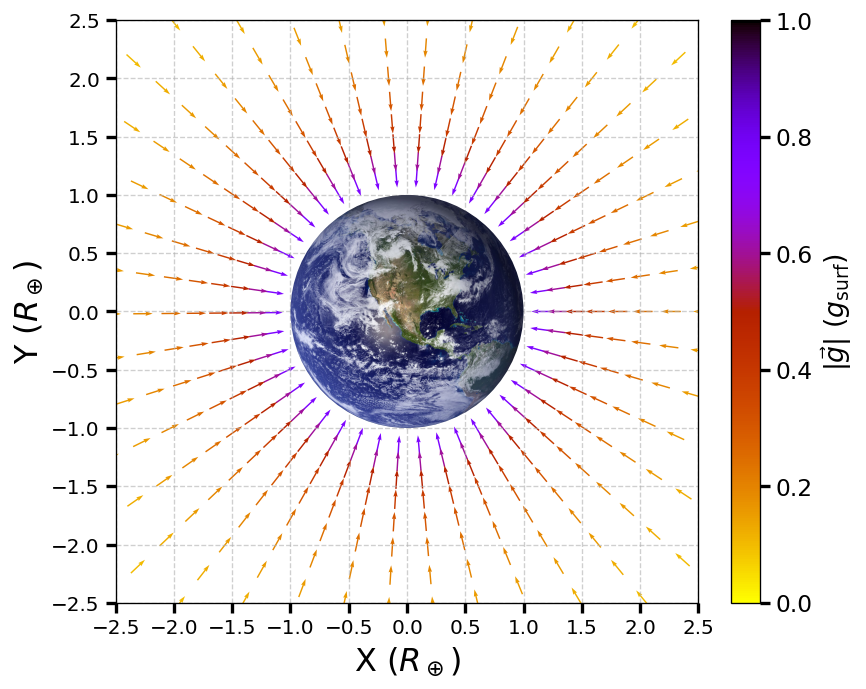
Fig. 13.4 Gravitational field around Earth shown in units of \(R_\oplus\) and \(g_{\rm surf}\).#
Show code cell content
import os
import numpy as np
import matplotlib.pyplot as plt
from matplotlib.colors import Normalize
from matplotlib import rcParams
from matplotlib.patches import Circle
try:
    from myst_nb import glue
except ModuleNotFoundError:
    def glue(name, value, display=False):
        return None

from PIL import Image
import requests
from io import BytesIO

rcParams.update({'font.size': 16})

G = 4*np.pi**2
M = 3.003e-6        # Mass of Earth in solar masses
R_earth = 4.26e-5  # Radius of Earth in AU

fs = 'large'
lim = 2.3
n = 20

r_vals = np.geomspace(1.15, 5.0, 14)
theta_vals = np.arange(0, 2*np.pi, 0.16)

pts = []
for r in r_vals:
    ntheta = max(8, int(40 / np.sqrt(r)))
    thetas = np.arange(0, 2*np.pi, 0.15)
    for th in thetas:
        pts.append((r*np.cos(th), r*np.sin(th)))

pts = np.array(pts)
Xr, Yr = pts[:, 0], pts[:, 1]

X = Xr * R_earth
Y = Yr * R_earth
R = np.sqrt(X**2 + Y**2)
Rr = np.sqrt(Xr**2 + Yr**2)

mask = Rr >= 1

gx = np.zeros_like(X)
gy = np.zeros_like(Y)
np.divide(-G*M*X, R**3, out=gx, where=mask)
np.divide(-G*M*Y, R**3, out=gy, where=mask)

g0 = G*M / R_earth**2
gx /= g0
gy /= g0
gmag = np.sqrt(gx**2 + gy**2)

ux = np.zeros_like(gx)
uy = np.zeros_like(gy)
np.divide(gx, gmag, out=ux, where=mask)
np.divide(gy, gmag, out=uy, where=mask)

ux[~mask] = np.nan
uy[~mask] = np.nan
gmag[~mask] = np.nan

fig = plt.figure(figsize=(7, 7),dpi=120)
ax = fig.add_subplot(111)
ax.grid(True,ls='--',alpha=0.6,zorder=2)

norm = Normalize(vmin=0, vmax=1)
q = ax.quiver(Xr, Yr, ux, uy, gmag, pivot='mid', scale=30, cmap='gnuplot_r',norm=norm)


cbar = fig.colorbar(q, ax=ax, fraction=0.055, pad=0.05, shrink=0.9)
cbar.set_label(r'$|\vec{g}|\ (g_{\rm surf})$')
cbar.ax.tick_params(axis='both', which='major', labelsize=14, length=6, width=2)

# Draw Earth, using the local image if it is available
if os.path.exists("Earth_Western_Hemisphere.jpg"):
    img = plt.imread("Earth_Western_Hemisphere.jpg")
    img = np.asarray(img)

    # Create alpha channel so near-black pixels are transparent
    threshold = 20
    image_mask = np.all(img < threshold, axis=-1)
    rgba = np.dstack((img, np.ones(img.shape[:2]) * 255))
    rgba[image_mask, 3] = 0
    img = rgba.astype(np.uint8)

    # Draw and clip the image to a circle of radius 1
    im = ax.imshow(img, extent=[-1.15, 1.15, -1.15, 1.15], zorder=5)
    clip = Circle((0, 0), 1, transform=ax.transData)
    im.set_clip_path(clip)
else:
    # Fallback if the image file is not available
    earth_disk = Circle((0, 0), 1, facecolor="0.85", edgecolor="black", linewidth=1.5, zorder=5)
    ax.add_patch(earth_disk)

ax.set_xlim(-lim, lim)
ax.set_ylim(-lim, lim)
ax.set_aspect('equal')
ax.set_xlabel(r'X ($R_\oplus$)',fontsize=fs)
ax.set_ylabel(r'Y ($R_\oplus$)',fontsize=fs)

ax.set_xticks(np.arange(-2.5,3,0.5))
ax.set_yticks(np.arange(-2.5,3,0.5))
#ax.minorticks_on()
ax.tick_params(axis='both', which='minor', length=4, width=1)
ax.tick_params(axis='both', which='major', labelsize=12, length=6, width=2);
glue("grav_field_2d", fig, display=False);
The direction of \(\vec{g}\) is parallel to the field lines at any point, where the strength of \(\vec{g}\) at any point is inversely proportional to the line spacing. In other words, the magnitude of the field in any region is proportional to the number of lines that pass through a unit surface area, effectively a density of lines.
Since the lines are equally spaced in angle \(\theta\), the number of lines per unit surface area at a distance \(r\) from the Earth is the total number of lines divided by the surface area of a sphere of radius \(r\), which is proportional to \(r^2\). Hence, you expect nearby lines to increase in spacing between the lines and along a single radial line.
In the field picture, we say that a mass \(m\) interacts with the gravitational field of mass \(M\).
13.2.3. Apparent Weight: Accounting for Earth’s Rotation#
Objects moving at constant speed in a circle have a centripetal acceleration directed toward the center of that circle. This means that there must be a net force directed toward the center of that circle. Since all objects on the surface of the Earth move through a circle every 24 hours, there must be a net centripetal force on each object.
Let’s first consider an object of mass \(m\) located at the equator, suspended from a scale (see Fig. 13.5). The scale exerts an upward force \(\vec{F}_{\rm SE}\) away from the Earth’s center. This is the reading on the scale, and is the apparent weight of the object. The weight \(mg\) points toward the Earth’s center. If Earth were not rotating, the acceleration would be zero, and the net force would be zero (i.e., \(F_s = mg\)).
Fig. 13.5 At the equator, part of gravity supplies the centripetal acceleration needed for circular motion with Earth’s rotation. Away from the equator, the normal force is not exactly radial because the required centripetal acceleration points toward the rotation axis. Image Credit: OpenStax: Gravitation Near Earth’s Surface.#
With rotation, the sum of these forces must provide the centripetal acceleration \(a_c\). Using Newton’s second law, we have
The centripetal acceleration \(a_c = -\frac{v^2}{r}\) points in the same direction as the weight; hence, it is negative. The tangential speed \(v\) is the speed at the equator and \(r = R_\oplus\).
We can calculate the speed simply by noting that objects on the equator travel the circumference of Earth in 24 hours. Recall that the tangential speed is related to the angular speed \(\omega\) by \(v = r\omega\), and \(a_c = -r\omega^2\). Therefore, we can write the force in terms of the angular speed by
The angular speed of Earth everywhere is
Substituting \(R_\oplus = 6371\ {\rm km}\) and \(\omega = 7.27 \times 10^{-5}\ {\rm rad/s}\) into the formula for the centripetal acceleration results in \(a_c = 0.0337\ {\rm m/s^2}\). This is only \(0.34\%\) of the surface gravity, so it is clearly a small correction.
Consider a more rapidly spinning Earth (e.g., \(12\ {\rm hr}\)), then this correction increases only to \(1.36\%\). For this correction to be large, the Earth needs to be larger and rapidly rotating. The surface gravity of Saturn is \({\sim}9.8\ {\rm m/s^2}\) at the edge of its atmosphere and rotating in about \(10.5\ {\rm hr}\). The centripetal acceleration would be \({\sim}50\times\) larger, which contributes to its slightly squashed appearance.
13.2.3.1. Example Problem: Zero Apparent Weight#
Exercise 13.5
The Problem
How fast would Earth need to spin for a person at the equator to have zero apparent weight? How long would the length of the day be?
Show worked solution
The Model
At the equator, a person moves in circular motion due to Earth’s rotation. The apparent weight is the normal force, which becomes zero when gravity alone provides the required centripetal acceleration. At this condition, the gravitational acceleration equals the centripetal acceleration at Earth’s surface. The speed and rotation period follow from circular motion relations.
The Math
The condition for zero apparent weight is that gravity supplies the centripetal acceleration, \(g = a_c.\) For circular motion, the centripetal acceleration is
Solving for the required speed gives
The rotation period follows from the relation between speed and circumference,
Solving for the period gives
The numerical value follows by evaluating the expression with the given values:
The Conclusion
The required equatorial speed is \(7910\ {\rm m/s}\), and the corresponding rotation period is \(5060\ {\rm s}\), or about \(84.3\) minutes. At this rotation rate, objects at the equator would be in continuous free fall and experience zero apparent weight.
The Verification
The verification computes the required speed from the condition \(g = v^2/R_\oplus\) and then determines the rotation period from the circumference of Earth. This confirms the analytical results.
import numpy as np

# Given values
g = 9.81          # m/s^2
R_E = 6.37e6      # m

# Compute required speed
v = np.sqrt(g * R_E)

# Compute rotation period
T = 2 * np.pi * R_E / v
T_min = T / 60

print(f"The required equatorial speed is {v:.2e} m/s.")
print(f"The rotation period is {T:.2e} s, which is {T_min:.1f} minutes.")
13.2.4. Results Away from the Equator#
At the pole, \(a_c \rightarrow 0\) and \(F_{\rm SN} = F_{\rm SS} = mg\) (see Fig. 13.5), just as is the case without rotation. At any other latitude \(\lambda\), the situation is more complicated.
The centripetal acceleration is directed toward point \(P\) in Fig. 13.5, which is the \(z\) distance from the center and the radius becomes \(r = R_\oplus \cos{\lambda}\). The vector sum of the weight and \(\vec{F}_s\) must point toward point \(P\), hence \(\vec{F}_s\) no longer points away from the center of Earth.
A plumb bob will always point along this deviated direction. All buildings are built aligned along this deviated direction, not along a radius through the center of Earth. For the tallest buildings, this represents a deviation of a few feet at the top.
The Earth is not a perfect sphere, where it has a bulge at the equator due to its rotation. The radius of the Earth is about \(30\ {\rm km}\) greater at the equator compared to the poles. There is a difference in your weight due to the rotation depending on your latitude, although this difference is small.
13.2.5. Gravity Away from the Surface#
The law of gravitation applies to spherically symmetric objects, but it also valid for symmetrical mass distributions and only valid for values \(r\geq R_\oplus\).
For \(r<R_\oplus\), our formulation of gravity is not valid nor is our acceleration due to gravity \(g\). However, we can determine \(g\) using a principle that comes from Gauss’ law. A consequence of Gauss’ law, applied to gravitation, is that only the mass within \(r\) contributes to the gravitational force. Also the mass interior to \(r\) can be considered to be located at the center. The gravitational effect of the mass outside \(r\) has zero net effect.
Two special cases occur:
The first considers a spherical planet with constant density, the mass within \(r\) is found by the product of the density and the volume within \(r\). The mass can be considered located at the center. We can replace the mass \(M_\oplus\) with the mass within \(r\), or \(M_r\). Then, we have
The value of \(g\) (and hence your weight) decreases linearly as you descend down a hole into the center of the Earth. At the center you are weightless, as teh mass of the planet pulls equally in all directions.
Actually Earth’s density is not constant, not is Earth solid throughout. Figure 13.6 shows the profile of \(g\) if Earth had constant density, as well as the more likely profile based upon density determined from seismic data.
Fig. 13.6 Inside Earth, only the mass enclosed within a smaller radius contributes to the gravitational field at that radius. The idealized linear trend applies to a uniform-density Earth, while the actual curve differs because Earth’s density varies with depth. Image Credit: OpenStax: Gravitation Near Earth’s Surface.#
The second interesting case concerns living on a spherical shell planet. This scenario has been proposed in many science fiction stories. Ignoring significant engineering issues, the shell could be constructed with a desired radius and total mass to mimic Earth’s surface gravity \(g\).
Checkpoint
At the height of the ISS, is gravity almost gone, or is the ISS mainly in continuous free fall? Explain briefly.
13.3. Gravitational Potential Energy and Total Energy#
13.3.1. Gravitational Potential Energy beyond Earth#
The usefulness of work and potential energy is the ease with which we can solve many problems using conservation of energy. Potential energy is particularly useful for forces that change with position, as the gravitational force varies over large distances.
We showed (in Chapter 8) that the change in gravitational potential energy near Earth’s surface is \(\Delta U = mgh\). This works very well if \(g\) does not change significantly over \(h\) (or, \(h\ll R_\oplus\)).
Recall that the work \(W\) is the integral of the dot product between force and distance. It is the product of a force along a displacement with that displacement. We define \(\Delta U\) as the negative of the work done by the force that we associate with the potential energy. For clarity we derive an expression for moving a mass \(m\) from a distance \(r_1\) to a distance \(r_2\).
Fig. 13.7 The gravitational potential energy becomes less negative as an object moves farther from Earth. The zero of potential energy is chosen at infinite separation, so bound systems have negative total energy. Image Credit: OpenStax: Gravitational Potential Energy and Total Energy.#
In Fig. 13.7, we take \(m\) from a distance \(r_1\) to a distance \(r_2\), where both radii are measured relative to Earth’s center. Gravity is a conservative force, so we can take any path we wish and the result for the calculation of the work is the same. Therefore,
we first move radially outward from \(r_1\) to \(r_2\), and then,
move along an arc until we reach the final position.
During the radial portion (move 1), \(\vec{F}\) is opposite to the direction owe travel along \(d\vec{r}\), so
Along the arc, \(\vec{F}\) is perpendicular to \(d\vec{r}\), so \(\vec{F}\cdot d\vec{r} = 0\). No work is done as we move along the arc. Using the expression for the gravitational force and noting the values for \(\vec{F}\cdot d\vec{r}\) along the two paths we have
Since \(\Delta U = U_2 - U_1\), we can adopt a simple expression for the potential energy function \(U(r)\):
Note
There are two import details with this definition.
Consider when \(U\rightarrow 0\) as \(r\rightarrow \infty\). The potential energy is zero when the masses are infinitely far apart. Only the difference in \(U\) is important, so the choice of \(U= 0\) for \(r=\infty\) is merely one of convenience.
Note that \(U\) becomes increasingly more negative as the masses get closer. AS the two masses are separated positive work must be done against the force of gravity, and hence \(U\) increases (becomes less negative). All masses naturally fall together under the influence of gravity, falling from a higher to a lower potential energy.
13.3.1.1. Example Problem: Lifting a Payload#
Exercise 13.6
The Problem
How much energy is required to lift the \(9000\ {\rm kg}\) Soyuz vehicle from Earth’s surface to the height of the ISS, \(400\ {\rm km}\) above the surface?
Show worked solution
The Model
The payload is lifted from Earth’s surface to a higher altitude in Earth’s gravitational field. The work required equals the change in gravitational potential energy. Because gravity varies with distance, the exact expression for gravitational potential energy of a point mass is used rather than a constant-\(g\) approximation.
The Math
The gravitational potential energy of a mass \(m\) at a distance \(r\) from Earth’s center is
The change in potential energy between Earth’s surface and orbital altitude is
This simplifies to
Using \(G = 6.67 \times 10^{-20}\ {\rm km^3/kg/s^2}\) is sometimes more useful when the radii are naturally measured in \(\rm km\) rather than \(\rm m\). Substituting this value of \(G\) and the given values, we find
Since \(1\ {\rm kg\cdot km^2/s^2} = 10^6\ {\rm J} = 10^3\ {\rm kJ}\), our final result is
The Conclusion
The energy required to lift the Soyuz vehicle to an altitude of \(400\ {\rm km}\) is \(3.32\times10^{7}\ {\rm kJ}\). This positive value reflects the increase in gravitational potential energy.
The Verification
The verification computes the change in gravitational potential energy using the same expression derived above. This confirms the magnitude of the energy required to lift the payload.
import numpy as np

# Define constants
G = 6.67e-11          # Gravitational constant in N·m^2/kg^2
M_E = 5.96e24         # Mass of Earth in kg
m = 9000.0            # Mass of the payload in kg
R_E = 6.37e6          # Radius of Earth in m
h = 400e3             # Altitude above Earth's surface in m

# Compute the change in gravitational potential energy
dU = G * M_E * m * (1 / R_E - 1 / (R_E + h))

# Compute change in potential energy
dU = G * M_E * m * (1/R_E - 1/(R_E + h))

print(f"The energy required to lift the payload is {dU:.3e} J.")
13.3.2. Conservation of Energy#
In Chapter 8, we described how to apply conservation of energy for systems with conservative forces. We solved some problems involving gravity using the conservation of energy, where similar principles and strategies can be applied here. The only change is use the more general expression for the gravitational potential energy function \(U(r)\), or
Note
We use \(m_2\) instead of \(M_\oplus\) and \(m_1\) rather than \(m\) to generalize beyond Earth-based problems. However, we still assume that \( m_1 \ll m_2\). When this is not true, we can use the conservation laws of energy and momentum to relate the velocities \(v_1\) and \(v_2\) to each other.
13.3.2.1. Escape velocity#
The minimum initial velocity of an object where it can escape the surface of a large body (i.e., the Earth) is called the escape velocity. We assume that no energy is lost to an atmosphere, so this just the ideal case.
Consider an object with a positive launch velocity directed away from the Earth. With the minimum velocity needed for escape, the object would come to rest once it is infinitely far away (i.e., where the force of gravity becomes negligible or the gravitational potential \(U(r)\) goes to zero). Since \(\displaystyle \lim_{r\rightarrow \infty} U_g(r) = 0\), this means that the total energy is also zero.
Thus, we find the escape velocity from the surface of an astronomical body of mass \(m_2\) and radius \(R\) by setting the total energy equal to zero. At the surface of the body, the object is located at \(r_{12}^i = R\) and it has an escape velocity \(v_1^i = v_{\rm esc}\). It reaches \(r_{12}^f = \infty\) with a velocity \(v_1^f = 0\). Substituting into our conservation of energy equation, we have
The escape velocity is the same for all objects, as long as \(m_2 \gg m_1\). In the special case of similar mass objects (i.e., \(m_1 \sim m_2\)), then we have
and both objects are escaping from an effective total mass that lies at the center-of-mass. In both cases, we are not restricted to the surface of a planet, where \(R\) can be any starting point beyond the surface of the bodies.
13.3.2.2. Energy and gravitationally bound objects#
Escape velocity can be defined as the initial velocity of an object that can escape surface of a body (e.g., a moon or planet). More generally, it is the speed at any position such that the total energy is zero. If the total energy is zero or greater the object escapes. If the total energy is negative the object cannot escape.
The figure below shows the gravitational potential (in black) and the energy levels give a mass moving at some fraction \(f\) of the escape speed \(v_{\rm esc}\). It illustrates that a rocket must supply some energy to escape the gravitational potential well of the Earth. It also shows that objects that can exist largely beyond Earth’s atmosphere (e.g., the International Space Station; ISS) and still be caught in Earth’s gravity. We say such objects are gravitationally bound to the Earth.
Only when the specific energy is positive can an object escape Earth’s gravitational pull. If the total energy is positive, then kinetic energy remains at \(r=\infty\) and the mass \(m\) does not return (i.e. fall back to the Earth). Then we say that \(m\) is not gravitationally bound to the Earth.
Show code cell source
import numpy as np
import matplotlib.pyplot as plt
from scipy.constants import G

def energy(v,U_g):
    #total specific energy given a potential energy U_g, and
    #velocity in m/s
    return U_g + 0.5*v**2

r_in = np.arange(0,1.0,0.001) #distance relative to Earth's center (in R_E)
r_out = np.arange(0,10,0.001) #distance relative to the Earth's surface (in R_E)
M_E = 5.97e24 #Earth mass (in kg)
R_E = 6371e3 #Earth radius (in m)

Ug_in = -G*M_E/(2*R_E**3)*(3*R_E**2-(r_in*R_E)**2)# r<R_E
Ug_out = -G*M_E/(R_E*(1+r_out)) #r>R_E
U_g = np.concatenate((Ug_in,Ug_out))
r = np.concatenate((r_in,r_out+1))

fs = 'large'
fig = plt.figure(figsize=(7,5),dpi=120)
ax = fig.add_subplot(111)

Ug_surf = abs(Ug_out[0])
ax.plot(r,U_g/Ug_surf,'k-',lw=2)

v_esc = np.sqrt(2*G*M_E/R_E)
colors = plt.rcParams['axes.prop_cycle'].by_key()['color']
i = 0
for f in [ 0.1, 0.5, 0.7, 0.8, 0.9, 0.999, 1.1]:
    E_f = energy(f*v_esc,Ug_out[0])/Ug_surf
    r_U = 10.
    if f< 1:
        r_U = -1/(f**2 -1)
    ax.axhline(E_f,0,r_U/10.,lw=2,ls='--',color=colors[i], label = r"%3.3g$\,v_{\rm esc}$" % f)
    i +=1

h_ISS = 408e3
r_ISS = 1 + h_ISS/R_E
U_ISS_norm = (-G*M_E/(R_E*r_ISS))/Ug_surf
ax.plot(r_ISS, U_ISS_norm, 'ko', ms=5)
ax.annotate(rf'ISS orbit ($h \approx {h_ISS/1e3:.0f}\,\mathrm{{km}}$)',
            xy=(r_ISS, U_ISS_norm), xytext=(1.8, -0.75),
            arrowprops=dict(arrowstyle='->', lw=1.5), fontsize=11)

ax.legend(loc='best')
ax.set_xticks(np.arange(0,11,1))
ax.minorticks_on()
ax.set_ylim(-1.6,0.25);
ax.set_xlim(0,10)
ax.set_xlabel(r"Distance from Earth's Center (in $R_\oplus$)", fontsize=fs)
ax.set_ylabel(r"Normalized Specific Energy $\frac{E}{|U_g|}$",fontsize=fs);
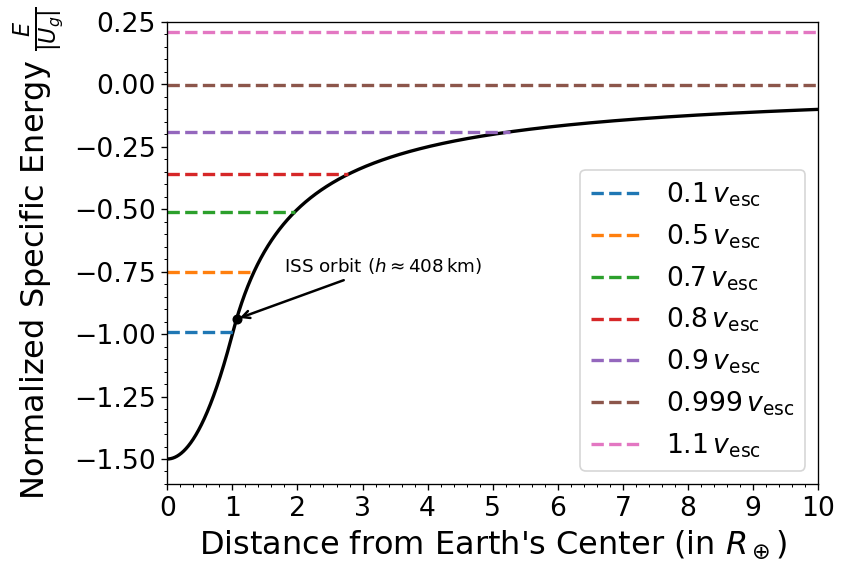
This result applies for any velocity because energy is a scalar quantity, meaning that the velocity need not point directly away from the Earth. It is possible to have a gravitationally bound system where the masses maintain an orbit about each other while falling together (in orbit) around a much larger mass.
13.3.2.3. Example Problem: Escape from Earth#
Exercise 13.7
The Problem
What is the escape speed from the surface of Earth? Assume there is no energy loss from air resistance. Compare this to the escape speed from the Sun, starting from Earth’s orbit.
Show worked solution
The Model
Escape speed is found by equating kinetic energy with gravitational potential energy. The mass and distance must always correspond to the same central body. For escape from Earth’s surface, the central body is Earth, so we use \(M_\oplus\) and \(R_\oplus\). For escape from the Sun starting at Earth’s orbit, the central body is the Sun, so we use \(M_\odot\) and \(a_\oplus\), where \(a_\oplus\) is Earth’s semimajor axis.
After computing the escape speed directly, we compare the two escape speeds with a ratio so you can see how the result scales with central mass and distance.
The Math
Starting from energy conservation, the escape speed from a distance \(r\) from a central mass \(M\) is
For escape from Earth’s surface, the central mass is \(M_\oplus\) and the distance from the central body is \(R_\oplus\):
For escape from the Sun starting at Earth’s orbit, the central mass is \(M_\odot\) and the distance from the central body is \(a_\oplus\):
The ratio of the solar escape speed at Earth’s orbit to the escape speed from Earth’s surface is
The numerical ratio follows from the central-body masses and their corresponding distances:
The solar escape speed at Earth’s orbit is therefore
The Conclusion
The escape speed from Earth’s surface is \(11.2\ {\rm km/s}\). The escape speed from the Sun, starting from Earth’s orbit, is \(42.1\ {\rm km/s}\), which is about \(3.8\) times larger. The comparison works only because each mass is paired with the appropriate distance from that central body.
The Verification
The verification computes both escape speeds directly using \(v_{\rm esc} = \sqrt{2GM/r}\) and then compares the ratio of the two results. This mirrors the analytical method and checks the central-body pairing used in the solution.
import numpy as np

# Define constants
G = 6.67e-11           # Gravitational constant in N·m^2/kg^2
M_E = 5.96e24          # Mass of Earth in kg
M_sun = 1.99e30        # Mass of the Sun in kg
R_E = 6.37e6           # Radius of Earth in m
a_E = 1.50e11          # Earth's semimajor axis in m

# Compute escape speeds directly
v_esc_E = np.sqrt(2 * G * M_E / R_E)       # Escape speed from Earth in m/s
v_esc_sun = np.sqrt(2 * G * M_sun / a_E)   # Solar escape speed at Earth in m/s

# Compute the ratio of escape speeds
speed_ratio = v_esc_sun / v_esc_E

print(f"The escape speed from Earth's surface is {v_esc_E/1000:.1f} km/s.")
print(f"The escape speed from the Sun at Earth's orbit is {v_esc_sun/1000:.1f} km/s.")
print(f"The ratio of escape speeds is {speed_ratio:.2f}.")
13.3.2.4. Example Problem: How Far Can an Object Escape?#
Exercise 13.8
The Problem
Let’s consider the preceding example again, where we calculated the escape speed from Earth and the Sun, starting from Earth’s orbit. We noted that Earth already has an orbital speed of \(30\ {\rm km/s}\). As we see in the next section, that is the tangential speed needed to stay in circular orbit. If an object had this speed at the distance of Earth’s orbit, but was headed directly away from the Sun, how far would it travel before coming to rest? Ignore the gravitational effects of any other bodies.
Show worked solution
The Model
The object moves in the Sun’s gravitational field and is treated as a point mass. It begins at Earth’s orbital distance with the circular orbital speed for that radius, but its velocity is directed radially outward rather than tangentially. As the object moves away from the Sun, its kinetic energy decreases while its gravitational potential energy increases. The maximum distance occurs when the speed becomes zero, so conservation of mechanical energy determines the turning point.
The Math
The total mechanical energy is conserved, so \(K_i + U_i = K_f + U_f.\) Using the gravitational potential energy \(U = -GM_\odot m/r\), this becomes
At the maximum distance, the object momentarily comes to rest, so \(v_f = 0\). Because the initial speed is the circular speed at \(r_i\), we use
Substituting these two facts into the energy equation gives
Factoring out \(GM_\odot m\) gives
This simplifies to
so the maximum distance is \(r_f = 2r_i.\)
Using \(r_i = 1.50\times10^{11}\ {\rm m}\) gives
The Conclusion
The object travels to a maximum distance of \(3.0\times 10^{11}\ {\rm m}\) before coming to rest. This is exactly twice Earth’s orbital distance from the Sun, which carries the object beyond Mars’s orbit but not as far as the main asteroid belt.
The Verification
The verification uses the circular-speed relation and conservation of energy to compute the turning-point distance numerically. This confirms that an object launched radially outward with the circular speed at Earth’s orbit reaches exactly twice its initial distance before stopping.
import numpy as np

# Define constants
G = 6.67e-11          # Gravitational constant in N·m^2/kg^2
M_sun = 1.99e30       # Mass of the Sun in kg
r_i = 1.50e11         # Initial distance from the Sun in m

# Compute the circular speed at the initial radius
v_i = np.sqrt(G * M_sun / r_i)    # Initial circular speed in m/s

# Compute the turning-point distance from energy conservation
r_f = 2.0 * r_i                   # Maximum distance from the Sun in m

print(f"The initial circular speed is {v_i/1000:.1f} km/s.")
print(f"The maximum distance from the Sun is {r_f:.2e} m.")
print(f"This is {r_f/r_i:.1f} times the initial orbital distance.")
13.4. Satellite Orbits and Energy#
13.4.1. Circular Orbits#
Nicolaus Copernicus suggested that the planets orbit the Sun in circles, where determined the radii of these circles using the synodic and sidereal periods (see my Introductory Astronomy Notes). Kepler was forced to abandon the assumption of circular orbits, where he showed that using elliptical orbits fit the data much better. Most of the planets in the Solar System have nearly circular orbits, where the Earth’s orbital eccentricity is \({\sim}0.0167\). In contrast, the orbit of Mars and Mercury have an eccentricity of \({\sim}0.1\) and \({\sim}0.2\), respectively.
Determining the orbital speed and orbital period of a satellite can be more easily determined by first assuming that they have circular orbits. Consider a satellite of mass \(m\) in a circular orbit about Earth at a distance \(r\) from the center of Earth (see Figure 13.8). It has a centripetal acceleration directed toward Earth’s center and gravity is the only force. Newton’s second law can be used, which gives
Fig. 13.8 A satellite in circular orbit continually falls toward Earth while moving sideways fast enough to keep missing the surface. Gravity supplies the inward centripetal acceleration required for the orbit. Image Credit: OpenStax: Satellite Orbits and Energy.#
We can solve for the speed of the orbit \(v_{\rm orbit}\) (note that \(m\) cancels) to get
The value of \(g\), the escape velocity, and the orbital velocity depend only on the distance from the center of the planet, and not upon the mass of the object. Let’s compare the escape velocity (see Eqn. (13.8)) to the orbital velocity through the ratio, assuming that \(m_1 = M_\oplus\) and \(m_2 = m\). Then, we have
In our case the mass of the satellite \(m\) is much less than the mass of the Earth \(M_\oplus\), which justifies our approximation. It also shows that the escape velocity is \(\sqrt{2}\) times greater (about \(40\%\)) than the orbital velocity.
To find the period of a circular orbit, we simply use the definition of average velocity, or
where \(\Delta s\) is the distance traveled along the circumference of the circle and \(\Delta t\) is the time it takes to traverse that distance. In physics and astronomy, it is common to use the letter \(T\) for this time interval, partly because we’ve used \(p\) for momentum already and will use \(P\) for pressure later.
For the satellite to complete one orbit in a time \(T\), \(\delta s\) must be the circumference of the circle or \(2\pi r\). Now we can substitute this into our equation for orbital speed and solve for \(T\). Therefore we have
The orbital period squared (the final expression) represent’s Kepler’s 3rd law and it confirms Copernicus’ observation that the period of a planet increases with distance from the Sun. This equation can be generalized by replacing \(M_\oplus\) with the mass of any central body (e.g., the Sun, a black hole, or any large mass).
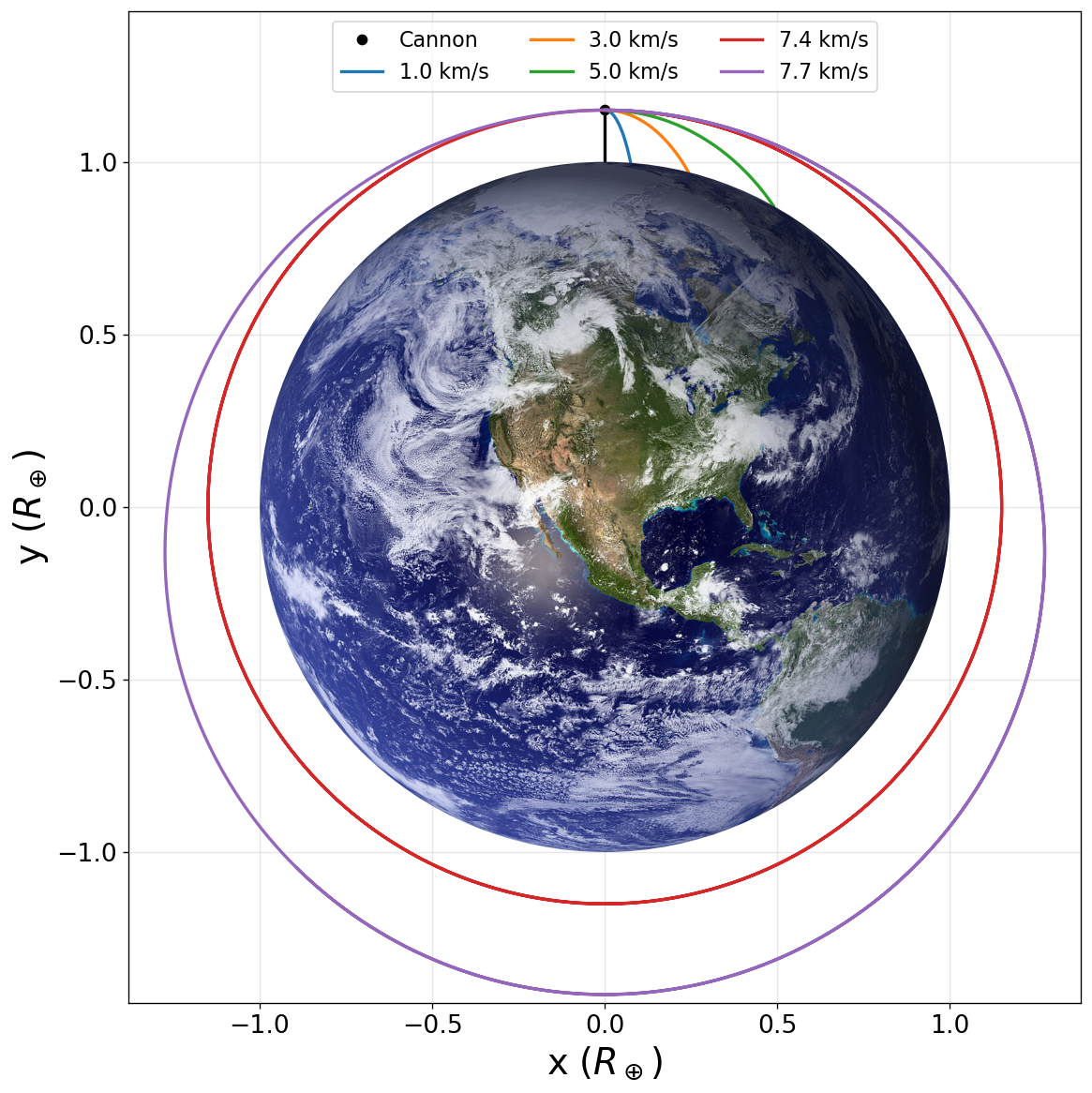
To achieve a circular orbit, Newton described in his Principia a thought experiment, where a cannon was set on top of a tall tower and fired the cannonball. In Chapter 4, we say this as projectile motion. However, his though was to increase the initial velocity \(v_o\) incrementally and orient the cannon to fire horizontally.
As you increase the speed of the cannonball, you would notice that our expectation of a parabolic trajectory begins to break. The cannon goes farther and farther, until it curves around the Earth. At this point, it achieves the necessary speed to be in a circular orbit.
The figure below demonstrates this by placing a cannon at \({\sim}955\ {\rm km}\) above Earth’s surface and firing a cannon at various speeds. This is a thought experiment, so complete realism is not required. Once the cannon is fired at \({\sim}7.4\ {\rm km/s}\) (i..e., the circular velocity for the given height), then the cannonball can be in a circular orbit (in red). If you keep going, then the orbit is more elliptical. Until you reach the escape speed and the trajectory no longer bends back towards the Earth (i.e., it becomes unbound).
Checkpoint
In a circular orbit, is centripetal force a new force, or is gravity providing the inward net force?
Show code cell source
import os
import numpy as np
import matplotlib.pyplot as plt
from matplotlib.patches import Circle
from scipy.integrate import solve_ivp
from scipy.constants import G

# ============================================================
# Earth + cannon with inverse-square gravity (no constant g)
# ============================================================
# -------------------------
# Constants
# -------------------------
M_E = 5.972e24          # Earth mass in kg
R_E = 6371e3            # Earth radius in m
mu = G * M_E
# -------------------------
# Launch setup
# -------------------------
h = 0.15*R_E                       # cannon height (m)
r0_mag = R_E + h
# Start at (x, y)
r0 = np.array([r0_mag, 0.0])
# Local directions
radial_hat = r0 / np.linalg.norm(r0)
tangent_hat = np.array([-radial_hat[1], radial_hat[0]])
# Launch angle (0 = horizontal)
angle_deg = 0.0
angle = np.deg2rad(angle_deg)
direction = np.cos(angle)*tangent_hat + np.sin(angle)*radial_hat
# -------------------------
# Speeds to test
# -------------------------
v_circ = np.sqrt(mu / r0_mag)
v_esc = np.sqrt(2 * mu / r0_mag)
speeds = [1000, 3000, 5000, v_circ,1.05*v_circ]
# -------------------------
# ODE system
# -------------------------
def deriv(t, y):
    x, y_pos, vx, vy = y
    r = np.sqrt(x**2 + y_pos**2)
    ax = -mu * x / r**3
    ay = -mu * y_pos / r**3
    return [vx, vy, ax, ay]
# Stop when hitting Earth
def hit_earth(t, y):
    x, y_pos = y[0], y[1]
    return np.sqrt(x**2 + y_pos**2) - R_E
hit_earth.terminal = True
hit_earth.direction = -1
# -------------------------
# Plot
# -------------------------
fig, ax = plt.subplots(figsize=(10,10),dpi=120)
ax.grid(True, alpha=0.3,zorder=2)

# Draw Earth, using the local image if it is available
if os.path.exists("Earth_Western_Hemisphere.jpg"):
    img = plt.imread("Earth_Western_Hemisphere.jpg")
    img = np.asarray(img)

    # Create alpha channel so near-black pixels are transparent
    threshold = 20
    image_mask = np.all(img < threshold, axis=-1)
    rgba = np.dstack((img, np.ones(img.shape[:2]) * 255))
    rgba[image_mask, 3] = 0
    img = rgba.astype(np.uint8)

    # Draw and clip the image to a circle of radius 1
    im = ax.imshow(img, extent=[-1.15, 1.15, -1.15, 1.15], zorder=5)
    clip = Circle((0, 0), 1, transform=ax.transData)
    im.set_clip_path(clip)
else:
    # Fallback if the image file is not available
    earth_disk = Circle((0, 0), 1, facecolor="0.85", edgecolor="black", linewidth=1.5, zorder=5)
    ax.add_patch(earth_disk)

# Cannon location
ax.plot(r0[1]/R_E, r0[0]/R_E, 'ko', label='Cannon')
ax.plot([0,0],[1,r0_mag/R_E],'k-',lw=2)
# -------------------------
# Simulate trajectories
# -------------------------
for v in speeds:
    v0 = v * direction
    y_init = [r0[0], r0[1], v0[0], v0[1]]
    sol = solve_ivp(deriv,t_span=(0, 12000),y0=y_init,max_step=5,events=hit_earth)
    ax.plot(sol.y[1]/R_E, sol.y[0]/R_E, lw=2,label=f"{v/1000:.1f} km/s")
# -------------------------
# Formatting
# -------------------------
ax.set_aspect('equal')
ax.set_xlim(-1.2*r0_mag/R_E, 1.2*r0_mag/R_E)
ax.set_ylim(-1.25*r0_mag/R_E, 1.25*r0_mag/R_E)
ax.set_xlabel("x ($R_\oplus$)",fontsize='x-large')
ax.set_ylabel("y ($R_\oplus$)",fontsize='x-large')
ax.legend(loc='upper center',ncols=3, fontsize='small')

plt.tight_layout()
plt.show()
Interactive Simulation: Gravity and Orbits
Use this PhET simulation to explore how gravity controls the motion of our Solar System. You can also experiment so that you can identify the variable that affect the strength of gravity.
13.4.1.1. Example Problem: The International Space Station#
Exercise 13.9
The Problem
Determine the orbital speed and period for the International Space Station (ISS).
Show worked solution
The Model
The ISS is modeled as a small object in circular orbit about Earth. Its orbital radius is the sum of Earth’s radius and its altitude. The orbital speed follows from the balance between gravity and centripetal acceleration, and the period follows from the relation between speed and circumference.
The Math
For a circular orbit of radius \(r\), the orbital speed is
and the orbital period is
The orbital radius of the ISS is
The orbital speed requires \(r\) in meters because \(G\) is written in SI units:
The orbital period is easier to interpret using kilometers and kilometers per second:
The Conclusion
The orbital speed of the ISS is \(7.67\ {\rm km/s}\), and its orbital period is \(92.5\ {\rm min}\). These values are characteristic of low Earth orbit.
The Verification
The verification computes the orbital radius from Earth’s radius and the ISS altitude, evaluates the orbital speed, and then determines the period using the circumference of the orbit. This confirms the analytical results while reporting the speed in the more useful unit of \({\rm km/s}\).
import numpy as np

# Define constants
G = 6.67e-11          # Gravitational constant in N·m^2/kg^2
M_E = 5.96e24         # Mass of Earth in kg
R_E = 6370.0          # Radius of Earth in km
h = 400.0             # Altitude of the ISS in km

# Convert radius to meters for calculation
r = (R_E + h) * 1e3   # Orbital radius in m

# Compute orbital speed
v = np.sqrt(G * M_E / r)   # Speed in m/s

# Compute orbital period
T = 2 * np.pi * (R_E + h) / (v / 1000)   # Use km and km/s for clarity
T_min = T / 60

print(f"The orbital speed is {v/1000:.2f} km/s.")
print(f"The orbital period is {T:.2e} s, which is {T_min:.1f} min.")
13.4.1.2. Example Problem: Determining the Mass of Earth (using the Moon)#
Exercise 13.10
The Problem
Determine the mass of Earth from the orbit of the Moon.
Show worked solution
The Model
The Moon is modeled as a small object in nearly circular orbit about Earth. Its orbital motion is governed by Newtonian gravitation, so the orbital period and orbital radius determine Earth’s mass. The direct solution uses the circular-orbit period formula. A ratio-based interpretation is also possible because the Moon’s orbital distance is much larger than Earth’s radius, and that distance relative to Earth’s radius was known long before modern measurements in SI units.
The Math
For a circular orbit of radius \(r\) about Earth, the orbital period is
Solving for Earth’s mass gives
Using the Moon’s orbital radius \(r = 384{,}000\ {\rm km}\) and period \(T = 27.3\ {\rm d}\), we convert only where necessary:
The numerical value follows from the converted values:
A useful ratio-based form uses the historical fact that the Moon’s orbital radius is about \(60\) Earth radii (from accurate eclipse measurements). Since Earth’s radius was already known from ancient measurements, we write \(r_M \approx 60R_\oplus.\) Using \(R_\oplus = 6.37\times10^6\ {\rm m}\) gives
The ratio-based mass follows from the orbital-mass relation:
This ratio-based result is close to the direct value because the historical estimate \(r_M \approx 60R_\oplus\) is already very good.
The Conclusion
The direct calculation using the Moon’s mean orbital radius and period gives Earth’s mass as \(6.01\times10^{24}\ {\rm kg}\). Using the historical ratio \(r_M \approx 60R_\oplus\) together with the known value of Earth’s radius gives \(5.92\times10^{24}\ {\rm kg}\). Both values are close to the accepted value, showing that Earth’s mass can be determined from lunar orbital motion once distances and time scales are known.
The Verification
The verification computes Earth’s mass directly from the Moon’s orbital radius and period, then repeats the calculation using the ratio method with \(r \approx 60R_\oplus\). This confirms that both approaches produce nearly the same value.
import numpy as np

# Define constants
G = 6.67e-11          # Gravitational constant in N·m^2/kg^2
R_E = 6.37e6          # Radius of Earth in m
r_moon = 3.84e8       # Mean orbital radius of the Moon in m
T = 27.3 * 24 * 3600  # Orbital period of the Moon in s
alpha = 60.0          # Moon's orbital radius in Earth radii

# Compute Earth's mass using the direct orbital radius
M_direct = 4 * np.pi**2 * r_moon**3 / (G * T**2)

# Compute the Moon's orbital radius using the ratio r ≈ 60 R_E
r_ratio = alpha * R_E  # Orbital radius from ratio in m

# Compute Earth's mass using the ratio-based radius
M_ratio = 4 * np.pi**2 * r_ratio**3 / (G * T**2)

print(f"The direct calculation gives Earth's mass as {M_direct:.3e} kg.")
print(f"The ratio-based orbital radius is {r_ratio:.3e} m.")
print(f"The ratio method gives Earth's mass as {M_ratio:.3e} kg.")
13.4.1.3. Example Problem: Galactic Speed and Period#
Exercise 13.11
The Problem
Assume that the Milky Way and Andromeda galaxies are in a circular orbit about each other. What would be the velocity of each and how long would their orbital period be? Assume the mass of each is \(8\times10^{11}\) solar masses and their centers are separated by \(2.5\) million light-years.
Show worked solution
The Model
The two galaxies are modeled as equal masses in circular orbit about their common center of mass. For equal masses, the center of mass lies midway between them, so each galaxy orbits with radius \(r_{\rm orbit} = r/2\), where \(r\) is the separation. The orbital speed follows from the balance between gravitational force and centripetal acceleration, and the period follows from circular motion.
The Math
The gravitational force provides the centripetal force,
Simplifying this expression in terms of \(v^2\) gives
Thus, the orbital speed is \( v = \sqrt{\frac{GM}{2r}}.\)
Substituting \(M = 8\times10^{11}(2.0\times10^{30}\ {\rm kg}) = 1.6\times10^{42}\ {\rm kg}\) and
\(r = 2.5\times10^6(9.5\times10^{15}\ {\rm m}) = 2.38\times10^{22}\ {\rm m}\) gives
The orbital period follows from
The numerical value follows by evaluating the expression with the given values:
The Conclusion
Each galaxy moves at a speed of \(47\ {\rm km/s}\) and the orbital period is approximately \(5\times10^{10}\) years. This timescale is much longer than the current age of the universe.
The Verification
The verification computes the galaxy mass, converts the separation into meters, and evaluates the orbital speed using the derived expression. It then computes the orbital period using the orbital radius and speed. This confirms the analytical results.
import numpy as np

# Define constants
G = 6.67e-11              # Gravitational constant in N·m^2/kg^2
M_sun = 2.0e30            # Solar mass in kg
M = 8e11 * M_sun          # Mass of each galaxy in kg
r = 2.5e6 * 9.5e15        # Separation between galaxies in m

# Compute orbital speed
v = np.sqrt(G * M / (2 * r))   # Orbital speed in m/s

# Compute orbital period
T = np.pi * r / v              # Period in s
T_yr = T / (365.25 * 24 * 3600)

print(f"The orbital speed of each galaxy is {v/1000:.1f} km/s.")
print(f"The orbital period is {T:.2e} s, which is {T_yr:.2e} years.")
13.4.2. Energy in Circular Orbits#
In Section 13.3, we argued that objects are gravitationally bound if their total energy is negative. Let’s examine the total energy for a circular orbit instead of only a velocity directly away from the planet. We can start by applying Newton’s second law, or
We stopped here because we now have something that looks almost like kinetic energy on the right-side. If we multiply both sides by \(\frac{1}{2}\), we find
The total energy is the sum of the kinetic and potential energies, so our final result is
We can see that the total energy is negative, with the same magnitude as half the kinetic energy. For circular orbits, the magnitude of the kinetic energy is exactly one-half the magnitude of the potential energy.
13.4.2.1. Example Problem: Energy Required to Orbit#
Exercise 13.12
The Problem
In Example 13.8, we calculated the energy required to simply lift the \(9000\ {\rm kg}\) Soyuz vehicle from Earth’s surface to the height of the ISS, \(400\ {\rm km}\) above the surface. What total energy change is required to take it from Earth’s surface and place it into orbit at that altitude? How much of that total energy is kinetic energy?
Show worked solution
The Model
The total energy required is the change in mechanical energy between Earth’s surface and a circular orbit at altitude \(h\). At the surface, the payload starts from rest, so its energy is purely gravitational potential energy. In orbit, the total energy is the sum of kinetic and potential energy, which for a circular orbit has the form \(E = -GM_\oplus m/(2r)\). The kinetic energy can then be found directly from the orbital speed or from its relation to the total energy.
The Math
At Earth’s surface, the total energy is \(E_{\rm surface} = -\frac{GM_\oplus m}{R_\oplus}.\) For a circular orbit at radius \(r = R_\oplus + h\), the total energy is \( E_{\rm orbit} = -\frac{GM_\oplus m}{2r}.\)
The required energy input is the change in total energy,
The numerical value follows by evaluating the expression with the given values:
The kinetic energy in orbit follows from \(K_{\rm orbit} = \frac{GM_\oplus m}{2r}.\)
Substituting gives
The Conclusion
The total energy required to place the Soyuz in orbit is \(2.98\times10^{11}\ {\rm J}\), of which \(2.65\times10^{11}\ {\rm J}\) is kinetic energy. Thus, most of the required energy goes into the spacecraft’s orbital motion rather than simply lifting it against gravity.
The Verification
The verification computes the total energy at Earth’s surface and in orbit using the standard expressions for gravitational potential and circular-orbit energy. The difference gives the required energy input, and the orbital kinetic energy is computed independently from the orbital-speed relation.
import numpy as np

# Define constants
G = 6.67e-11          # Gravitational constant in N·m^2/kg^2
M_E = 5.96e24         # Mass of Earth in kg
m = 9000.0            # Mass of the payload in kg
R_E = 6.37e6          # Radius of Earth in m
h = 400e3             # Altitude above Earth's surface in m

# Compute orbital radius
r = R_E + h           # Orbital radius in m

# Compute total energy at surface and in orbit
E_surface = -G * M_E * m / R_E
E_orbit = -G * M_E * m / (2 * r)

# Compute required energy and orbital kinetic energy
delta_E = E_orbit - E_surface
K_orbit = G * M_E * m / (2 * r)

print(f"The total energy required is {delta_E:.3e} J.")
print(f"The kinetic energy in orbit is {K_orbit:.3e} J.")
13.5. Kepler’s Laws of Planetary Motion#
The prevailing view during the time of Kepler (and Galileo) was that planetary orbits were circular. The data for Mars presented the greatest challenge to this paradigm. Even using the best data available (from Tycho Brahe), the best fitting circles were in error by 8 arcminutes. This error encouraged Kepler to abandon the popular idea.
If I had believed that we could ignore these eight minutes [of arc], I would have patched up my hypothesis accordingly. But, since it was not permissible to ignore, those eight minutes pointed the road to a complete reformation in astronomy.
—Johannes Kepler
Kepler published his 3 laws of planetary motion in 3 works from 1608-1621: Astronomia nova, Harmonice Mundi, and Epitome Astronomiae Coperincanae.
13.5.1. Kepler’s First Law#
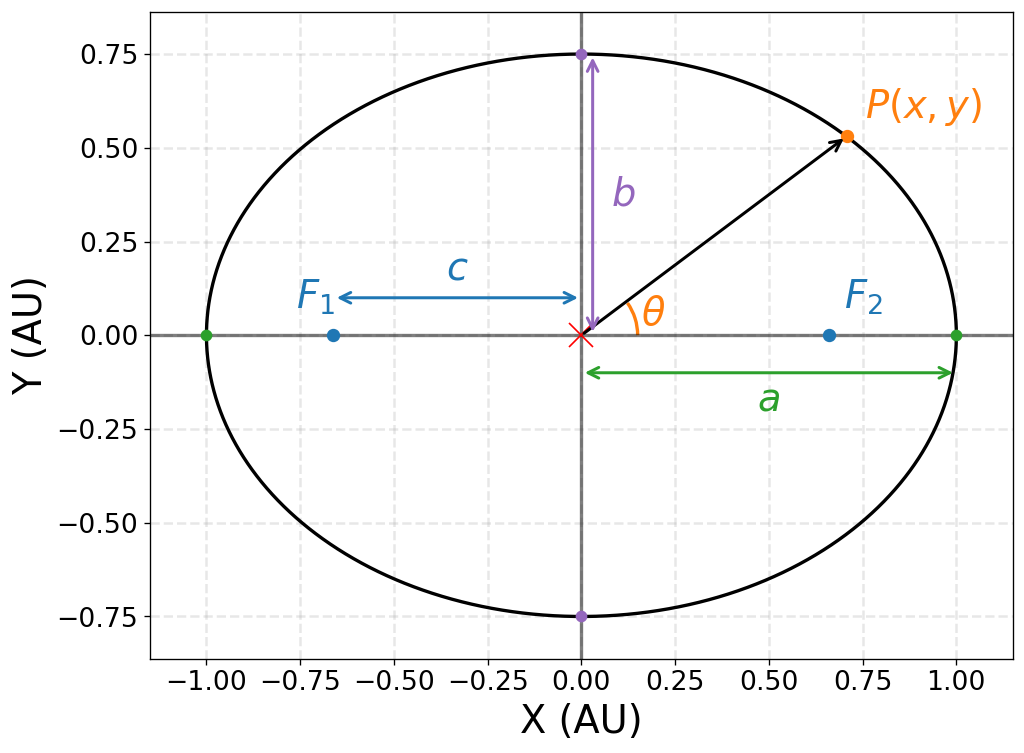
In Astronomia nova (1609), Kepler articulated his first law that states that every planet moves along an ellipse, with the Sun located at one focus. An ellipse is defined by mathematically, by
where the ellipse is centered on the point \((h,\, k)\), has a semimajor axis length \(a\), and semiminor length \(b\). The distance of the foci from the center of the ellipse can be found by \(c^2 = a^2-b^2\). The parametric form of an ellipse is given by
where the \(\theta\) angle is measured using the center point and represents the angle between the point on the ellipse and the reference axis. An ellipse is typically oriented so that the semimajor axis \(a\) is parallel to the \(x\)-axis and the semiminor axis lies along the \(y\)-axis (see the figure below).
Show code cell source
import numpy as np
import matplotlib.pyplot as plt
from matplotlib.patches import Arc

def ellipse_x(h,a,theta):
    return h + a*np.cos(theta)
def ellipse_y(k,b,theta):
    return k + b*np.sin(theta)

theta = np.arange(0,2*np.pi, 0.001)
h,k,a,b = 0,0,1,0.75
x,y = ellipse_x(h,a,theta), ellipse_y(k,b,theta)

fs = 'x-large'
fig = plt.figure(figsize=(10,7),dpi=120)
ax = fig.add_subplot(111,aspect='equal')
ax.grid(True,alpha=0.3,ls='--',lw=1.5)
ax.axhline(0,color='k',lw=2,alpha=0.5)
ax.axvline(0,color='k',lw=2,alpha=0.5)

c = np.sqrt(a**2-b**2)
#plot origin and foci
ax.plot(0,0,marker='x',color='r',ms=14)
ax.plot(c,0,'.',color='tab:blue',ms=14)
ax.plot(-c,0,'.',color='tab:blue',ms=14)
#plot ellipse
ax.plot(x,y,'-',color='k',lw=2)
#plot point P on ellipse
theta_p = np.radians(45)
x_p, y_p = ellipse_x(h,a,theta_p), ellipse_y(k,b,theta_p)
ax.annotate('', xy=(0, 0), xytext=(x_p, y_p), arrowprops=dict(arrowstyle='<-', lw=1.8, color='black'))
ax.plot(x_p,y_p,'.',color='tab:orange',ms=14)

# Angle theta arc
r_theta = 0.15  # radius of arc (adjust for aesthetics)
theta_deg = np.degrees(theta_p)-10
arc = Arc((0, 0),width=2*r_theta,height=2*r_theta,angle=0,theta1=0,theta2=theta_deg,color='tab:orange',lw=2)
ax.add_patch(arc)
# Position label halfway along arc
theta_mid = theta_p / 2
x_t, y_t = r_theta * np.cos(theta_mid), r_theta * np.sin(theta_mid)
ax.text(x_t + 0.02, y_t - 0.03, r'$\theta$', fontsize=fs, color='tab:orange')

# Plot vertices and co-vertices
ax.plot([-a, a], [0, 0], 'o', color='tab:green', ms=6)
ax.plot([0,0], [-b, b], 'o', color='tab:purple', ms=6)

# Semi-major axis a
ax.annotate('', xy=(0, -0.10), xytext=(a, -0.10), arrowprops=dict(arrowstyle='<->', lw=1.8, color='tab:green'))
ax.text(a/2, -0.2, r'$a$', color='tab:green', fontsize=fs, ha='center')
# Semi-minor axis b
ax.annotate('', xy=(0.03, 0), xytext=(0.03, b), arrowprops=dict(arrowstyle='<->', lw=1.8, color='tab:purple'))
ax.text(0.08*a, b/2, r'$b$', color='tab:purple', fontsize=fs, va='center')
# Focal distance c
ax.annotate('', xy=(0, 0.10), xytext=(-c, 0.10),arrowprops=dict(arrowstyle='<->', lw=1.8, color='tab:blue'))
ax.text(-c/2, 0.15, r'$c$', color='tab:blue', fontsize=fs, ha='center')

# Labels for points
ax.annotate(r'$F_1$', xy=(-c,0), xytext=(-c-0.10, 0.07), fontsize=fs, color='tab:blue')
ax.annotate(r'$F_2$', xy=(c,0), xytext=(c+0.04, 0.07), fontsize=fs, color='tab:blue')
ax.annotate(r'$P(x,y)$', xy=(x_p, y_p), xytext=(x_p+0.05, y_p+0.05), fontsize=fs, color='tab:orange')

ax.set_xticks(np.arange(-1,1.25,0.25))
ax.set_yticks(np.arange(-0.75,1.0,0.25))
ax.set_ylim(-1.15*b,1.15*b)
ax.set_xlim(-1.15*a,1.15*a)
ax.set_xlabel("X (AU)",fontsize=fs)
ax.set_ylabel("Y (AU)",fontsize=fs);
In physics & astronomy, we use one focus as the reference point instead of the center. In fact, one way to create an ellipse is to use to fixed points (e.g., using pushpins or nails) and a piece of string tied in a loop. From this construction, we can see that perimeter of a triangle using the foci and a point on the ellipse is constant. This must be true because the length of string does not change. See the video below for how to construct an ellipse with a piece of string.
Show code cell source
import numpy as np
import matplotlib.pyplot as plt
from matplotlib.patches import Arc

def ellipse_x(h,a,theta):
    return h + a*np.cos(theta)
def ellipse_y(k,b,theta):
    return k + b*np.sin(theta)

theta = np.arange(0,2*np.pi, 0.001)
h,k,a,b = 0,0,1,0.75
x,y = ellipse_x(h,a,theta), ellipse_y(k,b,theta)

fs = 'x-large'
fig = plt.figure(figsize=(10,7),dpi=120)
ax = fig.add_subplot(111,aspect='equal')
ax.grid(True,alpha=0.3,ls='--',lw=1.5)
ax.axhline(0,color='k',lw=2,alpha=0.5)
ax.axvline(0,color='k',lw=2,alpha=0.5)

c = np.sqrt(a**2-b**2)
#plot origin and foci
ax.plot(c,0,'.',color='tab:blue',ms=14)
ax.plot(-c,0,'.',color='tab:blue',ms=14)
#plot ellipse
ax.plot(x,y,'-',color='k',lw=2)
#plot point P on ellipse
theta_p = np.radians(45)
x_p, y_p = ellipse_x(h,a,theta_p), ellipse_y(k,b,theta_p)
ax.annotate('', xy=(-c, 0), xytext=(x_p, y_p), arrowprops=dict(arrowstyle='<-', lw=1.8, color='tab:orange'))
ax.annotate('', xy=(c, 0), xytext=(x_p, y_p), arrowprops=dict(arrowstyle='<-', lw=1.8, color='tab:orange'))
ax.plot(x_p,y_p,'.',color='tab:orange',ms=14)
ax.plot([-c,c],[0,0],'-',color='tab:orange', lw=2)

ax.plot(-a,0,'.',color='tab:green',ms=14)
ax.plot(a,0,'.',color='tab:green',ms=14)
# Angle theta arc
r_theta = 0.15  # radius of arc (adjust for aesthetics)
theta_deg = np.degrees(theta_p)-10
arc = Arc((-0.85*c, 0),width=2*r_theta,height=2*r_theta,angle=0,theta1=0,theta2=theta_deg,color='black',lw=2)
ax.add_patch(arc)
# Position label halfway along arc
theta_mid = theta_p / 2
x_t, y_t = r_theta * np.cos(theta_mid), r_theta * np.sin(theta_mid)
ax.text(x_t + 0.02-0.85*c, y_t - 0.03, r'$\theta$', fontsize=fs, color='black')

# Labels for points
ax.annotate(r'$F_1$', xy=(-c,0), xytext=(-c-0.10, 0.07), fontsize=fs, color='tab:blue')
ax.annotate(r'$M_\odot$', xy=(-c,0), xytext=(-c, -0.12), ha='center', fontsize=fs, color='black')
ax.annotate(r'$F_2$', xy=(c,0), xytext=(c+0.04, 0.07), fontsize=fs, color='tab:blue')
ax.annotate(r'$m$', xy=(x_p, y_p), xytext=(x_p+0.025, y_p+0.025), fontsize=fs, color='tab:orange')
ax.annotate(r'$\rm q$', xy=(-a,0), xytext=(-a-0.08, 0.04), fontsize=fs, color='tab:green')
ax.annotate(r'$\rm Q$', xy=(a,0), xytext=(a+0.02, 0.04), fontsize=fs, color='tab:green')

ax.set_xticks(np.arange(-1,1.25,0.25))
ax.set_yticks(np.arange(-0.75,1.0,0.25))
ax.set_ylim(-1.15*b,1.15*b)
ax.set_xlim(-1.15*a,1.15*a)
ax.set_xlabel("X (AU)",fontsize=fs)
ax.set_ylabel("Y (AU)",fontsize=fs);
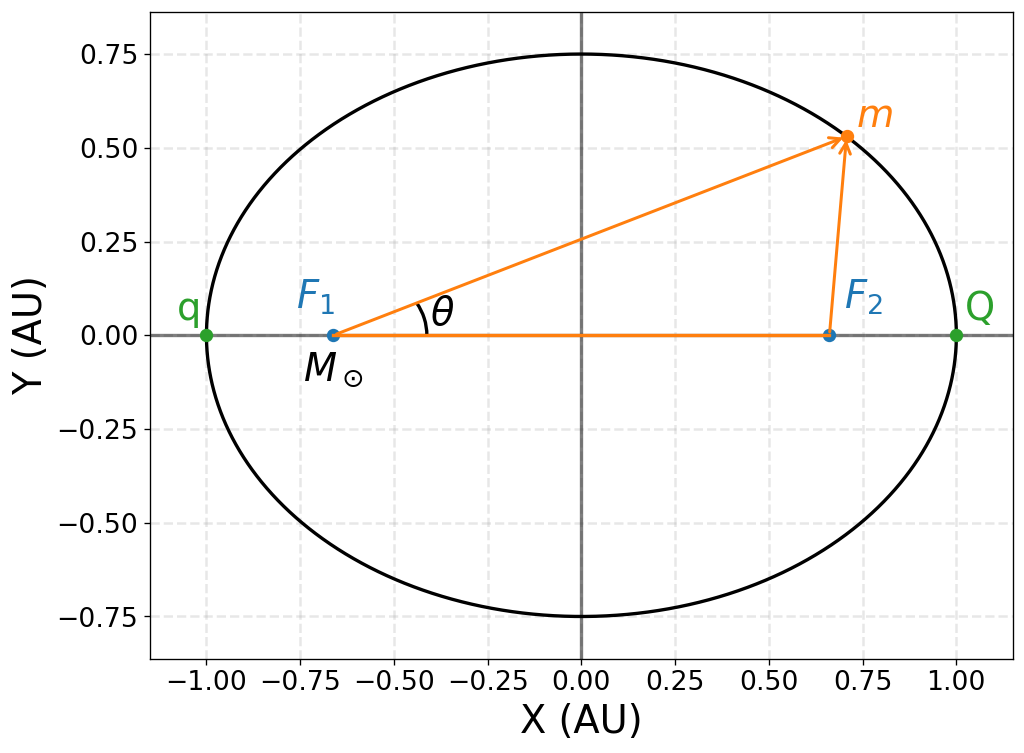
For elliptical orbits, there are two special points worth noting: (1) point of closest approach \(\rm q\) and (2) farthest point \(\rm Q\) from the Sun (at \(F_1\)). In Greek, the word for near is peri- (Greek: \(\pi\epsilon\rho\iota\)) and away from is apo- (Greek: \(\alpha\pi\omicron\)). The suffix tells us what the object is orbiting, where in our case it is the Sun (Helios). Therefore these points are named by combining the prefix + suffix (e.g., aphelion), or
perihelion \(q\): closest distance to the Sun.
aphelion \(Q\): farthest distance to the Sun.
For the Moon’s orbit around the Earth (Geo), the points are called perigee and apogee, respectively.
An ellipse has a specific form that can describe more generally described as a conic section. There are four conic sections, all given by the equation
where the \(r\) is the distance from the foci to the point on the ellipse, \(\ell\) is the semi-latus rectum, and \(\theta\) is the angle relative to the reference direction. The constant \(e\) is the eccentricity, which helps us determine which of the four conic sections represents the path of a satellite.
Every path taken by \(m\) is one of the four conic sections:
a circle or an ellipse for bound (or closed) orbits, or
a parabola or hyperbola for unbounded or open orbits.
The eccentricity of the ellipse is related to the total energy.
If the total energy is negative: then \(0\leq e <1 \); the path is either a circle or an ellipse. A circle is a special case of an ellipse, where \(e = 0\).
If the total energy is exactly zero: then \(e = 1\) and the path is a parabola. Recall that a satellite with zero total energy has exactly the escape velocity.
If the total energy is positive: then \(e>1\) and the path is a hyperbola.
Interactive Simulation: My Solar System
Use this PhET simulation Lab option to explore two interacting objects. Start with the Sun, Planet option, where you can explore the more complicated body problems as well.
13.5.2. Orbital Transfers#
People have imagined traveling to other planets of our Solar System, but how can we best do this? The most efficient method was discovered in 1925 by Walter Hohmann. The method is now called a Hohmann transfer.
For the case of traveling between two circular orbits, the transfer is along an ellipse that perfectly intercepts those orbits at the aphelion and perihelion points. Figure 13.9 shows the case for a trip from Earth to Mars, where the Sun is at the focus of the ellipse.
Fig. 13.9 A Hohmann transfer uses an elliptical orbit tangent to the initial and final circular orbits. Spacecraft change speed at the endpoints to move from one orbit to the transfer ellipse and then into the destination orbit. Image Credit: OpenStax: Kepler’s Laws of Planetary Motion.#
For any ellipse, the semimajor axis is defined as one-half the sum of the perihelion and aphelion distances. In general, these perihelion \(q\) and aphelion \(Q\) are given mathematically as
From Figure 13.9, we can see that the perihelion distance \(Q_t\) for the transfer orbit is the Earth’s semimajor axis \(a_{\rm E} = 1\ {\rm AU}\). The aphelion distance \(q_t\) of the transfer orbit is Mars’ semimajor axis \(a_{\rm Ma} = 1.52\ {\rm AU}\). We can add these two equations to find the semimajor axis \(a_t\) of the transfer orbit, or
We can find the necessary eccentricity as
Let’s now consider the energy needs for the transfer orbit. We found that the energy of an orbit depends on its semimajor axis, or
This means that a larger \(a\) corresponds to a higher energy (i.e., less negative). To move onto the transfer ellipse from Earth’s orbit, we will need to increase our kinetic energy (i.e., we need a velocity boost). The most efficient method is a very quick acceleration along the circular orbital path, which is also along the ellipse’s orbital path at that point.
Once you arrived at Mars’ orbit, you will need another velocity boost to move into that orbit. Otherwise you will stay on the elliptical orbit and simply fall back to perihelion where you started. For the return trip, you simply reverse the process with a retro-boost at each transfer point.
To make the move onto the transfer ellipse and then off again, we need to know the orbital velocity of Earth and Mars, as well as the orbit velocities at perihelion and aphelion of the transfer orbit. The velocity boost required is the difference between the circular velocity and the elliptical velocity at each point. The velocity at perihelion and aphelion are given by the Vis Viva equation
Then we can find the difference of the perihelion velocity (of the transfer orbit) and Earth’s circular velocity as
13.5.3. Kepler’s Second Law#
Kepler’s 2nd law state that a planet sweeps out equal areas in equal times, or the areal velocity \(\left(\frac{dA}{dt}\right)\) is constant. Figure 13.10 shows the path that a planet takes to move from position \(A\) to \(B\), sweeping out an area \(A_1\). It also shows the area \(A_2\) that is swept by moving from \(C\) to \(D\), and the area \(A_3\) swept by moving from \(E\) to \(F\). These areas are the same: \(A_1 = A_2 = A_3.\)
Fig. 13.10 Kepler’s second law says that a planet sweeps out equal areas in equal times. The planet moves faster near perihelion and slower near aphelion so that the swept area rate stays constant. Image Credit: OpenStax: Kepler’s Laws of Planetary Motion.#
In order fo the areas to be equal, the planet must speed up as it gets closer to the Sun and slow down as it moves away. We can show Kepler’s 2nd law as a consequence of the conservation of angular momentum, which holds for any system with only radial forces.
The angular momentum \(\vec{L}\) is determined via the cross product, or \(\vec{L} = \vec{r} \times \vec{p}\). For our case,
\(\vec{L}\) is the angular momentum of the planet about the Sun,
\(\vec{r}\) is the position vector of the planet measured relative to the Sun., and
\(\vec{p} = m\vec{\rm v}\) is the instantaneous linear momentum at any point in the orbit. Since the planet moves along the ellipse, \(\vec{p}\) is always tangent to the ellipse.
We can resolve the linear momentum into two components: (1) a radial component \(\vec{p}_\parallel\) that is parallel to \(\vec{r}\) (pointing to the Sun), and (2) a component \(\vec{p}_\perp\) that is perpendicular to \(\vec{r}\). The cross product can be written as
Term 1 is zero because \(\vec{r}\) is parallel to \(\vec{p}_\parallel\). Since the remaining component is perpendicular, we can write the magnitude as \(L = rp_\perp = rmv_\perp\).
Note
The angular momentum does not depend upon the radial component of the momentum \(p_\parallel\). The gravitational force is only in the radial direction, so it can only change \(p_\parallel\) and not \(p_\perp\). Therefore, the angular momentum must remain constant.
Fig. 13.11 For a very small time interval, the swept area is approximately a thin triangle. This connects Kepler’s second law with angular momentum conservation. Image Credit: OpenStax: Kepler’s Laws of Planetary Motion.#
Let’s break up the problem into a smaller piece, as shown in Figure 13.11. A small triangular element \(\Delta A\) is swept out in a time interval \(\Delta t\). The velocity is along the path and it makes an angle \(\theta\) with the radial direction. The perpendicular velocity is given by \(v_\perp = v\sin{\theta}\).
The planet moves a distance \(\Delta s = |\vec{\rm v}|\sin{\theta} = v\Delta t \sin{\theta}\) projected along the direction perpendicular to \(r\). Since the area of a triangle is one-half the base times the height (an assuming a small displacement), the area is given by \(\Delta A = \frac{1}{2}r\Delta s.\) Through some algebra, we have
The areal velocity is areal rate of change, so we have
Since the angular momentum is constant and the mass is constant, the areal velocity must also be a constant. This is exactly Kepler’s 2nd law.
13.5.4. Kepler’s Third Law#
Kepler’s third law states that the square of the period is proportional to the cube of the semimajor axis of the orbit (i.e., \(T^2 \propto a^3\)). We already derived Newton’s version of Kepler’s 3rd law (see Section 13.4.1). Kepler’s 3rd law is the same equation with \(r\rightarrow a\), where we have
13.5.5. Example Problem: Orbit of Halley’s Comet#
Exercise 13.13
The Problem
Determine the semimajor axis of the orbit of Halley’s comet, given that it arrives at perihelion every \(75.3\) years. If the perihelion is \(0.586\ {\rm AU}\), what is the aphelion?
Show worked solution
The Model
The comet orbits the Sun, so we apply Kepler’s third law. If we measure distance in astronomical units (AU), time in years, and mass in solar masses, then the gravitational constant is absorbed into the units such that \(GM_\odot = 4\pi^2\). In these units, Kepler’s third law simplifies to \(T^2 = a^3\). The semimajor axis is then used with the geometry of an ellipse to determine the aphelion.
The Math
In AU–yr–solar-mass units, Newton’s form of Kepler’s third law,
reduces to
because \(GM_\odot = 4\pi^2\) in these units. Solving for the semimajor axis gives \(a = T^{2/3}.\) Substituting \(T = 75.3\ {\rm yr}\) gives
For an elliptical orbit, the semimajor axis satisfies
so the aphelion distance is
The aphelion distance follows from 17.8\ {\rm AU}\( and \)r_{\rm peri} = 0.586\ {\rm AU}$ gives
The Conclusion
The semimajor axis of Halley’s comet is \(17.8\ {\rm AU}\), and its aphelion distance is \(35.0\ {\rm AU}\).
The Verification
The verification uses Kepler’s third law in AU–yr units to compute the semimajor axis and then applies the ellipse relation to find the aphelion distance.
import numpy as np

# Given values
T = 75.3              # Orbital period in years
r_peri = 0.586        # Perihelion distance in AU

# Compute semimajor axis using Kepler's 3rd law (AU–yr units)
a = T**(2/3)

# Compute aphelion distance
r_ap = 2 * a - r_peri

print(f"The semimajor axis is {a:.2f} AU.")
print(f"The aphelion distance is {r_ap:.1f} AU.")
13.6. Tidal Forces#
13.6.1. Lunar Tides#
If you live on an ocean shore almost anywhere in the world, you can observe the rising and falling of the sea level \(2\times\) per day. This is caused by the combination of the Earth’s rotation and the gravitational attraction of both the Moon and the Sun.
Fig. 13.12 The Moon’s gravity produces tidal bulges because the gravitational pull differs across Earth. The ocean response depends on both the tidal force and the rotation of Earth beneath the bulges. Image Credit: OpenStax: Tidal Forces.#
Consider first, the effect of the Moon, where we are looking “down” onto Earth’s North Pole (see Figure 13.12). One side of Earth is closer to the Moon than the other side, by a distance equal to Earth’s diameter. Hence, the gravitational force is greater on the near side than on the far side. As a result, there is a tidal bulge that appears on both sides of Earth.
The tidal force can be viewed as the difference between the force at Earth’s center and that at any other location. In Figure 13.13, we show the difference vectors at sea level. The net force is outward preferentially in one direction due to the combination of the centripetal acceleration (from Earth’s rotation) and the Moon’s differential (tidal) force.
Fig. 13.13 The gravitational force from the Moon is strongest on the near side of Earth and weakest on the far side. Subtracting the force at Earth’s center leaves the tidal-force pattern that stretches Earth along the Earth-Moon line. Image Credit: OpenStax: Tidal Forces.#
Why does the rise and fall of the tides occur twice per day?
If Earth were not rotating and the Moon was fixed, then the bulges would remain in the same location relative to Earth. Relative to the Moon, the bulges stay fixed along the line connecting the Earth and Moon. But Earth rotates (counterclockwise from above) approximately every 24 hours.
In 6 hours, the near and far locations of Earth move to where the low tides are occurring, and 6 hours later, those locations are back to the high-tide position. Since the Moon also orbits Earth approximately every 28 days, and in the same direction as Earth rotates, the time between high (and low) tides is actually about 12.5 hours.
13.6.2. The Effect of the Sun on Tides#
In addition to the Moon’s tidal forces on Earth’s oceans, the Sun exerts a tidal force as well. The Sun is much more massive than the Moon, where we expect it to exert a much larger gravitational force for any object on Earth. However, the tidal effect of the Moon is about \(2\times\) larger than for the Sun (see my Intro Astronomy notes). Depending on the positions of the Moon and Sun relative to the Earth, the net tidal effect can be amplified or attenuated.
Fig. 13.14 Spring tides occur when the Sun, Earth, and Moon are nearly aligned, so lunar and solar tidal effects reinforce one another. Neap tides occur when the Sun and Moon are at roughly right angles, so the tidal effects partially oppose one another. Image Credit: OpenStax: Tidal Forces.#
Figure 13.14 illustrates the relative positions of the Sun and the Moon that create the largest tides called spring tides because they “spring up”. During spring tides, there is an alignment between the Earth, Moon, and Sun so that the tidal effects add together.
Alternatively, there are neap tides when the Moon, Earth and Sun make a right angle (i.e., quadrature), which minimize the effect of the tides. The extremes of both high and low tides are affected during either the spring or neap tides. Due to the necessary alignment to create a spring or neap tide, this means that spring or neap tides only occur as specific lunar phases. The Spring tides occur at new or full moon, whereas neap tides occur at 1st or 3rd quarter moons.

Fig. 13.15 This NASA animation connects the changing Moon phase geometry with the pattern of spring and neap tides. Watch how the alignment of the Sun, Earth, and Moon changes the combined tidal effect. Image Credit: NASA/Vi Nguyen.#
13.6.3. The Magnitude of the Tides#
With accurate data for the positions of the Moon and Sun, the time of maximum and minimum tides at most locations (on our planet) can be predicted accurately. The magnitude of the tides is complicate by the relative angles of the Earth and Moon, as well as, the distance between the Earth and Moon. Tidal forces are greater when the distances are smaller because they follow an inverse cube law, which means that they decrease more rapidly with distance than the normal inverse square law we normally associate with gravity.
The orbit of the Moon around the Earth and the orbit of the Earth around the Sun are both elliptical. Thus, a spring tide is exceptionally large if it occurs when the Moon is at perigee (i.e., its closest approach to the Earth) and Earth is at perihelion (i.e., its closest approach to the Sun). Conversely, it is relatively small if it occurs when the Moon is at apogee and Earth is at aphelion, i.e., their respective farthest approaches.
The greatest causes of tide variation are the topography of the local shoreline and the profile of the depth (i.e., bathymetry). The range of tides du to these effects are astounding, where costal towns and villages have taken advantage of them for centuries. The ocean tides are much smaller than a meter in many places, but the tides at the Bay of Fundy on the east coast of Canada can be as much as \(16.3\) meters.
Checkpoint
If the Sun pulls much harder on Earth than the Moon does, why can the Moon still produce the larger tidal effect?
13.6.3.1. Example Problem: Comparing Tidal Forces#
Exercise 13.14
The Problem
Compare the Moon’s gravitational force on a \(1.0\ {\rm kg}\) mass located on the near side and another on the far side of Earth. Repeat this for the Sun and then compare the results to confirm that the Moon’s tidal forces are about twice that of the Sun.
Show worked solution
The Model
The tidal force is the difference between the gravitational force on the near side and the far side of Earth. For a body of mass \(M\) at distance \(d\) from Earth’s center, the near-side and far-side distances are \(d - R_\oplus\) and \(d + R_\oplus\). The problem asks about those two forces, but the comparison between the Moon and Sun is clearer if we approximate the near-far difference using \(R_\oplus \ll d\). This approximation reduces the problem to a ratio because tidal forces scale as \(M/d^3\).
The Math
The gravitational force on a mass \(m\) at distance \(r\) from an external body is
The exact near-far difference for a body at distance \(d\) is therefore
Because \(R_\oplus \ll d\) for both the Moon and the Sun, the first-order approximation to this difference is
This approximation still answers the original question because it represents the difference between the near-side and far-side gravitational forces. It also shows that the tidal force scales as
The ratio of the Moon’s tidal force to the Sun’s tidal force is therefore
The Moon’s mass is \(M_{\rm Moon} = 0.0123\,M_\oplus\), and \(1\,M_\odot = 333{,}000\,M_\oplus\), so the Moon’s mass in solar masses is
The tidal-force ratio follows from \(d_{\rm EM} = 0.00257\ {\rm AU}\) and \(d_{\rm ES} = 1\ {\rm AU}\):
The Conclusion
The difference between the gravitational forces on the near and far sides of Earth due to the Moon is about \(2.18\) times larger than the corresponding difference due to the Sun. The Sun exerts a much stronger overall gravitational force on Earth, but the Moon produces the stronger tidal effect because it is much closer and tidal effects depend on \(1/d^3\).
The Verification
The verification computes the tidal-force ratio using the proportionality \(F_{\rm tidal} \propto M/d^3\). This mirrors the analytical comparison and confirms that the Moon’s near-far gravitational difference is a little more than twice the Sun’s.
import numpy as np

# Define mass ratios
M_moon_E = 0.0123          # Mass of the Moon in Earth masses
M_sun_E = 333000.0         # Mass of the Sun in Earth masses

# Define distances
d_EM = 0.00257             # Earth-Moon distance in AU
d_ES = 1.0                 # Earth-Sun distance in AU

# Convert Moon's mass into solar masses
M_moon_solar = M_moon_E / M_sun_E   # Mass of the Moon in solar masses

# Compute tidal-force ratio
tide_ratio = M_moon_solar * (d_ES / d_EM)**3

print(f"The Moon's mass is {M_moon_solar:.3e} solar masses.")
print(f"The ratio of the Moon's tidal force to the Sun's tidal force is {tide_ratio:.2f}.")
print("This shows the Moon produces about twice the tidal effect of the Sun.")
13.6.4. Other Tides#
Tidal forces exist between any two bodies, just like our normal notion of gravity exists between any two bodies with mass. The effect stretches the bodies along the line between their centers. Although the tidal effect on Earth’s seas is observable on a daily basis, long-term consequences are harder to see.
One consequence is the dissipation of rotational energy due to the friction during the flexure of the bodies themselves. Earth’s rotation rate is slowing down as the tidal forces transfer rotational energy into heat. The other effect is called tidal synchronization (or “locking”) and is related to the dissipation and the conservation of angular momentum.
Most moons in our Solar System (including our Moon) are tidally locked. The Moon keeps one face toward Earth, where its rotation rate has locked into the orbital rate about Earth. The same process is happening to Earth, and eventually (ignoring the Sun’s post main-sequence evolution) it will keep one face toward the Moon. If that happens, we would no longer see tides because the tidal bulge would remain in the same place on Earth and half the planet would never see the Moon. This locking takes billions of years, where our Sun will likely engulf the Earth by that time (see Baronett et al. (2022)).
Another dramatic example of tidal effects is found on Jupiter’s moon Io. In 1979, Stan Peale and his collaborators predicted that Io would likely to have a molten interior and volcanic action on its surface due to the tidal stretching caused by Jupiter. Later in the year, the Voyager spacecraft sent back dramatic images of volcanic activity on Io. It is the only other astronomical body in our Solar System where we have found tidally induced hot volcanism.
For some stars, the effect of tidal forces can be catastrophic. The tidal forces in very close binary systems can be strong enough to transfer matter from one star to the other. This effect can be seen when a normal star orbits a nearby compact object (e.g., white dwarf, neutron star, or black hole). As matter falls toward the compact object, if forms and accretion disc that becomes super-heated and radiates in the X-ray portion of the electromagnetic spectrum.
The energy output of these binary systems can exceed that of an entire galaxy if carbon fusion can begin on the surface of a white dwarf resulting in te a Type Ia supernova. Another example is a quasar (quasi-stellar radio source), which can exceed the energy output of entire galaxies due to the supermassive black hole at the center of a distant galaxy consuming a multitude of stars at once.
13.7. Einstein’s Theory of Gravity#
Newton’s law of universal gravitation accurately predicts much of what we see within our Solar System. Newton’s laws are accurate enough to send every space vehicle on its journey. However, there are some phenomena where Newton’s laws are insufficient, including the orbit of Mercury and the effect that gravity has on light.
13.7.1. Revolution in Perspective#
In 1905, Albert Einstein publishes his Special Theory Relativity (see Electrodynamics of Moving Bodies or my Modern Physics notes). In this theory, no motion can exceed the speed of light, which is a prediction made in Maxwell’s field theory for electromagnetism. Einstein’s theory proves this in a new framework for relativistic motion. Light as a speed limit for the Universe has be verified in countless experiments.
However, it has incredible consequences where space and time now depend on each other and are not absolute. Two people moving relative to one another do not agree on the length of objects or the passage of time. However, this is only the case when an object is approaching the speed of light.
The speed limit on the Universe was also a challenge to the inherent assumption in Newton’s law of gravitation that gravity is an action-at-a-distance force. Newton considered action at a distance to be:
… so great an absurdity that I believe no Man who has in philosophical matters a competent faculty of thinking can ever fall into it.
—Isaac Newton, Letters to Bentley, 1692-1693
Action at a distance implies that any change in the position of one mass is instantly communicated to all other masses without physical contact. This assumption does not come from any first principle.
A second assumption also appears in Newton’s law of gravitation, where the gravitational mass is assumed to be exactly the same as the one used in Newton’s second law (\(\vec{F}=m\vec{a}\)). We made that assumption to solve many gravitational problems in this chapter. There is not underlying principle (i.e., rule of the universe) that compels that this must be. But the experimental results are consistent with this assumption.
In 1915, Einstein produces his general theory of relativity to address these problems of action at a distance and equivalence. His theory expanded his notion of how a space-time geometry can explain how gravitational masses can communicate. Each massive object distorts space-time, where this distortion causes the other masses to accelerate in reaction.
13.7.2. The Principle of Equivalence#
Einstein came to his general theory of relativity (GR) by wondering why someone who was free falling did not feel their weight. It is common to speak of astronauts orbiting EArth as being weightless, despite the fact that Earth’s gravity is only about \({\sim}10\%\) less than on its surface. In Einstein’s GR, there is no difference between free fall and being weightless. This is called the principle of equivalence. The surprising corollary is that there is no difference between a uniform gravitational field and a uniform acceleration in the absence of gravity.
With a reasonably size laboratory on Earth, the gravitational field \(\vec{g}\) is essentially uniform. The corollary states that any physical experiments performed there have the identical results as those done in a laboratory that is accelerating at \(\vec{a} = \vec{g}\) in deep space, well away from other masses.
How can these two apparently fundamentally different situations be the same?
The answer is that gravitation is not a force between to objects like for electromagnetism. But it is a result of each object responding locally to the effect that the other has on the spacetime surrounding it. A uniform gravitational field and a uniform acceleration have exactly the same effect on space-time.
13.7.3. A Geometric Theory of Gravity#
Euclidean geometry assumes a “flat” space in which
a straight line is the shortest path between two distant points,
the sum of the angles of a triangle must equal \(180^\circ\), and
parallel lines never intersect.
Non-Euclidean geometry (or the geometry of curved spaces) was not seriously investigated until the 19th century. So, it is not surprising that Euclidean space is inherently assumed in all of Newton’s laws.
Einstein’s GR challenges this long-held assumption, where only empty space (devoid of any masses) is flat. The presence of mass (or energy) distorts or curves the spacetime around it. The motion of any other mass is simply a response to this curved space-time.
For weak gravitational fields, the results of GR do not differ significantly from Newton’s laws of gravitation. But for intense gravitational fields, the results diverge where GR has been shown to predict the correct results. Even in our Sun’s relatively weak gravitational field at the distance of Mercury’s orbit, we can observe the effect due to GR.
Starting in the mid-19th century, Mercury’s elliptical orbit had been carefully measured. The measurements indicated that the perihelion position oof Mercury slowly advances. Most of the advance is due to the gravitational tugs from the other planets, but a small portion of the advancement could not be accounted for using Newton’s laws. At one time, it was suggested that a planet interior to Mercury’s orbit was responsible. But GR predicts that Mercury’s orbit must adjust due to the small changes in spacetime near the Sun. In turn, this forces Mercury’s periastron to precess.
13.7.4. Black Holes#
Einstein’s theory of gravitation is expressed in one deceptively simple-looking tensor equation, where tensors are a generalization of scalars and vectors. The equation expresses how a mass (or energy) determines the curvature of spacetime around it. Karl Schwarzschild was the first to identify a solution to Einstein’s equation for a single non-spinning dense object in spacetime. This solution led to one of the most fascinating predictions: the black hole.
The prediction is that a sufficiently dense object can bend spacetime so much that all possible paths in spacetime away from the object actually curve around point back towards the dense object. The boundary for this curvature is called the event horizon because it lies beyond the horizon for which an outside observer can see the events occurring. Since light follows the paths through curved spacetime, it cannot escape the spacetime curvature within the event horizon. The name “black hole” was coined by John Wheeler in 1969.
The idea fo a massive body from which light cannot escape dates back to the late 18th century. Independently, John Michell and Pierre-Simon Laplace used Newton’s law fo gravitation to sho that light leaving the surface of a star with enough mass could not escape. Their work was based on the fact that the speed of light had been measured by Ole Rømer in 1676. Rømer realized that the difference in measured orbital period for Jupiter’s moon arose from the relative position of Earth and Jupiter at different times. This meant that light didn’t travel instantaneously, where he could estimate the speed of light from the timing differences.
Michell and Laplace realized that light had a finite speed, which meant that there could be a star massive enough so that the escape speed form its surface was larger than the speed of light. Hence, light always would fall back to the star. Oddly, observers far enough away from the very largest stars would not be able to see them, yet they could see a smaller star from the same distance.
Recall in Section 13.3.2.1 Escape velocity, we found that the escape speed is depends on the total mass, where in many cases the mass of the escaping object is negligible. In the case of a photon, its massless, and our approximation holds. Substituting \(c\) (the speed of light) for the escape velocity, we have
We only need values for the object’s radius \(R\) and mass \(M\), such that the escape velocity equals \(c\) and the light cannot escape. Michell posited that if a star had the density of our Sun and a radius that extended just beyond Mars, then light would not be able to escape from its surface. He also conjectured that we would still be able to detect such a star from the gravitational effect it would have on the objects around it.
In Schwarzschild’s solution to the tensor equation from GR, he found a critical radius (now called the Schwarzschild radius \(R_S\)). For any mass \(M\) with a radius less than the Schwarzschild radius, then the mass will collapse to a singularity, and anything that passes inside that radius cannot escape. Once inside \(R_S\), the arrow of time takes all things to the singularity. The Schwarzschild radius is given by
If you look at our escape velocity equation with \(v_{\rm esc} = c\), you will notice that it gives precisely this result. However this is a fortuitous accident caused by several incorrect assumptions. The kinetic energy of light is \(E_{\rm ph} = p^2c^2\) because it is massless.
13.7.4.1. Example Problem: Calculating the Schwarzschild Radius#
Exercise 13.15
The Problem
Calculate the Schwarzschild radius for both the Sun and Earth. Compare the density of the nucleus of an atom to the density required to compress Earth’s mass uniformly to its Schwarzschild radius. The density of a nucleus is about \(2.3\times10^{17}\ {\rm kg/m^3}\).
Show worked solution
The Model
The Schwarzschild radius gives the radius at which a mass must be compressed for a black hole to form. It depends only on the mass of the object. After finding the Schwarzschild radii of the Sun and Earth, Earth’s required average density is found by placing its mass uniformly inside a sphere of radius equal to its Schwarzschild radius. That density is then compared with the density of an atomic nucleus.
The Math
The Schwarzschild radius of a mass \(M\) is \(R_S = \frac{2GM}{c^2}.\) The Sun’s Schwarzschild radius follows from the Sun’s mass:
Earth’s Schwarzschild radius follows from Earth’s mass:
If Earth’s mass were compressed uniformly into a sphere of radius \(R_{S,\oplus}\), its average density would be
The numerical value follows by evaluating the expression with the given values:
To compare this with nuclear density, we form the ratio
The Conclusion
The Schwarzschild radius of the Sun is \(2.95\times10^3\ {\rm m}\), and the Schwarzschild radius of Earth is \(8.85\times10^{-3}\ {\rm m}\). If Earth were compressed uniformly to its Schwarzschild radius, its average density would be \(2.06\times10^{30}\ {\rm kg/m^3}\), which is about \(9.0\times10^{12}\) times the density of an atomic nucleus.
The Verification
The verification computes the Schwarzschild radii of the Sun and Earth from the standard formula, then uses Earth’s Schwarzschild radius to compute the corresponding average density. Finally, it compares that density with the density of an atomic nucleus.
import numpy as np

# Define constants
G = 6.67e-11               # Gravitational constant in N·m^2/kg^2
c = 3.0e8                  # Speed of light in m/s
M_sun = 1.99e30            # Mass of the Sun in kg
M_E = 5.97e24              # Mass of Earth in kg
rho_nucleus = 2.3e17       # Density of an atomic nucleus in kg/m^3

# Compute Schwarzschild radii
R_sun = 2 * G * M_sun / c**2   # Schwarzschild radius of the Sun in m
R_E = 2 * G * M_E / c**2       # Schwarzschild radius of Earth in m

# Compute the density required to compress Earth to its Schwarzschild radius
V_E = (4/3) * np.pi * R_E**3   # Volume of a sphere with Earth's Schwarzschild radius in m^3
rho_E = M_E / V_E              # Required average density in kg/m^3

# Compute the ratio to nuclear density
density_ratio = rho_E / rho_nucleus

print(f"The Schwarzschild radius of the Sun is {R_sun:.3e} m.")
print(f"The Schwarzschild radius of Earth is {R_E:.3e} m.")
print(f"The required average density for Earth is {rho_E:.3e} kg/m^3.")
print(f"This density is {density_ratio:.3e} times the density of an atomic nucleus.")
13.7.4.2. The Event Horizon#
The Schwarzschild radius is called the event horizon of a black hole. Figure 13.16 illustrates the effect that mass has on space and time near massive objects (e.g., black holes). The distortion caused by our Sun is quite small, and the diagram is exaggerated for clarity. Consider the case of a neutron star, its spacetime distortion is quite high, but the neutron star’s radius is still larger than its Schwarzschild radius. Therefore, objects could still escape its surface.
Fig. 13.16 General relativity describes gravity as curvature of spacetime rather than as a traditional force. More compact objects produce stronger curvature near their surfaces, and a black hole has an event horizon from which light cannot escape. Image Credit: OpenStax: Einstein’s Theory of Gravity.#
However, if a neutron star gains additional mass, it would eventually collapse and shrink beyond the Schwarzschild radius. After which, the entire mass would be pulled to a singularity. In the diagram, the space stretches to infinity, where the time is stretched to infinity as well. AS objects fall toward the vent horizon, we see them approaching ever more slowly, but never reaching the event horizon. As outside observers, we never see objects pass through the event horizon because time is effectively stretched to a stop.
13.8. In-Class Problems#
13.8.1. Part I#
Problem 1
Evaluate the magnitude of the gravitational force between two \(5\ {\rm kg}\) spherical steel balls separated by a center-to-center distance of \(15\ {\rm cm}\).
Problem 2
The mean diameter of the planet Saturn is \(1.2 \times 10^{8}\ {\rm m}\), and its mean mass density is \(0.69\ {\rm g/cm^3}\). Find the acceleration due to gravity at Saturn’s surface.
Problem 3
An average-sized asteroid located \(5.0 \times 10^{7}\ {\rm km}\) from Earth with mass \(2.0 \times 10^{13}\ {\rm kg}\) is detected headed directly toward Earth with speed of \(2.0\ {\rm km/s}\). What will its speed be just before it hits our atmosphere? (You may ignore the size of the asteroid.)
Problem 4
Find the escape speed of a projectile from the surface of Mars.
13.8.2. Part II#
Problem 5
If a planet with \(1.5\) times the mass of Earth was traveling in Earth’s orbit, what would its period be?
Problem 6
The perihelion of Halley’s comet is \(0.586\ {\rm AU}\) and the aphelion is \(17.8\ {\rm AU}\). Given that its speed at perihelion is \(55\ {\rm km/s}\), what is the speed at aphelion? (\(1\ {\rm AU} = 1.496 \times 10^{11}\ {\rm m}\).) Hint: You may use either conservation of energy or angular momentum, but the latter is much easier.
Problem 7
Eros has an elliptical orbit about the Sun, with a perihelion distance of \(1.13\ {\rm AU}\) and an aphelion distance of \(1.78\ {\rm AU}\). What is the period of its orbit?
Problem 8
What is the Schwarzschild radius for the black hole at the center of our galaxy if it has a mass of \(4\) million solar masses?
13.9. Homework Problems#
13.9.1. Conceptual Problems#
Problem 1
It was stated that a satellite with negative total energy is in a bound orbit, whereas one with zero or positive total energy is in an unbounded orbit. Why is this true? What choice for gravitational potential energy was made such that this is true?
Problem 2
Many satellites are placed in geosynchronous orbits. What is special about these orbits? For a global communication network, how many of these satellites would be needed?
13.9.2. Quantitative Problems#
Problem 3
Astrology makes much of the position of the planets at the moment of one’s birth. The only known force a planet exerts on Earth is gravitational.
(a) Calculate the gravitational force exerted on a \(4.20\ {\rm kg}\) baby by a \(100\ {\rm kg}\) father \(0.200\ {\rm m}\) away at birth (he is assisting, so he is close to the child).
(b) Calculate the force on the baby due to Jupiter if it is at its closest distance to Earth, some \(6.29 \times 10^{11}\ {\rm m}\) away.
How does the force of Jupiter on the baby compare to the force of the father on the baby?
Problem 4
(a) What is the acceleration due to gravity on the surface of the Moon? (b) On the surface of Mars?
The mass of Mars is \(6.418 \times 10^{23}\ {\rm kg}\) and its radius is \(3.38 \times 10^{6}\ {\rm m}\).
Problem 5
What is the escape speed of a satellite located at the Moon’s orbit about Earth? Assume the Moon is not nearby.
Problem 6
Find the mass of Jupiter based on the fact that Io, its innermost moon, has an average orbital radius of \(421{,}700\ {\rm km}\) and a period of \(1.77\ {\rm days}\).
Problem 7
If the Sun were to collapse into a black hole, the point of no return for an investigator would be approximately \(3\ {\rm km}\) from the center singularity. Would the investigator be able to survive visiting even \(300\ {\rm km}\) from the center? Answer this by finding the difference in the gravitational attraction the black hole exerts on a \(1.0\ {\rm kg}\) mass at the head and at the feet of the investigator.