


11. Angular Momentum#
Jul 20, 2026 | 10791 words | 72 min read
Version: v1.0-captioned baseline
Chapter roadmap
Angular momentum helps you describe how objects keep, change, or share rotational motion. In this chapter, you will connect rolling motion, torque, and conservation laws into one framework for analyzing rotating systems.
As you read, focus on three questions:
How does rolling motion connect translation of the center of mass with rotation about the center of mass?
How do torque and angular momentum depend on the origin or axis you choose?
When can angular momentum be conserved, even if kinetic energy changes?
These ideas will let you analyze wheels, gyroscopes, collisions, spinning bodies, and systems that change their moment of inertia.
11.1. Rolling Motion#
Rolling motion is a combination of rotational and translational motion. It is seen through wheels moving on a car, on a plane, or on a robotic explorer on another planet. Understanding the forces and torques involved in rolling motion is a crucial factor in many different types of situations.
11.1.1. Rolling Motion without Slipping#
Consider the interaction of a car’s tires and the surface of the road. If the driver
suddenly depresses the accelerator to the floor, then the tires spin without the car moving forward. There must be kinetic friction between the wheels and the surface of the road.
slowly depresses the accelerator, then the car moves forward because the tires roll without slipping. The bottom of the wheel is at rest (with respect to the ground) which means that there must be static friction between the tires and the road surface.
Fig. 11.1 A bicycle wheel rolls along the road without slipping. The tire contact point is momentarily at rest relative to the ground, even though the bicycle moves forward. Image Credit: OpenStax: Rolling Motion.#
Figure 11.1 shows a bicycle in motion while the rider stays upright. The tires have contact with the road surface and the bottoms of the tires deform slightly (while not slipping) and are at rest with respect to the road surface for a measurable amount of time, even though the tires are rolling. There must be static friction between the tire and the road surface.
Checkpoint
When a wheel rolls without slipping, which point on the wheel is instantaneously at rest relative to the ground?
What type of surface has the maximum amount of slipping?
In the case of Scooby-Doo, all surfaces have the potential for maximal slipping (see Fig. 11.2). In real life, it is a frictionless, perfectly horizontal surface.
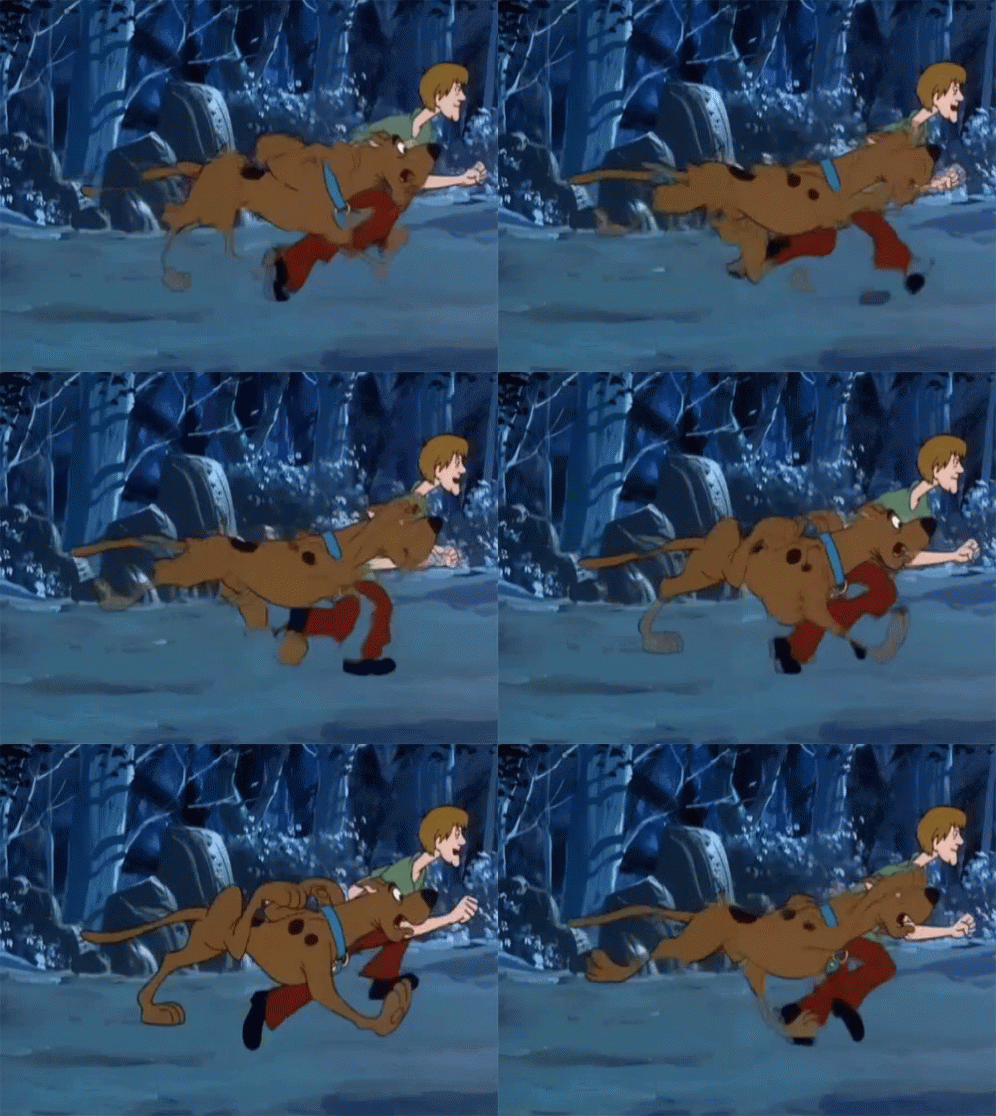
Fig. 11.2 A cartoon example of motion without useful traction. The feet move rapidly, but the body does not immediately move forward because the contact with the ground is slipping rather than rolling without slipping. Image Credit: tenor.com.#
To analyze rolling without slipping, we relate the linear variables of velocity and acceleration (of the center-of-mass) of the wheel in terms of the angular variables that describe the wheel’s motion (see Fig. 11.3).
Fig. 11.3 A rolling wheel can be analyzed by separating the motion of the center of mass from the rotation about the center of mass. When rolling occurs without slipping, the contact point is momentarily at rest relative to the ground. Image Credit: OpenStax: Rolling Motion.#
Figure 11.3a shows the force vectors involved that prevent the wheel from slipping. The wheel is in contact with the surface at point \(P\), which remains at rest relative to the surface in Fig. 11.3b. Relative to the center-of-mass, point \(P\) has a velocity \(-R\omega\hat{i}\), where \(R\) is the radius of the wheel and \(\omega\) is the wheel’s angular velocity about its axis.
Since the wheel is rolling, the total velocity of \(P\) is given by
which includes both the center-of-mass velocity for the wheel and the relative velocity of point \(P\) relative to the center-of-mass. If the wheel is rolling without slipping, then \(|\vec{\rm v}_P| = v_P = 0\) (i.e., the velocity of \(P\) relative to the surface is zero), and we have
The velocity of the wheel’s center of mass is its radius times the angular velocity about its axis. Now we have a correspondence of the linear variable (\(v_{\rm CoM}\)) to the angular variable (\(R\omega\)). This uses the same vector-component reasoning introduced in Chapter 4, but now the linear motion is tied to rotation through the radius of the wheel.
If we take a time-derivative to find the rate of change for the center-of-mass velocity \(a_{\rm CoM}\), we have
Since \(R\) is a constant, then \(\frac{dR}{dt} = 0\).
Fig. 11.4 As a wheel rolls without slipping from \(A\) to \(B\), the center of mass moves the same distance as the arc length that unwraps from the rim. Image Credit: OpenStax: Rolling Motion.#
We can also find the distance the wheel travels in terms of the angular variables. In Figure 11.4, the wheel rolls from point \(A\) to point \(B\), but its outer surface maps onto the ground by exactly the distance traveled \(d_{\rm CoM}\). The outer surface that maps onto the ground is the arclength \(R\theta\), or
11.1.1.1. Example Problem: Rolling Down an Inclined Plane#
Exercise 11.1
The Problem
A solid cylinder rolls down an inclined plane without slipping, starting from rest. It has mass \(m\) and radius \(r\).
(a) What is its acceleration?
(b) What condition must the coefficient of static friction \(\mu_s\) satisfy so the cylinder does not slip?
Fig. 11.5 A solid cylinder rolls down an incline without slipping. Gravity, the normal force, and static friction act on the cylinder, with friction supplying the torque that makes the cylinder rotate. Image Credit: OpenStax: Rolling Motion.#
Show worked solution
The Model
The cylinder rolls down an inclined plane while maintaining the rolling-without-slipping constraint. The motion therefore involves both translational motion of the center of mass and rotational motion about the center of mass. The physical framework required to describe the motion is Newton’s 2nd law for translation together with Newton’s 2nd law for rotation.
A coordinate system is chosen so that the \(x\)-axis lies along the plane and points down the incline, while the \(y\)-axis is perpendicular to the plane and points away from the surface. With this coordinate choice, the component of gravity parallel to the incline points in the positive \(x\)-direction, while the normal force points in the positive \(y\)-direction.
The forces acting on the cylinder are the gravitational force \(\vec{W}\), the normal force \(\vec{N}\) exerted by the surface, and the static friction force \(\vec{f}_s\). The gravitational force acts vertically downward, the normal force acts perpendicular to the surface, and the static friction force acts along the plane. Because the cylinder rolls without slipping, the friction force acts up the incline and provides the torque required to produce rotational motion.
The rolling constraint ties the translational acceleration of the center of mass to the angular acceleration through the cylinder radius. The strategy is therefore to apply Newton’s 2nd law along the incline to determine the translational acceleration and then apply the rotational equation about the center of mass to relate the friction force to the angular acceleration.
The Math
The motion of the cylinder is governed by Newton’s 2nd law applied along and perpendicular to the inclined plane. Along the incline, the component of gravity acts downward while the static friction force acts upward. Applying Newton’s 2nd law along the \(x\)-direction gives
Perpendicular to the plane, the normal force balances the perpendicular component of gravity. Newton’s 2nd law in the \(y\)-direction therefore gives
The rotational motion of the cylinder is governed by Newton’s 2nd law for rotation about the center of mass. The only force producing a torque about the center of mass is the friction force. The rotational equation therefore gives
Because the cylinder rolls without slipping, the translational and rotational accelerations are related by the rolling constraint. The linear acceleration of the center of mass is therefore related to the angular acceleration by
Solving the rotational equation for the friction force and using the rolling constraint gives
Replacing the friction force in the translational equation with this rotational expression gives
Solving this equation for the acceleration of the center of mass gives
For a solid cylinder, the moment of inertia about the center of mass is
Substituting this expression into the acceleration formula gives
This result determines the translational acceleration of the cylinder.
To determine the condition for rolling without slipping, we first determine the friction force required to maintain the rolling motion. Using the rotational relation and the expression for the acceleration gives
Rolling without slipping requires that the magnitude of the friction force not exceed the maximum static friction force. The condition for rolling is therefore
Substituting the expression for the normal force \(N = mg\cos\theta\) gives
Solving this inequality for \(\mu_s\) gives
For a solid cylinder, \(I_{\rm CoM} = \tfrac{1}{2}mr^2\), which gives
The Conclusion
The acceleration of a solid cylinder rolling down an incline without slipping is
This result shows that the acceleration depends only on the gravitational acceleration and the incline angle and is independent of the coefficient of static friction, provided sufficient friction exists to maintain rolling.
The condition required to prevent slipping is
This result indicates that steeper inclines require a larger coefficient of static friction to maintain rolling without slipping.
The Verification
The analytical solution predicts that the acceleration of the cylinder depends only on the incline angle and gravitational acceleration once the moment of inertia of a solid cylinder is included. The computation below evaluates the acceleration and friction force directly from the derived expressions.
The numerical calculation confirms that the analytical formulas reproduce the predicted acceleration and the minimum coefficient of static friction required for rolling without slipping.
import numpy as np
import matplotlib.pyplot as plt

# Parameters
g = 9.81 # gravitational acceleration (m/s^2)
theta = np.deg2rad(30) # incline angle in radians
m = 2.0 # mass of cylinder (kg)
r = 0.25 # radius of cylinder (m)

# Moment of inertia for a solid cylinder
I = 0.5 * m * r**2

# (a) Acceleration of the center of mass
a_cm = (m * g * np.sin(theta)) / (m + I / r**2)

# (b) Required static friction coefficient
mu_required = (1/3) * np.tan(theta)

print(f"The acceleration of the cylinder is {a_cm:.2f} m/s^2.")
print(f"The minimum coefficient of static friction required for rolling without slipping is {mu_required:.3f}.")

fig = plt.figure(figsize=(5,4), dpi=120)
ax = fig.add_subplot(111)

x = np.linspace(0, 1, 100)
y = np.tan(theta) * x

ax.plot(x, y)
ax.set_xticks([])
ax.set_yticks([])

plt.tight_layout()
plt.show()
11.1.2. Rolling Motion with Slipping#
In the case of rolling motion with slipping, we must use the coefficient of kinetic friction. In this case, \(\vec{\rm v}_P\) is not at rest and therefore, \(v_{\rm CoM}-R\omega \neq 0\). As a result, \(v_{\rm CoM} \neq R\omega\) and \(a_{\rm CoM} \neq R\alpha\).
Note
The previous relations applied only because there was a mapping from the rotational motion to the translational motion. In the case of slipping, there is no translational motion to map onto.
Fig. 11.6 When the contact point slides relative to the surface, the wheel’s translation and rotation are no longer locked together by the rolling-without-slipping constraint. Image Credit: OpenStax: Rolling Motion.#
11.1.2.1. Example Problem: Rolling Down an Inclined Plane with Slipping#
Exercise 11.2
The Problem
A solid cylinder rolls down an inclined plane from rest and undergoes slipping. It has mass \(m\) and radius \(r\).
(a) What is its linear acceleration?
(b) What is its angular acceleration about an axis through the center of mass?
Fig. 11.7 For a cylinder that slips while moving down an incline, kinetic friction acts opposite the slipping motion and provides the torque that changes the cylinder’s angular speed. Image Credit: OpenStax: Rolling Motion.#
Show worked solution
The Model
The cylinder moves down an inclined plane while slipping, so the rolling-without-slipping constraint does not apply. The motion therefore consists of translational motion of the center of mass together with rotational motion about the center of mass, but these two motions are not linked by the usual rolling constraint. The physical framework required to describe the motion is Newton’s 2nd law for translation together with Newton’s 2nd law for rotation.
A coordinate system is chosen so that the \(x\)-axis lies along the plane and points down the incline, while the \(y\)-axis is perpendicular to the plane and points away from the surface. With this coordinate choice, the component of gravity parallel to the incline points in the positive \(x\)-direction, while the normal force points in the positive \(y\)-direction.
The forces acting on the cylinder are the gravitational force \(\vec{W}\), the normal force \(\vec{N}\) exerted by the surface, and the kinetic friction force \(\vec{f}_k\). The gravitational force acts vertically downward, the normal force acts perpendicular to the plane, and the kinetic friction force acts up the incline because the cylinder slips relative to the surface while moving downward.
The strategy is to apply Newton’s 2nd law along the incline to determine the linear acceleration of the center of mass and then apply Newton’s 2nd law for rotation about the center of mass to determine the angular acceleration produced by the kinetic friction force.
The Math
The translational motion of the cylinder is governed by Newton’s 2nd law applied along and perpendicular to the inclined plane. This is the same free-body-diagram and force-balance logic used in Chapter 5, but the force now also determines a torque. Along the incline, the component of gravity acts downward while the kinetic friction force acts upward. Applying Newton’s 2nd law along the \(x\)-direction gives
Perpendicular to the plane, the normal force balances the perpendicular component of gravity. Newton’s 2nd law in the \(y\)-direction therefore gives
Because the cylinder is slipping, the friction force is kinetic friction. The kinetic friction force follows from the normal force found from the perpendicular force balance:
Replacing the kinetic friction force in the translational equation gives
Solving this equation for the linear acceleration gives
This result determines the linear acceleration of the center of mass.
The rotational motion of the cylinder is governed by Newton’s 2nd law for rotation about the center of mass. The only force producing a torque about the center of mass is the kinetic friction force. The rotational equation therefore gives
For a solid cylinder, the moment of inertia about the center of mass is
Substituting this expression for the moment of inertia into the rotational equation gives
We solve this expression for the angular acceleration, which gives
Substituting \(f_k = \mu_k mg\cos\theta\) into this expression gives
The Conclusion
The linear acceleration of the cylinder while it slips down the incline is
This result is the same as the acceleration of an object sliding down an incline with kinetic friction because the translational motion depends only on the net force along the plane.
The angular acceleration of the cylinder about its center of mass is
This result shows that the angular acceleration is produced entirely by the kinetic friction force, so it depends on \(\mu_k\), the incline angle, and the cylinder radius.
The Verification
The analytical solution predicts that the linear acceleration comes from the net force along the incline, while the angular acceleration comes from the torque due to kinetic friction about the center of mass. The computation below evaluates both expressions directly for a representative set of parameter values.
The numerical calculation confirms that the analytical formulas reproduce the expected linear and angular accelerations for a slipping solid cylinder on an incline.
import numpy as np
import matplotlib.pyplot as plt

# Parameters
g = 9.81 # gravitational acceleration (m/s^2)
theta = np.deg2rad(30) # incline angle in radians
mu_k = 0.20 # coefficient of kinetic friction
m = 2.0 # mass of cylinder (kg)
r = 0.25 # radius of cylinder (m)

# (a) Linear acceleration of the center of mass
a_com = g * (np.sin(theta) - mu_k * np.cos(theta))

# (b) Angular acceleration about the center of mass
alpha = (2 * mu_k * g * np.cos(theta)) / r

print(f"The linear acceleration of the cylinder is {a_com:.2f} m/s^2.")
print(f"The angular acceleration of the cylinder is {alpha:.2f} rad/s^2.")

fig = plt.figure(figsize=(5,4), dpi=120)
ax = fig.add_subplot(111)

x = np.linspace(0, 1, 100)
y = np.tan(theta) * x

ax.plot(x, y)
ax.set_xticks([])
ax.set_yticks([])

plt.tight_layout()
plt.show()
11.1.3. Conservation of Mechanical Energy in Rolling Motion#
Any rolling object carries rotational kinetic energy, translational kinetic energy, and potential energy as the system requires. If we include the gravitational potential energy, the total mechanical energy of an object rolling is
In the absence of any nonconservative forces, the total energy of a rolling object without slipping is conserved and is constant throughout the motion. In contrast, the energy is not conserved when there is a rolling object that is slipping which produces heat as a result of kinetic friction, and a rolling object encountering air resistance.
Why does a rolling object without slipping conserve energy when the static frictional force is nonconservative?
From Fig. 11.3, point \(P\) is in contact with the surface at rest with respect to the surface. Therefore, its infinitesimal displacement \(d\vec{r}\) with respect to the surface is zero, and the incremental work done by the static friction is zero.
Checkpoint
If the contact point of a rolling wheel is instantaneously at rest, why can static friction be present without doing work on that point?
11.1.3.1. Example Problem: Curiosity Rover#
Exercise 11.3
The Problem
The Curiosity rover was deployed on Mars on August 6, 2012. The wheels of the rover have a radius of \(25\ {\rm cm}\). Suppose astronauts arrive on Mars in the year \(2050\) and find the now-inoperative Curiosity on the side of a basin. While they are dismantling the rover, an astronaut accidentally loses a grip on one of the wheels, which rolls without slipping down into the bottom of the basin \(25\ {\rm m}\) below. If the wheel has a mass of \(5\ {\rm kg}\), what is its velocity at the bottom of the basin?
Show worked solution
The Model
The wheel rolls down into the basin without slipping, so its motion includes both translational motion of the center of mass and rotational motion about the center of mass. Because the problem asks for the speed at the bottom after a vertical drop, the appropriate physical framework is conservation of mechanical energy. The wheel starts from rest at the top, so its initial energy is entirely gravitational potential energy. At the bottom, that potential energy has been converted into translational kinetic energy and rotational kinetic energy.
The wheel is modeled as a hollow cylinder, which is a reasonable approximation for the rover wheel. Since the wheel rolls without slipping, the translational and rotational variables are tied together by the rolling constraint.
The strategy is to apply conservation of mechanical energy between the top and bottom of the basin, use the hollow-cylinder moment of inertia, apply the rolling constraint to eliminate the angular speed, and then solve for the linear speed at the bottom.
The Math
Because only conservative work is included in the model, the mechanical energy of the wheel is conserved as it rolls into the basin. The initial gravitational potential energy therefore equals the final translational plus rotational kinetic energy, which gives
The wheel is modeled as a hollow cylinder, so its moment of inertia about the center of mass is
Because the wheel rolls without slipping, the linear speed and angular speed are related by the rolling constraint
We solve this relation for the angular speed so that it can be substituted into the energy equation, which gives
The energy equation becomes simpler when the hollow-cylinder moment of inertia and rolling constraint are used:
Combining the two kinetic-energy terms gives
We divide both sides by \(m\) to eliminate the mass, which gives
We now solve this expression for the speed at the bottom of the basin, which gives
For Mars, the gravitational acceleration is \(g = 3.71\ {\rm m/s^2}\), and the vertical drop is \(h = 25\ {\rm m}\). Substituting these values into the expression for the speed gives
The Conclusion
The speed of the rover wheel at the bottom of the basin is
This result follows from conservation of mechanical energy with the wheel modeled as a hollow cylinder rolling without slipping. Because part of the gravitational potential energy becomes rotational kinetic energy, the wheel reaches the bottom with a smaller speed than a point mass or sliding object would have after the same vertical drop.
The Verification
The analytical solution predicts that the wheel’s gravitational potential energy is converted into both translational and rotational kinetic energy as it rolls downward. The computation below evaluates the speed using the same energy relation and the hollow-cylinder moment of inertia used in the analytical derivation.
The numerical calculation confirms that the energy-conservation model reproduces the analytical result for the speed of the wheel at the bottom of the basin.
import numpy as np
import matplotlib.pyplot as plt

# Parameters
g_mars = 3.71 # Mars gravitational acceleration (m/s^2)
h = 25.0 # Vertical drop into the basin (m)
m = 5.0 # Mass of the wheel (kg)
r = 0.25 # Radius of the wheel (m)

# Moment of inertia for a hollow cylinder
I = m * r**2 # Moment of inertia about the center of mass (kg m^2)

# Speed at the bottom from energy conservation
v_com = np.sqrt(g_mars * h) # Linear speed of the center of mass (m/s)

# Angular speed from the rolling constraint
omega = v_com / r # Angular speed (rad/s)

print(f"The speed of the wheel at the bottom of the basin is {v_com:.2f} m/s.")
print(f"The corresponding angular speed of the wheel is {omega:.2f} rad/s.")

fig = plt.figure(figsize=(5,4), dpi=120)
ax = fig.add_subplot(111)

y = np.linspace(0, h, 200)
potential = m * g_mars * (h - y)

ax.plot(potential, y)
ax.set_xlabel(r"$U\ ({\rm J})$")
ax.set_ylabel(r"$y\ ({\rm m})$")

plt.tight_layout()
plt.show()
11.2. Angular Momentum#
There are many questions that we can ask about why objects spin or how they can change their spin, such as
Why does the Earth keep spinning?
What started it spinning to begin with?
Why doesn’t the Earth’s gravity cause the Moon to crash towards the Earth?
How does an ice skater manage to spin faster simply by pulling her arms in? Why does she not have to exert a torque to spin faster?
Questions like these are answered by angular momentum, which is the rotational analog to linear momentum.
11.2.1. Angular Momentum of a Single Particle#
Figure 11.8 illustrates how we can define the coordinate system for a particle moving in the \(xy\)-plane with a linear momentum \(\vec{p}\). The particle is located within the \(xy\)-plane using the vector \(\vec{r}\) relative to the origin.
Fig. 11.8 A particle’s angular momentum about the origin depends on both its position vector and its linear momentum. The cross product points perpendicular to the plane formed by those two vectors. Image Credit: OpenStax: Angular Momentum.#
Angular Momentum of a Particle
The angular momentum \(\vec{L}\) of a particle is defined as the cross-product of \(\vec{r}\) and \(\vec{p}\), or
Recall the property of a cross product produces a vector that is perpendicular to the plane containing the two vectors. Also the positive vector points upward relative to the plane and counterclockwise denotes a positive direction so that we can use the right-hand rule.
Warning
For a cross product, the order matters. The cross-product of \(\vec{p}\) and \(\vec{r}\) produces a vector that points downward (negative \(z\)-direction), or
Even if the particle is not rotating about the origin, we can still define the angular momentum in terms of the position vector and the linear momentum.
The magnitude of the angular momentum is found from the definition of the cross product, or
where \(\theta\) is the angle between \(\vec{r}\) and \(\vec{p}\). The units of angular momentum are \(\rm kg\cdot m^2\).
As with the definition of torque, we define a lever arm \(r_\perp\) that is the perpendicular distance from the momentum vector \(\vec{p}\) to the origin (\(r_\perp = r\sin{\theta}\)). With this definition, the magnitude of the angular momentum becomes
If the direction of \(\vec{p}\) passes through the origin, then \(\sin{\theta} = 0\) (i.e., \(\vec{r}\) and \(\vec{p}\) are parallel or antiparallel) and the angular momentum is zero because the lever arm is zero.
The magnitude of the angular momentum depends on the choice of origin.
Checkpoint
If a particle’s momentum points directly toward or directly away from the chosen origin, what happens to its lever arm?
As you watch, focus on why an object moving in a straight line can still have angular momentum about a chosen origin. The key question is whether the line of motion has a nonzero lever arm relative to that origin.
If we take the time-derivative of the angular momentum, we arrive at the net torque on the particle:
We used the vector property that \(\vec{a} \times \vec{a} = 0\), and the alternative form of Newton’s 2nd law. Therefore, we can write the definition of the net torque as:
Problem-Solving Strategy
Angular Momentum of a Particle
Define the coordinate system for the angular momentum.
Write down the radius and linear momentum vector of the particle in unit vector notation.
Take the cross product \(\vec{L} = \vec{r} \times \vec{p}\) and use the right-hand rule to establish the direction of the angular momentum vector.
See if there is any time dependence in the expression of the angular momentum vector.
Use \(\frac{d\vec{L}}{dt} = \displaystyle \sum_j \vec{\tau}_j\) calculate the net torque from the time-varying angular momentum.
If there is no time dependence, then \(\tau_{\rm net} = 0\).
11.2.1.1. Example Problem: Angular Momentum and Torque on a Meteor#
Exercise 11.4
The Problem
A meteor enters Earth’s atmosphere (see Fig. 11.9) and is observed by someone on the ground before it burns up in the atmosphere. The vector \(\vec{r} = 25\ {\rm km}\,\hat{i} + 25\ {\rm km}\,\hat{j}\) gives the position of the meteor with respect to the observer. At the instant the observer sees the meteor, it has linear momentum \(\vec{p} = 15\ {\rm kg}(-2.0\ {\rm km/s}\,\hat{j})\), and it is accelerating at a constant \(2.0\ {\rm m/s^2}(-\hat{j})\) along its path, which for our purposes can be taken as a straight line.
(a) What is the angular momentum of the meteor about the origin, which is at the location of the observer?
(b) What is the torque on the meteor about the origin?
Fig. 11.9 The meteor’s position vector points from the observer to the meteor, while its linear momentum points downward. Their cross product determines the angular momentum about the observer. Image Credit: OpenStax: Angular Momentum.#
Show worked solution
The Model
The meteor is treated as a particle moving in the \(xy\)-plane, where the origin is located at the observer. The angular momentum of a particle about a chosen origin is determined from the cross product of its position vector and its linear momentum, and the torque about that same origin is determined from the cross product of the position vector with the net force.
The coordinate system is defined so that \(\hat{i}\) points horizontally and \(\hat{j}\) points vertically upward. The given position vector has both \(x\)- and \(y\)-components, while the meteor’s momentum and acceleration are purely in the negative \(y\)-direction. Because the position and momentum vectors lie in the \(xy\)-plane, the angular momentum must point along the \(z\)-axis. The same is true for the torque because the force is also confined to the \(xy\)-plane.
The strategy is to compute the angular momentum directly from the position and momentum vectors using component form. We then compute the torque from the position vector and the net force, where the net force is found from Newton’s 2nd law.
The Math
The angular momentum of a particle about the origin is given by the cross product of its position vector and its linear momentum. Using the given vectors, we write
Before carrying out the cross product, we convert the given quantities into SI units. The position vector becomes
and the linear momentum becomes
Substituting these expressions into the cross product gives
The second term is zero because \(\hat{j}\times\hat{j}=0\), so the angular momentum reduces to
This result gives the angular momentum of the meteor about the observer.
The torque on the meteor about the origin is the cross product of the position vector with the net force. We first determine the net force from Newton’s 2nd law. The meteor’s acceleration is
Multiplying by the mass gives the net force,
The torque about the origin is therefore
and through substitution, we find that
Again, the second term is zero because \(\hat{j}\times\hat{j}=0\), so the torque becomes
The Conclusion
The angular momentum of the meteor about the observer is
The negative \(\hat{k}\) direction means the angular momentum points into the page when the motion is viewed in the standard \(xy\)-plane.
The torque on the meteor about the observer is
This torque has the same direction as the angular momentum change, which is consistent with the meteor accelerating downward while its line of motion remains offset from the observer.
The Verification
The analytical solution uses the vector definitions \(\vec{L} = \vec{r}\times\vec{p}\) and \(\sum \vec{\tau} = \vec{r}\times\vec{F}\) with \(\vec{F} = m\vec{a}\). The computation below evaluates these same cross products directly in component form using SI units.
The numerical calculation confirms that the cross-product method reproduces the analytical values and shows that both the angular momentum and torque point in the negative \(\hat{k}\) direction.
import numpy as np
import matplotlib.pyplot as plt


r_vec = np.array([2.5e4, 2.5e4, 0.0]) # Position vector of the meteor relative to the observer (m)
m = 15.0 # Mass of the meteor (kg)

# Velocity vector inferred from the given momentum statement (m/s)
v_vec = np.array([0.0, -2.0e3, 0.0])
p_vec = m * v_vec # Linear momentum vector of the meteor (kg m/s)
a_vec = np.array([0.0, -2.0, 0.0]) # Acceleration vector of the meteor (m/s^2)
F_vec = m * a_vec # Net force vector on the meteor (N)

# Angular momentum about the observer (kg m^2/s)
L_vec = np.cross(r_vec, p_vec)

# Torque about the observer (N m)
tau_vec = np.cross(r_vec, F_vec)

print(f"The angular momentum of the meteor is {L_vec[2]:.2e} kg·m^2/s in the k-direction.")
print(f"The torque on the meteor is {tau_vec[2]:.2e} N·m in the k-direction.")

fig = plt.figure(figsize=(5,4), dpi=120)
ax = fig.add_subplot(111)

# Plot the observer and meteor position in the xy-plane
ax.plot([0, r_vec[0]], [0, r_vec[1]], linewidth=2)
ax.annotate("", xy=(r_vec[0], r_vec[1]), xytext=(0, 0), arrowprops=dict(arrowstyle="->", lw=2))
ax.annotate("", xy=(r_vec[0], r_vec[1] - 8e3), xytext=(r_vec[0], r_vec[1]), arrowprops=dict(arrowstyle="->", lw=2))

ax.set_xlabel(r"$x\ ({\rm m})$")
ax.set_ylabel(r"$y\ ({\rm m})$")
ax.set_aspect("equal")
plt.tight_layout()
plt.show()
11.2.2. Angular Momentum of a System of Particles#
The angular momentum of a system of particles is important for many scientific disciplines, especially for those considering a spinning disk composed of individual particles (e.g., astronomy).
Consider a spiral galaxy, where the individual stars can be treated as point particles and each particle has its own angular momentum. The vector sum of the individual angular momenta gives the total angular momentum of the galaxy.
If we have a system of \(N\) particles, then each particle will have its own position vector \(\vec{r}_j\) and momentum \(\vec{p}_j\) relative to the origin. The total angular momentum of the system of particles is the vector sum of the individual angular momenta, or
If particle \(j\) is subject to a net torque \(\vec{\tau}_j\) about the origin, then we can find the net torque due to the system of particles by differentiating with respect to time, or
The rate of change of the total angular momentum of a system is equal to the net external torque acting on the system when both quantities are measured with respect to a given origin. Mathematically, this is given as
11.2.2.1. Example Problem: Angular Momentum of 3 Particles#
Exercise 11.5
The Problem
Referring to Figure 11.10, (a) determine the total angular momentum due to the three particles about the origin. (b) What is the rate of change of the angular momentum?
Fig. 11.10 Three particles have different positions, velocities, and applied forces in the \(xy\)-plane. The system’s total angular momentum and net torque are found by adding the individual vector contributions. Image Credit: OpenStax: Angular Momentum.#
Show worked solution
The Model
The system consists of three particles moving in the \(xy\)-plane, each with a specified position, mass, velocity, and applied force. The total angular momentum of the system about the origin is the vector sum of the angular momenta of the individual particles. The rate of change of the total angular momentum is equal to the net external torque about the origin, which is the vector sum of the torques due to the applied forces.
The coordinate system is the standard Cartesian system shown in the figure, with \(\hat{i}\) along the \(x\)-axis and \(\hat{j}\) along the \(y\)-axis. Since all position, momentum, and force vectors lie in the \(xy\)-plane, every angular momentum and torque vector must point along the \(z\)-axis. The sign of each contribution is determined by the right-hand rule applied to the relevant cross product.
The strategy is to write the position and momentum vectors for each particle, compute the three angular momenta about the origin, and add them to obtain the total angular momentum. We then compute the torque on each particle from its position vector and applied force and add those torques to determine the rate of change of the total angular momentum.
The Math
The total angular momentum of the system is the vector sum of the angular momenta of the three particles. For each particle, the angular momentum about the origin is given by
We begin by writing the position and momentum vectors for particle 1. From the figure, the position vector is
and the momentum vector is
Substituting these vectors into the cross product gives
For particle 2, the position vector is
and the momentum vector is
Substituting these vectors into the cross product gives
For particle 3, the position vector is
and the momentum vector is
Substituting these vectors into the cross product gives
The total angular momentum is the sum of these three contributions. Adding the individual angular momenta gives
The rate of change of angular momentum is equal to the net torque about the origin. For each particle, the torque is given by
For particle 1, the applied force is
Substituting \(\vec{r}_1\) and \(\vec{F}_1\) into the torque expression gives
For particle 2, the applied force is
Substituting \(\vec{r}_2\) and \(\vec{F}_2\) into the torque expression gives
For particle 3, the applied force is
Substituting \(\vec{r}_3\) and \(\vec{F}_3\) into the torque expression gives
The net torque is the sum of the three torque contributions. Adding them gives
Since the net torque equals the rate of change of angular momentum, we have
The Conclusion
The total angular momentum of the three-particle system about the origin is
The negative \(\hat{k}\) direction means the total angular momentum points into the page.
The rate of change of the angular momentum is
This result is equal to the net external torque about the origin, which points out of the page in the positive \(\hat{k}\) direction.
The Verification
The analytical solution computes the angular momentum and torque of each particle separately and then adds the vector contributions. The computation below reproduces that same method using NumPy cross products for the three position, momentum, and force vectors.
The numerical calculation confirms that the individual contributions combine to give the same total angular momentum and net torque obtained analytically.
import numpy as np
import matplotlib.pyplot as plt

# Position vectors of the three particles (m)
r1 = np.array([-2.0,  1.0, 0.0])
r2 = np.array([ 4.0,  1.0, 0.0])
r3 = np.array([ 2.0, -2.0, 0.0])

# Momentum vectors of the three particles (kg m/s)
p1 = np.array([0.0, 8.0, 0.0])
p2 = np.array([20.0, 0.0, 0.0])
p3 = np.array([3.0, 0.0, 0.0])

# Force vectors on the three particles (N)
F1 = np.array([-6.0,  0.0, 0.0])
F2 = np.array([ 0.0, 10.0, 0.0])
F3 = np.array([ 0.0, -8.0, 0.0])

# Angular momentum vectors about the origin (kg m^2/s)
L1 = np.cross(r1, p1)
L2 = np.cross(r2, p2)
L3 = np.cross(r3, p3)
L_total = L1 + L2 + L3

# Torque vectors about the origin (N m)
tau1 = np.cross(r1, F1)
tau2 = np.cross(r2, F2)
tau3 = np.cross(r3, F3)
tau_total = tau1 + tau2 + tau3

print(f"The total angular momentum of the three particles is {L_total[2]:.1f} kg·m^2/s in the k-direction.")
print(f"The rate of change of the angular momentum is {tau_total[2]:.1f} N·m in the k-direction.")

fig = plt.figure(figsize=(5,4), dpi=120)
ax = fig.add_subplot(111)

# Plot particle locations
ax.plot(r1[0], r1[1], 'o')
ax.plot(r2[0], r2[1], 'o')
ax.plot(r3[0], r3[1], 'o')

# Plot position vectors from the origin
ax.annotate("", xy=(r1[0], r1[1]), xytext=(0, 0), arrowprops=dict(arrowstyle="->", lw=1.5))
ax.annotate("", xy=(r2[0], r2[1]), xytext=(0, 0), arrowprops=dict(arrowstyle="->", lw=1.5))
ax.annotate("", xy=(r3[0], r3[1]), xytext=(0, 0), arrowprops=dict(arrowstyle="->", lw=1.5))

ax.set_xlabel(r"$x\ ({\rm m})$")
ax.set_ylabel(r"$y\ ({\rm m})$")
ax.set_aspect("equal")
plt.tight_layout()
plt.show()
11.2.3. Angular Momentum of a Rigid Body#
Celestial objects (e.g., planets) have angular momentum due to their spin and orbits around stars. In engineering, anything that rotates about an axis carries angular momentum (e.g., flywheels, propellers, and rotating parts in engines).
To develop the angular momentum of a rigid body, we model a rigid body as composed of many small mass segments \(\Delta m_i\). In Figure 11.11, a rigid body is constrained to rotate about the \(z\)-axis with an angular velocity \(\omega\), where all the mass segments that make up the rigid body undergo circular motion with the same angular velocity.
Fig. 11.11 A rigid body rotating about the \(z\)-axis can be treated as many small mass elements. Each element contributes angular momentum, and the sum gives the angular momentum of the rigid body. Image Credit: OpenStax: Angular Momentum.#
Figure 11.11a shows a mass segment \(\Delta m_i\) with a position vector \(\vec{r}_i\) from the origin, and a radius \(R_i\) to the \(z\)-axis. The magnitude of its tangential velocity is \(v_i = R_i\omega\) because it is undergoing circular motion. Since \(\vec{\rm v}_i\) is perpendicular to \(\vec{r}_i\), the magnitude of the angular momentum of this mass segment is
The angular momentum vector \(\vec{L}_i\) points in a direction perpendicular to the \(rv\)-plane towards the \(z\)-axis, which we can find using the right-hand rule.
The sum of the angular momenta of all the mass segments contains components both along and perpendicular to the axis of rotation. However, due to cylindrical symmetry, every mass segment has a perpendicular component of the angular momentum that will be cancelled by an identical mass segment that is on the opposite side of the body.
The component along the axis of rotation \(\left(\vec{L}_i\right)_z\) is the only component that gives a nonzero value when summed over all the mass segments. This component is given by
The net angular momentum of the rigid body along the axis of rotation is
The summation \(\displaystyle \sum_i \Delta m_i R_i^2\) is simply the moment of inertia \(I\) of the rigid body about the axis of rotation. The magnitude of the angular momentum along the axis of the rotation of a rigid body that rotates with an angular velocity \(\omega\) is
The direction of the angular momentum vector is directed along the axis of rotation given by the right-hand rule.
Note
Recall that the magnitude of the linear momentum is \(p = mv.\) The form of the equation has a source of inertia times a velocity. The form of the equation for a rigid rotator is \(L = I\omega\), which also has a source of inertia times a velocity.
11.2.3.1. Example Problem: Angular Momentum of a Robot Arm#
Exercise 11.6
The Problem
A robot arm on a Mars rover like Curiosity shown in Figure 11.12 is \(1.0\ {\rm m}\) long and has forceps at the free end to pick up rocks. The mass of the arm is \(2.0\ {\rm kg}\) and the mass of the forceps is \(1.0\ {\rm kg}\). See Figure 11.13. The robot arm and forceps move from rest to \(\omega = 0.1\pi\ {\rm rad/s}\) in \(0.1\ {\rm s}\). It rotates down and picks up a Mars rock that has mass \(1.5\ {\rm kg}\). The axis of rotation is the point where the robot arm connects to the rover.
(a) What is the angular momentum of the robot arm by itself about the axis of rotation after \(0.1\ {\rm s}\) when the arm has stopped accelerating?
(b) What is the angular momentum of the robot arm when it has the Mars rock in its forceps and is rotating upwards?
(c) When the arm does not have a rock in the forceps, what is the torque about the point where the arm connects to the rover when it is accelerating from rest to its final angular velocity?
Fig. 11.12 A rover arm rotates about the joint where it attaches to the rover. The arm can be modeled as a rod, while the forceps and rock can be modeled as point masses near the end of the arm. Image Credit: OpenStax: Angular Momentum.#
Show worked solution
The Model
The robot arm rotates about a fixed axis at the point where it connects to the rover. The angular momentum of a rigid system about that axis depends on the total moment of inertia and the angular speed. The torque during the speeding-up phase is determined from Newton’s 2nd law for rotation.
The arm is modeled as a uniform solid rod rotating about one end. The forceps and the Mars rock are each modeled as point masses located at the free end of the arm. The total moment of inertia is therefore the sum of the contributions from the arm, the forceps, and, when present, the Mars rock.
The direction of the angular momentum is determined by the right-hand rule. When the arm rotates downward as shown, the angular momentum points out of the page in the positive \(\hat{k}\) direction. When the arm rotates upward after picking up the rock, the angular momentum points into the page in the negative \(\hat{k}\) direction.
The strategy is to compute the total moment of inertia for each configuration, multiply by the given angular speed to obtain the angular momentum, and then use the angular acceleration during the startup interval to determine the torque.
The Math
The angular momentum of a rotating system about a fixed axis is given by \( L = I\omega. \)
We first determine the individual moments of inertia about the pivot point. The robot arm is modeled as a uniform rod rotating about one end, so its moment of inertia is
The forceps are modeled as a point mass located at the free end of the arm, so their moment of inertia is
The Mars rock is also modeled as a point mass located at the free end, so its moment of inertia is
(a) When the arm is rotating without the Mars rock, the total moment of inertia is the sum of the arm and forceps contributions. This gives
After \(0.1\ {\rm s}\), the angular speed is \(\omega = 0.1\pi\ {\rm rad/s}\). Substituting this angular speed into \(L = I\omega\) gives
The arm is rotating downward, so the right-hand rule gives the angular momentum direction as positive \(\hat{k}\). This direction statement gives the angular momentum vector,
(b) When the arm is holding the Mars rock, the total moment of inertia must include the arm, the forceps, and the rock. This gives
Using the same angular speed, the angular momentum becomes
The arm is now rotating upward, so the right-hand rule gives the angular momentum direction as negative \(\hat{k}\). This direction statement gives the angular momentum vector,
(c) When the arm does not have the Mars rock, the torque during the speeding-up interval is determined from Newton’s 2nd law for rotation,
The angular acceleration is the change in angular speed divided by the time interval. Since the arm starts from rest and reaches \(0.1\pi\ {\rm rad/s}\) in \(0.1\ {\rm s}\), the angular acceleration is
The relevant moment of inertia is the one from part (a), since the rock is not present. Substituting \(I = 1.67\ {\rm kg\cdot m^2}\) and \(\alpha = \pi\ {\rm rad/s^2}\) into the rotational equation gives
The Conclusion
When the robot arm rotates downward without the Mars rock, its angular momentum is
When the robot arm rotates upward while holding the Mars rock, its angular momentum is
The larger magnitude in part (b) occurs because the Mars rock increases the total moment of inertia while the angular speed remains the same.
When the arm accelerates from rest to its final angular speed without the Mars rock, the torque about the pivot is
This torque is positive in the sense of the downward rotation used in part (a).
The Verification
The analytical solution computes the total moment of inertia for each configuration and then uses \(L = I\omega\) and \(\sum \tau = I\alpha\) to determine the angular momentum and torque. The computation below follows that same sequence using the rod and point-mass approximations described in the model.
The numerical calculation confirms that the angular momentum increases when the Mars rock is included and that the torque during the acceleration interval matches the analytical result.
import numpy as np
import matplotlib.pyplot as plt

# Given parameters
r = 1.0 # Length of the robot arm (m)
m_arm = 2.0 # Mass of the robot arm (kg)
m_forceps = 1.0 # Mass of the forceps (kg)
m_rock = 1.5 # Mass of the Mars rock (kg)
omega = 0.1 * np.pi # Final angular speed (rad/s)
dt = 0.1 # Time interval for acceleration (s)

# Moments of inertia about the pivot
I_arm = (1/3) * m_arm * r**2 # Robot arm modeled as a uniform rod about one end (kg m^2)
I_forceps = m_forceps * r**2 # Forceps modeled as a point mass at the end (kg m^2)
I_rock = m_rock * r**2 # Mars rock modeled as a point mass at the end (kg m^2)

# Total moments of inertia
I_no_rock = I_arm + I_forceps # Total without the Mars rock (kg m^2)
I_with_rock = I_arm + I_forceps + I_rock # Total with the Mars rock (kg m^2)

# Angular momenta
L_no_rock = I_no_rock * omega # Angular momentum without the Mars rock (kg m^2/s)
L_with_rock = I_with_rock * omega # Angular momentum with the Mars rock (kg m^2/s)

# Angular acceleration and torque during startup
alpha = omega / dt # Angular acceleration from rest (rad/s^2)
tau = I_no_rock * alpha # Net torque without the Mars rock (N m)

print(f"The angular momentum of the robot arm without the rock is {L_no_rock:.3f} kg·m^2/s in the positive k-direction.")
print(f"The angular momentum of the robot arm with the rock is {L_with_rock:.3f} kg·m^2/s in the negative k-direction.")
print(f"The torque on the robot arm during the acceleration interval is {tau:.2f} N·m.")

fig = plt.figure(figsize=(5,4), dpi=120)
ax = fig.add_subplot(111)

# Plot the robot arm in two configurations
ax.plot([0, r], [0, 0], linewidth=3)
ax.plot([0, 0.7], [0, -0.7], linewidth=3)
ax.plot(r, 0, 'o')
ax.plot(0.7, -0.7, 'o')

ax.set_xlabel(r"$x\ ({\rm m})$")
ax.set_ylabel(r"$y\ ({\rm m})$")
ax.set_aspect("equal")
plt.tight_layout()
plt.show()
As you watch, compare the particle expression \(\vec{L} = \vec{r}\times\vec{p}\) with the rigid-body result \(L = I\omega\). The important connection is that a rigid body can be treated as many small mass pieces whose angular momenta add together.
11.3. Conservation of Angular Momentum#
Suppose there is no net external torque on the system, \(\vec{\tau}_{\rm net} = 0.\) In this case, Equation (11.1) becomes the law of conservation of angular momentum.
Law of Conservation of Angular Momentum
The angular momentum of a system of particles around a point in a fixed inertial frame is conserved if there is no net external torque around that point:
or
Warning
The total angular momentum \(\vec{L}\) is conserved. Any of the individual angular momenta can change as long as their sum remains constant. This is analogous to linear momentum being conserved when the external force on a system is zero.
Checkpoint
During a collision or shape change, which torques decide whether angular momentum is conserved for the system you chose: internal torques, external torques, or both?
Figure 11.13 shows an ice skater executing a spin. The net torque on her is very close to zero because there is relatively little friction between her skates and the ice. The friction is exerted very close to the pivot point. Since \(|\vec{F}|\) and \(|\vec{r}|\) are both small, this means that \(|\vec{\tau}|\) is negligible. Consequently, she can spin for quite some time.
Fig. 11.13 An ice skater changes her spin rate by changing how far her mass is from the rotation axis. Pulling her arms inward decreases rotational inertia and increases angular speed. Image Credit: OpenStax: Conservation of Angular Momentum.#
The ice skater can increase her rate of spin by pulling her arms and legs in. Why does this increase her spin rate?
Her angular momentum is constant, where we represent the angular momentum \(L\) and \(L^\prime\), before and after she has pulled her arms in, respectively. We can model her as a rigid body and find
Because \(I^\prime\) corresponds to her smaller radius (i.e., smaller moment of inertia), the angular velocity \(\omega^\prime\) must increase to keep the angular momentum constant.
Since her moment of inertia changes, does that also change her rotational kinetic energy?
Let’s represent her initial rotational kinetic energy as \(K_{rot} = \frac{1}{2}I\omega^2\), and her final rotational kinetic energy \(K_{rot}^\prime = \frac{1}{2}I^\prime \left(\omega^\prime\right)^2\). Then we can compare her final to initial kinetic energy through the ratio,
Since \(I^\prime \omega^\prime = I\omega\), we can substitute \(\omega^\prime = \frac{I}{I^\prime}\omega\) and find:
Because her moment of inertia has decreased (\(I^\prime < I\)), her final rotational kinetic energy has increased. The source of this additional kinetic energy is the work required to pull her arms inward. This work causes an increase in the rotational kinetic energy, while her angular momentum remains constant.
Since she is in a frictionless environment, no energy escapes the system. Thus, she can return to her original angular velocity by extending her arms to their original positions.
The Solar System is another example of how conservation of angular momentum works in our universe. Our Solar System was born from a huge cloud of gas and dust that initially had rotational energy. As the gas cloud contracted under gravity, the rotation rate increased as a result of conservation of angular momentum (see Fig. 11.14).
Fig. 11.14 A rotating cloud of gas and dust spins faster as it contracts under gravity. This same angular-momentum idea helps explain why material in the Solar System formed with a common rotation direction. Image Credit: OpenStax: Conservation of Angular Momentum.#
As you watch, track the system choice carefully. Angular momentum is conserved only when the net external torque on that system is zero, even if internal forces or friction redistribute the motion inside the system.
11.3.1. Example Problem: Coupled Flywheels#
Exercise 11.7
The Problem
A flywheel rotates without friction at an angular velocity \(\omega_o = 600\ {\rm rev/min}\) on a frictionless, vertical shaft of negligible rotational inertia. A second flywheel, which is at rest and has a moment of inertia three times that of the rotating flywheel, is dropped onto it (see Fig. 11.15). Because friction exists between the surfaces, the flywheels very quickly reach the same rotational velocity, after which they spin together.
(a) Use the law of conservation of angular momentum to determine the angular velocity \(\omega\) of the combination.
(b) What fraction of the initial kinetic energy is lost in the coupling of the flywheels?
Fig. 11.15 Two flywheels couple through internal friction and eventually rotate together. Angular momentum is conserved for the pair, even though some rotational kinetic energy is transformed into thermal energy. Image Credit: OpenStax: Conservation of Angular Momentum.#
Show worked solution
The Model
The two flywheels rotate about the same fixed vertical axis, and the shaft is frictionless with negligible rotational inertia. Because no external torque acts about the rotation axis, the total angular momentum of the two-flywheel system is conserved during the coupling process. The friction between the flywheels is internal to the system, so it can redistribute angular momentum between the flywheels but cannot change the total angular momentum.
Initially, only the lower flywheel rotates, while the upper flywheel is at rest. After contact, friction causes the two flywheels to reach a common angular velocity and rotate together as a single system. The relevant physical framework is therefore conservation of angular momentum for the rotational motion and comparison of rotational kinetic energies before and after coupling.
The strategy is to write the initial and final angular momenta about the common axis, solve for the shared final angular velocity, and then use that result to compare the final rotational kinetic energy with the initial rotational kinetic energy. The difference between those two energies determines the fraction of energy lost during the coupling.
The Math
Because no external torque acts on the two-flywheel system about the common axis, the total angular momentum is conserved during the coupling. The initial angular momentum is due only to the rotating flywheel, while the second flywheel is initially at rest. If the first flywheel has moment of inertia \(I_o\), then the second flywheel has moment of inertia \(3I_o\).
(a) Conservation of angular momentum requires that the initial angular momentum equal the final angular momentum. This gives
The total final moment of inertia is therefore
We solve the angular-momentum equation for the common final angular velocity, which gives
Substituting \(\omega_o = 600\ {\rm rev/min}\) gives
To express this result in SI units, we convert revolutions per minute to radians per second. This gives
(b) The initial rotational kinetic energy is due only to the rotating flywheel. This gives
After the two flywheels couple, they rotate together with total moment of inertia \(4I_o\) and angular velocity \(\omega = \omega_o/4\). The final rotational kinetic energy is therefore
We now compare the final and initial kinetic energies to determine the fraction that remains after coupling. This ratio is
Thus, the final kinetic energy is one-fourth of the initial kinetic energy. The fraction of the initial kinetic energy lost is therefore
The Conclusion
The common angular velocity of the coupled flywheels is
This decrease in angular speed occurs because the total rotational inertia increases by a factor of \(4\) while angular momentum remains constant.
The fraction of the initial kinetic energy lost during the coupling is \( \frac{3}{4}. \) This result shows that although angular momentum is conserved, rotational kinetic energy is not conserved during the coupling because friction converts some of the mechanical energy into thermal energy.
The Verification
The analytical solution first applies conservation of angular momentum to determine the final common angular velocity and then uses that result to compare the final and initial rotational kinetic energies. The computation below implements those same two steps directly.
The numerical calculation confirms that the coupled flywheels rotate at one-fourth of the initial angular velocity and retain only one-fourth of the original kinetic energy, so three-fourths of the initial kinetic energy is lost during the coupling.
import numpy as np
import matplotlib.pyplot as plt

# Parameters
omega0_rpm = 600.0 # Initial angular velocity of the rotating flywheel (rev/min)
I0 = 1.0 # Moment of inertia of the initially rotating flywheel (arbitrary units)
I2 = 3.0 * I0 # Moment of inertia of the second flywheel

# Convert the initial angular velocity to rad/s
omega0 = omega0_rpm * 2 * np.pi / 60 # Initial angular velocity (rad/s)

# Final common angular velocity from conservation of angular momentum
omega_f = (I0 * omega0) / (I0 + I2) # Final angular velocity (rad/s)

# Initial and final rotational kinetic energies
K_i = 0.5 * I0 * omega0**2 # Initial rotational kinetic energy
K_f = 0.5 * (I0 + I2) * omega_f**2 # Final rotational kinetic energy

# Fraction of the initial kinetic energy lost
fraction_lost = 1 - K_f / K_i

print(f"The final common angular velocity is {omega_f:.1f} rad/s.")
print(f"The fraction of the initial kinetic energy lost is {fraction_lost:.2f}.")

fig = plt.figure(figsize=(5,4), dpi=120)
ax = fig.add_subplot(111)

# Compare the initial and final kinetic energies
x = np.array([0, 1])
y = np.array([K_i, K_f])

ax.plot(x, y, 'o-')
ax.set_xticks([0, 1])
ax.set_xticklabels(["Initial", "Final"])
ax.set_ylabel(r"$K\ ({\rm J,\ arbitrary\ units})$")

plt.tight_layout()
plt.show()
11.3.2. Example Problem: Dismount from a High Bar#
Exercise 11.8
The Problem
An \(80.0\ {\rm kg}\) gymnast dismounts from a high bar. He starts the dismount at full extension, then tucks to complete a number of revolutions before landing. His moment of inertia when fully extended can be approximated as a rod of length \(1.8\ {\rm m}\) and when in the tuck a rod of half that length. If his rotation rate at full extension is \(1.0\ {\rm rev/s}\) and he enters the tuck when his center of mass is at \(3.0\ {\rm m}\) height moving horizontally to the floor, how many revolutions can he execute if he comes out of the tuck at \(1.8\ {\rm m}\) height? See Fig. 11.16.
Fig. 11.16 A gymnast changes rotational inertia by moving from an extended position into a tuck. The smaller rotational inertia in the tuck increases the rotation rate during the dismount. Image Credit: OpenStax: Conservation of Angular Momentum.#
Show worked solution
The Model
The gymnast is modeled as a rotating rigid body whose moment of inertia changes when he moves from full extension into the tuck position. While airborne, the external torque about his center of mass is negligible, so the angular momentum of the gymnast about his center of mass is conserved during the change in body configuration. This allows the rotation rate in the tuck to be determined from the ratio of the moments of inertia.
The gymnast’s body is approximated as a uniform rod in both positions. At full extension, the effective rod length is larger; in the tuck position, the effective rod length is half as large. Since the rod rotates about its center of mass, the appropriate moment-of-inertia model is the one for a rod about its center.
The vertical motion of the center of mass is independent of the rotation and is modeled as free fall. The gymnast enters the tuck while moving horizontally, so the initial vertical velocity is zero. The time spent in the tuck is therefore determined from the vertical drop using constant-acceleration kinematics. Once the time in the tuck is known, the number of revolutions follows from the angular speed in the tuck multiplied by that time interval.
The Math
The moment of inertia of a uniform rod rotating about its center of mass is given by
At full extension, the gymnast is modeled as a rod of length \(L_0 = 1.8\ {\rm m}\). Substituting the given mass and length gives
In the tuck position, the effective length is half as large, so \(L_f = 0.9\ {\rm m}\). Substituting this length into the same expression gives
Because the external torque is negligible while the gymnast changes shape in midair, angular momentum is conserved. The initial and final angular momenta are therefore equal, which gives
We solve this expression for the angular speed in the tuck, which gives
The tuck rotation rate follows from the angular-momentum ratio using the two moments of inertia and \(\omega_o = 1.0\ {\rm rev/s}\):
The time spent in the tuck is determined from the vertical motion of the center of mass. The gymnast drops from \(3.0\ {\rm m}\) to \(1.8\ {\rm m}\), so the vertical displacement is
Since the gymnast enters the tuck moving horizontally, the initial vertical velocity is zero. Taking upward as the positive \(y\)-direction, the vertical acceleration is \(a_y = -g = -9.81\ {\rm m/s^2}\). The constant-acceleration relation for vertical displacement is therefore
The time in the tuck follows from the vertical displacement equation with \(v_{y0} = 0\), \(\Delta y = -1.2\ {\rm m}\), and \(a_y = -9.81\ {\rm m/s^2}\):
We solve this expression for the time interval in the tuck, which gives
The number of revolutions completed while tucked is the angular speed multiplied by the time spent in the tuck. This gives
Rounded to an appropriate number of significant figures, the gymnast can execute
The Conclusion
The gymnast can complete \( N = 2.0\ {\rm rev} \) while in the tuck position. This result follows from two facts: tucking reduces the moment of inertia by a factor of \(4\), which increases the rotation rate from \(1.0\ {\rm rev/s}\) to \(4.0\ {\rm rev/s}\), and the gymnast remains in the tuck for about \(0.495\ {\rm s}\) while falling from \(3.0\ {\rm m}\) to \(1.8\ {\rm m}\). The answer is therefore very close to two full revolutions.
The Verification
The analytical solution first uses conservation of angular momentum to determine the gymnast’s rotation rate in the tuck and then uses free-fall kinematics to determine the time interval over which that faster rotation occurs. The computation below follows the same sequence and then multiplies the tuck rotation rate by the time in the tuck to obtain the number of revolutions.
The numerical calculation confirms that the reduced moment of inertia in the tuck increases the angular speed enough for the gymnast to complete essentially two revolutions before opening up again.
import numpy as np
import matplotlib.pyplot as plt

# Given parameters
m = 80.0 # Mass of the gymnast (kg)
L0 = 1.8 # Effective body length at full extension (m)
Lf = 0.9 # Effective body length in the tuck position (m)
omega0 = 1.0 # Initial rotation rate at full extension (rev/s)
yi = 3.0 # Initial height of the center of mass (m)
yf = 1.8 # Final height of the center of mass when leaving the tuck (m)
g = 9.81 # Gravitational acceleration (m/s^2)

# Moments of inertia for a uniform rod about its center of mass
I0 = (1/12) * m * L0**2 # Moment of inertia at full extension (kg m^2)
If = (1/12) * m * Lf**2 # Moment of inertia in the tuck position (kg m^2)

# Rotation rate in the tuck from conservation of angular momentum
omega_f = (I0 / If) * omega0 # Rotation rate in the tuck (rev/s)

# Time spent in the tuck from vertical free-fall motion
t_tuck = np.sqrt(2 * (yi - yf) / g) # Time interval in the tuck (s)

# Number of revolutions completed in the tuck
N_rev = omega_f * t_tuck # Number of revolutions

print(f"The gymnast's rotation rate in the tuck is {omega_f:.1f} rev/s.")
print(f"The time spent in the tuck is {t_tuck:.3f} s.")
print(f"The number of revolutions completed in the tuck is {N_rev:.2f} rev.")

fig = plt.figure(figsize=(5,4), dpi=120)
ax = fig.add_subplot(111)

# Plot the vertical motion of the center of mass during the tuck
t = np.arange(0, t_tuck, 0.01)
y = yi - 0.5 * g * t**2

ax.plot(t, y)
ax.set_xlabel(r"$t\ ({\rm s})$")
ax.set_ylabel(r"$y\ ({\rm m})$")

plt.tight_layout()
plt.show()
11.3.3. Example Problem: Conservation of Angular Momentum of a Collision#
Exercise 11.9
The Problem
A bullet of mass \(m = 2.0\ {\rm g}\) is moving horizontally with a speed of \(500.0\ {\rm m/s}\). The bullet strikes and becomes embedded in the edge of a solid disk of mass \(M = 3.2\ {\rm kg}\) and radius \(R = 0.5\ {\rm m}\). The cylinder is free to rotate around its axis and is initially at rest (Fig. 11.17). What is the angular velocity of the disk immediately after the bullet is embedded?
Fig. 11.17 A bullet embeds in the edge of a disk that is free to rotate about its vertical axis. The collision is inelastic, but angular momentum about the disk’s axis is conserved during the impact. Image Credit: OpenStax: Conservation of Angular Momentum.#
Show worked solution
The Model
The system consists of a bullet and a solid disk that rotate about the fixed vertical axis through the center of the disk. During the short collision interval, the external torque about this rotation axis is negligible, so the angular momentum of the bullet-disk system about that axis is conserved. This makes conservation of angular momentum the appropriate framework for the problem.
Before the collision, only the bullet contributes to the system’s angular momentum because the disk is initially at rest. The bullet is modeled as a point mass striking the rim of the disk at a perpendicular distance equal to the disk radius from the axis. After the collision, the bullet remains embedded in the disk, so the two objects rotate together as a single rigid system.
The final rotating system has two contributions to its moment of inertia: the solid disk about its center and the embedded bullet at the rim. The strategy is therefore to compute the initial angular momentum of the bullet about the disk’s axis, compute the total final moment of inertia, and then solve for the common angular velocity immediately after impact.
The Math
Because the external torque about the disk’s rotation axis is negligible during the collision, the angular momentum of the system about that axis is conserved. The initial angular momentum is due only to the bullet, since the disk is initially at rest.
The bullet strikes the edge of the disk, so the lever arm is the disk radius \(R\). The initial angular momentum of the bullet about the axis is therefore
Before substituting numerical values, we convert the bullet’s mass into SI units. This gives
After the collision, the bullet remains embedded in the edge of the disk, so the bullet and disk rotate together with a common angular velocity \(\omega_f\). The total moment of inertia of this combined system is the sum of the moment of inertia of the disk and the moment of inertia of the embedded bullet.
The bullet is modeled as a point mass at radius \(R\), so its moment of inertia is
The disk is modeled as a solid disk rotating about its center, so its moment of inertia is
Adding these two contributions gives the total final moment of inertia,
The final angular momentum of the combined system is therefore
Conservation of angular momentum requires that the initial and final angular momenta be equal, so
The conservation equation becomes
We solve this expression for the final angular velocity, which gives
The final angular speed follows from the conserved angular momentum and the total final moment of inertia:
Rounded to the appropriate number of significant figures, the final angular velocity is \( \omega_f = 1.3\ {\rm rad/s}. \)
The Conclusion
The angular velocity of the disk immediately after the bullet becomes embedded is \( \omega_f = 1.3\ {\rm rad/s}. \)
This result follows from conservation of angular momentum about the disk’s rotation axis during the collision. The bullet supplies the initial angular momentum, and after impact that same angular momentum is shared by the much larger rotational inertia of the combined bullet-disk system, which is why the final angular speed is relatively small.
The Verification
The analytical solution computes the bullet’s initial angular momentum about the disk’s axis and then divides by the total final moment of inertia of the embedded bullet and solid disk. The computation below follows that same method directly using the given numerical values in SI units.
The numerical calculation confirms that conserving angular momentum during the collision gives a final angular velocity a little larger than \(1\ {\rm rad/s}\) for the combined system.
import numpy as np
import matplotlib.pyplot as plt

# Given parameters
m = 2.0e-3 # Mass of the bullet (kg)
v = 500.0 # Speed of the bullet before impact (m/s)
M = 3.2 # Mass of the disk (kg)
R = 0.5 # Radius of the disk (m)

# Initial angular momentum of the bullet about the disk axis
L_i = m * v * R # Initial angular momentum (kg m^2/s)

# Final moment of inertia of the bullet-disk system
I_bullet = m * R**2 # Bullet modeled as a point mass at the rim (kg m^2)
I_disk = 0.5 * M * R**2 # Solid disk about its center (kg m^2)
I_f = I_bullet + I_disk # Total final moment of inertia (kg m^2)

# Final angular velocity from conservation of angular momentum
omega_f = L_i / I_f # Final angular velocity (rad/s)

print(f"The final angular velocity of the bullet-disk system is {omega_f:.2f} rad/s.")

fig = plt.figure(figsize=(5,4), dpi=120)
ax = fig.add_subplot(111)

theta = np.arange(0, 2*np.pi, 0.01)
x_disk = R * np.cos(theta)
y_disk = R * np.sin(theta)

# Draw the disk
ax.plot(x_disk, y_disk)

# Draw the embedded bullet at the rim
ax.plot(R, 0, 'o')

# Draw the rotation axis
ax.plot(0, 0, 'o')

ax.set_xlabel(r"$x\ ({\rm m})$")
ax.set_ylabel(r"$y\ ({\rm m})$")
ax.set_aspect("equal")
plt.tight_layout()
plt.show()
11.4. Precession of a Gyroscope#
A gyroscope is defined as a spinning disk in which the axis of rotation is free to assume any orientation. When spinning the orientation of the spin is unaffected by the orientation of the body that encloses it. The body or vehicle enclosing the gyroscope can be moved from place to place and the orientation of the spin axis will remain the same. This makes gyroscopes very useful in navigation, especially where magnetic compasses can’t be used.
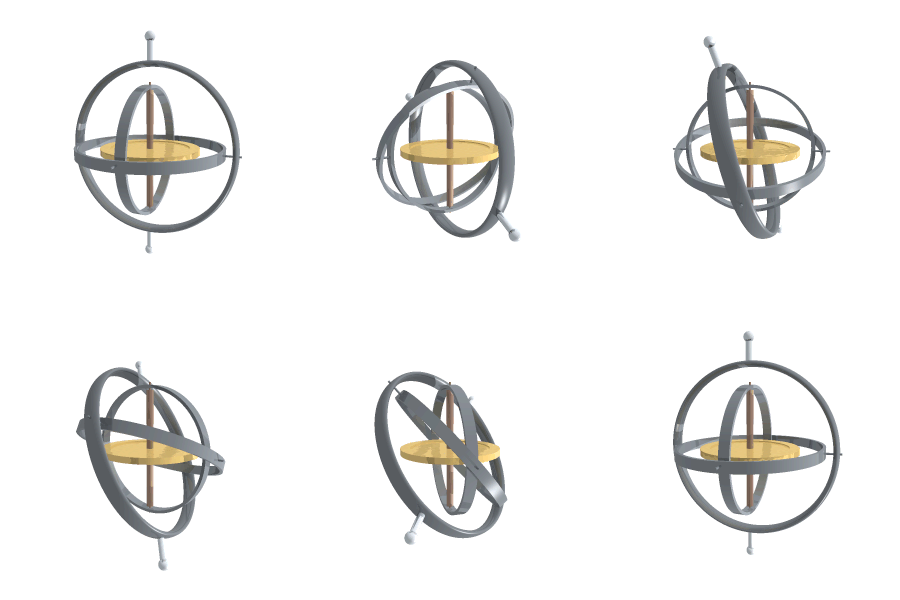
Fig. 11.18 A gyroscope keeps the direction of its spin axis nearly fixed as the supporting frame changes orientation. This behavior is why gyroscopes are useful for navigation and attitude control. Image Credit: Wikipedia: Gyroscope.#
The precession of a gyroscope can be illustrated with an example of a toy top. If the top is placed on a flat surface near the ground at an angle and is not spinning, it will fall over. The force of gravity produces a torque on its center-of-mass (see Fig. 11.19a).
Fig. 11.19 A top that is not spinning topples because gravity produces a torque about the contact point. A spinning top instead precesses, so its axis sweeps around rather than simply falling. Image Credit: OpenStax: Precession of a Gyroscope.#
However if the top is spinning on its axis, it precesses about the vertical instead of toppling over due to this torque (see Fig. 11.19b). This is due to the torque on the center-of-mass, which provides the change in angular momentum.
Figure 11.20 shows the forces acting on a spinning top. The torque \(\vec{\tau}\) produced is perpendicular to the angular momentum vector \(\vec{L}\). This changes the direction of the angular momentum vector according to \(d\vec{L} = \vec{\tau} dt\), but not its magnitude. As a result, the top precesses around a vertical axis, since the torque is always horizontal and perpendicular to \(\vec{L}\).
Checkpoint
If a torque is perpendicular to the angular momentum vector, does it mainly change the magnitude of \(\vec{L}\) or the direction of \(\vec{L}\)?
Fig. 11.20 The weight of a spinning top acts at its center of mass and creates a torque about the pivot. This torque changes the direction of the angular momentum vector and produces precession. Image Credit: OpenStax: Precession of a Gyroscope.#
If the top is not spinning, it acquires angular momentum in the direction of the torque. It rotates around a horizontal axis and falls over just as we expect.
You can experience this phenomenon first hand by holding a spinning bicycle wheel and trying to rotate it about an axis perpendicular to the spin axis. If the woman in Fig. 11.21 applies forces perpendicular to the spin axis in an attempt to rotate the wheel, the wheel axis starts to change direction to her left due to the applied torque.
Fig. 11.21 A spinning bicycle wheel behaves like a gyroscope. Forces that try to tilt the wheel change the direction of the angular momentum and produce precession. Image Credit: OpenStax: Precession of a Gyroscope.#
The spinning of the bicycle wheel when you’re riding acts as a gyroscope and keeps you from falling over.
As you watch, focus on the direction of the applied torque and how the spinning wheel responds by changing the direction of its angular momentum rather than simply tipping straight down.
We can calculate the precession rate of the top in Fig. 11.20, where we see that the magnitude of the torque is
which we can rewrite as
The angle the top precesses through in time \(dt\) is given by
The precession angular velocity is \(\omega_P = \frac{d\phi}{dt}\), where we see that
since \(L = I\omega\).
Note
We assumed that \(\omega_P \ll \omega\), which means that the precession angular velocity is much less than the angular velocity of the gyroscope disk. The precession angular velocity adds a small component to the angular momentum along the \(z\)-axis. This is seen in a slight bob up and down as the gyroscope precesses, which is referred to as nutation.
Earth acts like a gigantic gyroscope. Its angular momentum is along its axis and currently points at Polaris, the North Star. But Earth is slowly precessing (every \({\sim}\)26,000 years) due to the torque of the Sun and the Moon on its nonspherical shape.
As you watch, compare Earth’s slow axial precession with the precession of a toy top. The important idea is that a long-term torque can slowly change the direction of a large angular momentum vector.
11.4.1. Example Problem: Period of Precession#
Exercise 11.10
The Problem
A gyroscope spins with its tip on the ground and is spinning with negligible frictional resistance. The disk of the gyroscope has mass \(0.3\ {\rm kg}\) and is spinning at \(20\ {\rm rev/s}\). Its center of mass is \(5.0\ {\rm cm}\) from the pivot and the radius of the disk is \(5.0\ {\rm cm}\). What is the precessional period of the gyroscope?
Show worked solution
The Model
The gyroscope is modeled as a spinning solid disk whose axle is supported at one end. The weight of the disk acts at its center of mass, which is offset from the pivot. Because the gyroscope spins rapidly and friction is negligible, the gravitational torque does not significantly change the magnitude of the spin angular momentum. Instead, that torque causes the angular momentum vector to change direction slowly, producing steady precession.
The relevant physical framework is the steady-precession model for a rapidly spinning rigid body under the action of gravity. The torque magnitude is set by the weight of the disk and the distance from the pivot to the center of mass, while the spin angular momentum depends on the disk’s moment of inertia and spin angular speed. The disk is modeled as a solid disk about its spin axis.
The strategy is to compute the disk’s moment of inertia, convert the spin rate into radians per second, use these quantities to find the precessional angular speed, and then convert that angular speed into the precessional period.
The Math
For a rapidly spinning gyroscope undergoing steady precession, the precessional angular speed is given by
The disk is modeled as a solid disk spinning about its symmetry axis, so its moment of inertia is
The mass of the disk is \(m = 0.3\ {\rm kg}\) and the radius of the disk is \(R = 5.0\ {\rm cm} = 0.050\ {\rm m}\). Substituting these values into the moment-of-inertia expression gives
The given spin rate is \(20\ {\rm rev/s}\). To use the precession formula, we convert this spin rate into radians per second. This gives
The center of mass is located \(r = 5.0\ {\rm cm} = 0.050\ {\rm m}\) from the pivot. The precessional angular speed follows from the gravitational torque and spin angular momentum:
The precessional period is the time required for one complete revolution of the precession motion. This period is related to the precessional angular speed by
The precessional period follows from this precessional angular speed:
Rounded appropriately, the precessional period is \( T_P = 2.0\ {\rm s}. \)
The Conclusion
The precessional period of the gyroscope is \( T_P = 2.0\ {\rm s}.\) This result means the gyroscope’s axis sweeps once around the vertical in about two seconds. The precession is much slower than the spin itself, which is consistent with the steady-precession approximation used in the model.
The Verification
The analytical solution computes the disk’s moment of inertia, converts the spin rate into radians per second, and then uses the steady-precession formula to determine the precessional angular speed and period. The computation below follows that same sequence directly from the given numerical values.
The numerical calculation confirms that the gyroscope precesses much more slowly than it spins and gives a precessional period of about \(2\ {\rm s}\).
import numpy as np
import matplotlib.pyplot as plt

# Given parameters
m = 0.3 # Mass of the gyroscope disk (kg)
R = 0.050 # Radius of the disk (m)
r = 0.050 # Distance from pivot to center of mass (m)
g = 9.81 # Gravitational acceleration (m/s^2)
f_spin = 20.0 # Spin frequency (rev/s)

# Moment of inertia of the solid disk about its spin axis
I = 0.5 * m * R**2 # Disk moment of inertia (kg m^2)

# Spin angular speed
omega = 2 * np.pi * f_spin # Spin angular speed (rad/s)

# Precessional angular speed and period
omega_p = r * m * g / (I * omega) # Precessional angular speed (rad/s)
T_p = 2 * np.pi / omega_p # Precessional period (s)

print(f"The precessional angular speed of the gyroscope is {omega_p:.2f} rad/s.")
print(f"The precessional period of the gyroscope is {T_p:.2f} s.")

fig = plt.figure(figsize=(5,4), dpi=120)
ax = fig.add_subplot(111)

# Plot one cycle of the precession angle versus time
t = np.arange(0, T_p, 0.01)
phi = omega_p * t

ax.plot(t, phi)
ax.set_xlabel(r"$t\ ({\rm s})$")
ax.set_ylabel(r"$\phi\ ({\rm rad})$")

plt.tight_layout()
plt.show()
PhET Interactive: Torque
Open the PhET Torque simulation
Adjust the applied force, the distance from the rotation axis, and the rotational inertia. Watch how the angular acceleration and angular momentum respond, then compare cases where the same force is applied closer to or farther from the axis.
11.5. In-class Problems#
11.5.1. Part I#
Problem 1
A solid cylinder of radius \(10.0\ {\rm cm}\) rolls down an incline with slipping. The angle of the incline is \(30^\circ\). The coefficient of kinetic friction on the surface is \(0.40\). (a) What is the angular acceleration of the solid cylinder? (b) What is the linear acceleration?
Problem 2
A hollow cylinder that is rolling without slipping is given an initial velocity and rolls up an incline to a vertical height of \(1.0\ {\rm m}\). If a hollow sphere of the same mass and radius is given the same initial velocity, how high vertically does it roll up the incline?
Problem 3
A satellite is spinning at \(6.0\ {\rm rev/s}\). The satellite consists of a main body in the shape of a sphere of radius \(2.0\ {\rm m}\) and mass \(10{,}000\ {\rm kg}\), and two antennas projecting out from the center of mass of the main body that can be approximated by rods of length \(3.0\ {\rm m}\) each and mass \(10\ {\rm kg}\). The antennas lie in the plane of rotation. What is the angular momentum of the satellite?
Problem 4
A pulsar is a rapidly rotating neutron star. The Crab nebula pulsar in the constellation Taurus has a period of \(33.5\times10^{-3}\ {\rm s}\), radius \(10.0\ {\rm km}\), and mass \(2.8\times10^{30}\ {\rm kg}\). The pulsar’s rotation period will increase over time due to the release of electromagnetic radiation, which doesn’t change its radius but reduces its rotational energy.
(a) What is the angular momentum of the pulsar?
(b) Suppose the angular velocity decreases at a rate of \(10^{-14}\ {\rm rad/s^2}\). What is the torque on the pulsar?
11.5.2. Part II#
Problem 5
A diver off the high board imparts an initial rotation with his body fully extended before going into a tuck and executing three back somersaults before hitting the water. If his moment of inertia before the tuck is \(16.9\ {\rm kg\cdot m^2}\) and after the tuck during the somersaults is \(4.2\ {\rm kg\cdot m^2}\), what rotation rate must the diver impart to his body directly off the board and before the tuck if they take \(1.4\ {\rm s}\) to execute the somersaults before hitting the water?
Problem 6
A merry-go-round has a radius of \(2.0\ {\rm m}\) and a moment of inertia \(300\ {\rm kg\cdot m^2}\). A boy of mass \(50\ {\rm kg}\) runs tangent to the rim at a speed of \(4.0\ {\rm m/s}\) and jumps on. If the merry-go-round is initially at rest, what is the angular velocity after the boy jumps on?
Problem 7
The centrifuge at NASA Ames Research Center has a radius of \(8.8\ {\rm m}\) and can produce forces on its payload of \(20\ g\) (twenty times the force of gravity on Earth).
(a) What is the angular momentum of a \(20\ {\rm kg}\) payload that experiences \(10\ g\) in the centrifuge?
(b) If the driver motor was turned off in (a) and the payload lost \(10\ {\rm kg}\), what would be its new spin rate, assuming there are no frictional forces present?
Problem 8
The axis of Earth makes a \(23.5^\circ\) angle with a direction perpendicular to the plane of Earth’s orbit. This axis precesses, making one complete rotation in \(25{,}780\ {\rm y}\).
(a) Calculate the change in angular momentum in half this time.
(b) What is the average torque producing this change in angular momentum?
(c) If this torque were created by a pair of forces acting at the most effective point on the equator, what would the magnitude of each force be?
Fig. 11.22 Earth’s rotation axis is tilted relative to the plane of its orbit and slowly precesses. In half a precession cycle, the angular momentum vector changes direction by sweeping to the opposite side of the cone. Image Credit: OpenStax: Chapter 11 Problems.#
11.6. Homework#
11.6.1. Conceptual Problems#
Problem 1
If a particle is moving with respect to a chosen origin it has linear momentum. What conditions must exist for this particle’s angular momentum to be zero about the chosen origin?
Problem 2
Explain why stars spin faster when they collapse.
11.6.2. Quantitative Problems#
Problem 3
A bowling ball rolls up a ramp \(0.5\ {\rm m}\) high without slipping to storage. It has an initial velocity of its center of mass of \(3.0\ {\rm m/s}\). (a) What is its velocity at the top of the ramp? (b) If the ramp is \(1\ {\rm m}\) high does it make it to the top?
Problem 4
A boulder of mass \(20\ {\rm kg}\) and radius \(20\ {\rm cm}\) rolls down a hill \(15\ {\rm m}\) high from rest. (a) What is its angular momentum when it is half way down the hill? (b) What is its angular momentum at the bottom?
Problem 5
The Sun’s mass is \(2.0\times10^{30}\ {\rm kg}\), its radius is \(7.0\times10^{5}\ {\rm km}\), and it has a rotational period of approximately \(28\ {\rm days}\). If the Sun should collapse into a white dwarf of radius \(3.5\times10^{3}\ {\rm km}\), what would its period be if no mass were ejected and a sphere of uniform density can model the Sun both before and after?
Problem 6
A gyroscope has a \(0.5\ {\rm kg}\) disk that spins at \(40\ {\rm rev/s}\). The center of mass of the disk is \(15\ {\rm cm}\) from a pivot and the radius of the disk is \(10\ {\rm cm}\). What is the precession angular velocity?