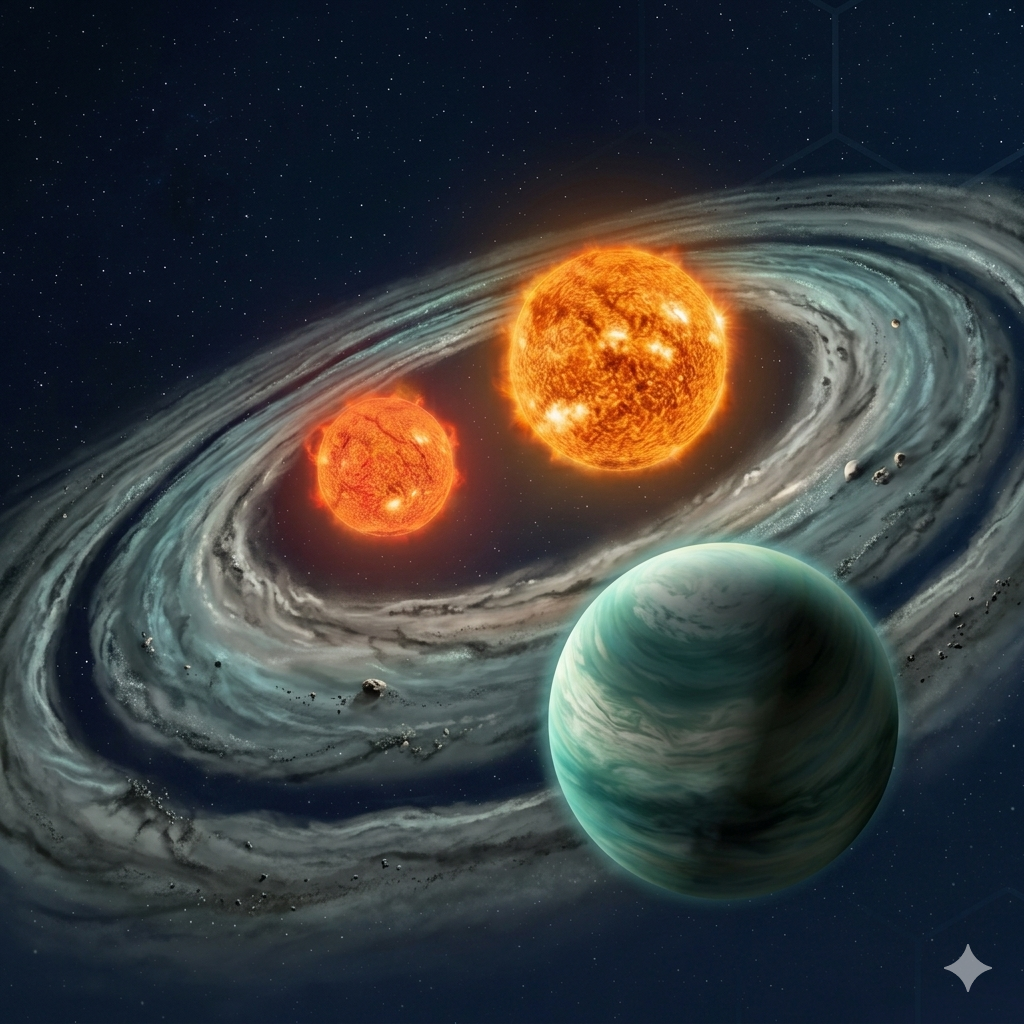
Exoplanets within Binary Systems#
This JupyterBook introduces research methods, background concepts, and computational tools used to study planets in binary star systems. The tutorials combine short explanations with Python-based examples so that students can move from reading about a topic to testing ideas directly.
The main goal of these notes is to support early research training. They are written for students who are beginning work in exoplanet dynamics, binary star systems, observational astronomy, or computational astrophysics. The examples are intentionally practical: they are meant to be copied, modified, questioned, and extended as part of a research workflow.
What you will find here#
The tutorials are organized around three connected parts of the research process:
Introduction — background on binary star systems, N-body simulations, and basic dynamical stability.
Applications — examples involving planet packing, eccentricity evolution, obliquity, climate, and GPU-accelerated simulations.
Observations — research logging, sky coordinates, CCD photometry, AstroImageJ, and archival light curve analysis.
Some tutorials are conceptual, while others are more computational. In both cases, the emphasis is on building habits that are useful in research: documenting assumptions, checking results, comparing models, and connecting code output back to the underlying physics.
How to use these notes#
You do not need to read the tutorials strictly in order. If you are new to the project, start with the introductory material and then move to the tutorial that best matches your current task. If you are working on observations, the research logging and photometry tutorials are a good place to begin. If you are working on simulations, start with the N-body and three-body stability tutorials.
When using the code examples, treat them as starting points rather than final answers. A good research workflow should include notes about what you changed, what you tested, what failed, and what you learned from the result.
Citation and reuse#
If you find any of this material useful, please cite the relevant source material and/or the literature references given in the References section of each tutorial. Many of the ideas, methods, and examples here are based on published work, and those original sources should receive proper credit.
Shield: 
This work is licensed under a Creative Commons Attribution 4.0 International License.
