


4. The Habitability of Earth#
Aug 16, 2026 | 11760 words | 78 min read
How to use this chapter
This chapter uses Earth as the starting point for thinking about habitability. Focus on how geology preserves evidence, how Earth became and remained habitable, and why a world can be physically suitable for life without giving us easy evidence that life is or was present.
This narration is AI-generated from the course text.
Earth is the only world we know for certain is inhabited. That makes Earth special, but it does not mean Earth should be treated as magical or scientifically separate from other planets. Earth is a planet with a surface, an interior, an atmosphere, oceans, changing climate, impacts from space, and a long history written into rocks. Those same categories can be studied on other worlds.
The central question in this chapter is not simply, “Why is Earth alive?” A better question is, “What physical conditions made Earth habitable, and how do we know those conditions existed in the past?” That second question is more useful for astrobiology because we cannot travel backward in time and watch early Earth directly. We have to reconstruct the story from surviving evidence.
That reconstruction is not easy. Rocks can be melted, buried, compressed, eroded, or recycled. Fossils are rare and biased toward organisms with hard parts. Impact craters can be erased. Atmospheres can change or escape. Even so, Earth gives us the best example we have of how a rocky planet can develop oceans, an atmosphere, a long-term climate system, and a biosphere.
The habitability of Earth depends on several linked processes. Volcanism helped build the atmosphere and oceans. Plate tectonics recycles rock and helps regulate climate over long timescales. Earth’s magnetic field helps limit atmospheric loss from the solar wind. The greenhouse effect keeps the planet warm enough for liquid water. The Moon may also have influenced Earth’s long-term environment, and the Moon’s rocks preserve evidence from the early Solar System that Earth itself has mostly erased.
As we work through these ideas, keep a careful distinction in mind. A world can be habitable without being inhabited. Habitability means that the ingredients and conditions for life could be present. It does not prove that life exists. Earth is our strongest case study because it is both habitable and inhabited, but astrobiology often deals with worlds where only part of that statement can be tested.
4.1. Geology and Life#
4.1.1. Why geology matters for life#
At first glance, geology may seem like a separate subject from the search for life. Rocks, volcanoes, earthquakes, and mountain ranges do not look much like biology. But on planetary timescales, geology and life are deeply connected. A planet’s geology helps determine whether it has an atmosphere, whether it can keep liquid water, how its climate changes, and what evidence of past environments survives.
The contrast among the terrestrial worlds makes this clear. Mercury and the Moon are barren, airless worlds with heavily cratered surfaces. Venus has a thick atmosphere and a surface hot enough to destroy ordinary spacecraft in a short time. Mars is cold and dry today, even though evidence suggests it had liquid water on its surface in the past. Earth is the world where oceans cover much of the surface, the atmosphere is stable enough for life, and surface conditions have remained suitable for billions of years.
The word geology literally points to Earth, but in planetary science it is used more broadly. Geology can mean the study of any world with a solid surface. It also means the processes and features that shape solid worlds: impacts, volcanism, tectonics, erosion, sedimentation, and internal heat flow. In this sense, the Moon, Mars, Venus, asteroids, and icy moons all have geology, even when they do not have Earthlike geology.
For astrobiology, geology is important because life needs more than a surface to stand on. Life as we know it depends on chemical ingredients, energy sources, and a stable enough environment for biology to operate. Geological processes move chemicals through the surface and interior. They can release gases into an atmosphere, recycle carbon, expose minerals to water, bury and preserve fossils, and create environments where liquid water can persist.
A single volcanic eruption may affect life locally, but the deeper importance of volcanism is long-term. Over billions of years, volcanism helps transfer material from a planet’s interior to its surface and atmosphere. This includes gases such as water vapor, carbon dioxide, nitrogen, and sulfur-bearing compounds. Those gases matter because atmospheres and oceans are not just placed on planets fully formed. They are built, lost, modified, and sometimes rebuilt through planetary processes.
The comparison below helps us see why Earth’s habitability is not just a matter of being a rocky planet. Mercury, Venus, Earth, Mars, and the Moon formed in the same Solar System, but their surfaces, atmospheres, and geological histories turned out very differently.

Fig. 4.1 The terrestrial planets formed from rocky material in the inner Solar System, but their present environments are dramatically different: Mercury is airless and heavily cratered, Venus is a dense-atmosphere hothouse, Earth has long-lived surface oceans and life, and Mars is cold and dry today. Use this comparison to keep the chapter’s main question in view: why did Earth remain habitable when neighboring rocky planets did not? Image credit: NASA/Lunar and Planetary Institute via Wikimedia Commons, public domain.#

4.1.2. Three geological ingredients for Earth’s habitability#
Three aspects of Earth’s geology are especially important in this chapter: volcanism, plate tectonics, and the magnetic field.
Volcanism releases gases and minerals from Earth’s interior. Early in Earth’s history, this outgassing helped build the atmosphere and contributed water vapor that could later condense into oceans. Volcanism also continues to return gases to the atmosphere today, which matters for long-term climate regulation.
Plate tectonics recycles rock. At some boundaries, old seafloor is pushed back into the mantle through subduction. At other boundaries, new seafloor forms as mantle material rises and cools. This recycling moves carbon between the atmosphere, oceans, rocks, and interior. It also rearranges continents, opens and closes oceans, builds mountains, and changes climate patterns.
Earth’s magnetic field forms a protective bubble around the planet. It does not make Earth invulnerable, and it does not stop every charged particle from reaching the atmosphere. But it helps reduce the direct stripping of atmospheric gas by the solar wind. Mars shows why this matters. Mars does not have a strong global magnetic field today, and spacecraft observations show that its atmosphere continues to lose gas to space.
These three pieces do not work independently. A planet’s interior heat drives volcanism and mantle convection. Mantle convection is connected to plate motion. Motion of electrically conducting fluid in the outer core helps generate the magnetic field. Climate, atmosphere, water, and surface geology are all connected to what is happening beneath the surface.
Checkpoint
Why is being a rocky planet at the right distance from the Sun not enough, by itself, to explain Earth’s long-term habitability?
This is why studying Earth’s habitability requires more than asking how far Earth is from the Sun. Distance from the Sun matters because it helps determine how much sunlight a planet receives. But Earth’s long-term habitability also depends on what Earth is made of, how large it is, how its interior evolved, whether it kept an atmosphere, whether it developed oceans, and whether climate feedbacks prevented the planet from becoming permanently frozen or overheated.
The three visuals below connect the chapter’s three geological ingredients: outgassing, plate recycling, and atmospheric protection.

Fig. 4.2 Volcanism matters for habitability because it transfers heat, gases, and minerals from a planet’s interior to its surface and atmosphere. This Kīlauea eruption is a modern example of a process that, over geologic time, helped build and modify Earth’s atmosphere and oceans. Image credit: Hawaiʻi Volcanoes National Park via Wikimedia Commons, public domain.#


Fig. 4.3 Plate tectonics gives Earth a moving surface. The map shows that plate boundaries form a connected global system, which matters because plate motion builds mountains, opens oceans, recycles crust, and helps move carbon between rocks, oceans, atmosphere, and mantle. Image credit: USGS-derived map by Eric Gaba via Wikimedia Commons, CC BY-SA 2.5.#


Fig. 4.4 Earth’s magnetic field shapes how the solar wind interacts with the atmosphere. The magnetosphere does not make Earth isolated from space, but it helps reduce direct stripping of atmospheric gas by charged particles from the Sun. Image credit: NASA via Wikimedia Commons, NASA media/public domain.#

4.2. Reconstructing the History of Earth and Life#
This narration is AI-generated from the course text.
4.2.1. Deep time and the problem of evidence#
Human history is short compared with Earth history. Written records and archaeological evidence preserve only a tiny fraction of the time life has existed. Life on Earth extends back billions of years, while human civilization occupies only the most recent sliver of that history. To understand early Earth, we need records that last far longer than written language.
Those records are physical. Rocks, fossils, minerals, isotope ratios, and craters preserve clues about past environments. They do not preserve everything. They are more like surviving pages from a book than a complete movie of the past. The job of geology is to read those surviving pages carefully and reconstruct the most likely story.
Fossils are relics or traces of past life. They are not always bones that have turned into stone. A fossil can be a preserved shell, a mineral replacement of once-living tissue, a footprint, a burrow, a leaf imprint, or even petrified excrement. Plant fossils matter enough that there is a whole field, paleobotany, focused on ancient plant life and plant traces.
Fossils are not limited to bones, shells, or dinosaur skeletons. Plant fossils can preserve leaves, stems, pollen, seeds, wood, and other traces of ancient ecosystems. Paleobotany matters because fossil plants help reconstruct past environments, showing what kinds of climates and habitats existed when particular rock layers formed.
Rocks also preserve environmental history even when no fossil is present. A sedimentary rock may tell us that material was transported by water, wind, ice, or gravity. A volcanic rock may tell us that molten material reached the surface. A mineral’s isotope ratios may tell us when a rock cooled, whether water interacted with it, or how its source changed over time. In astrobiology, these clues matter because a world does not need to preserve a fossil to preserve evidence that it was once habitable.
The Grand Canyon gives us three connected ways to think about deep time. A real outcrop shows the visible layers, a stratigraphic column organizes those layers by age and rock unit, and fossils help correlate layers because different organisms appear in a recognizable order through geologic time.

Fig. 4.5 This labeled view connects the abstract idea of strata to a real cliff face. The youngest Paleozoic layers are exposed near the rim, while progressively older layers appear lower in the canyon walls. The dates next to the formations show how relative dating from layer order can be tied to numerical ages from other evidence. Image credit: National Park Service, Grand Canyon National Park, NPS media.#
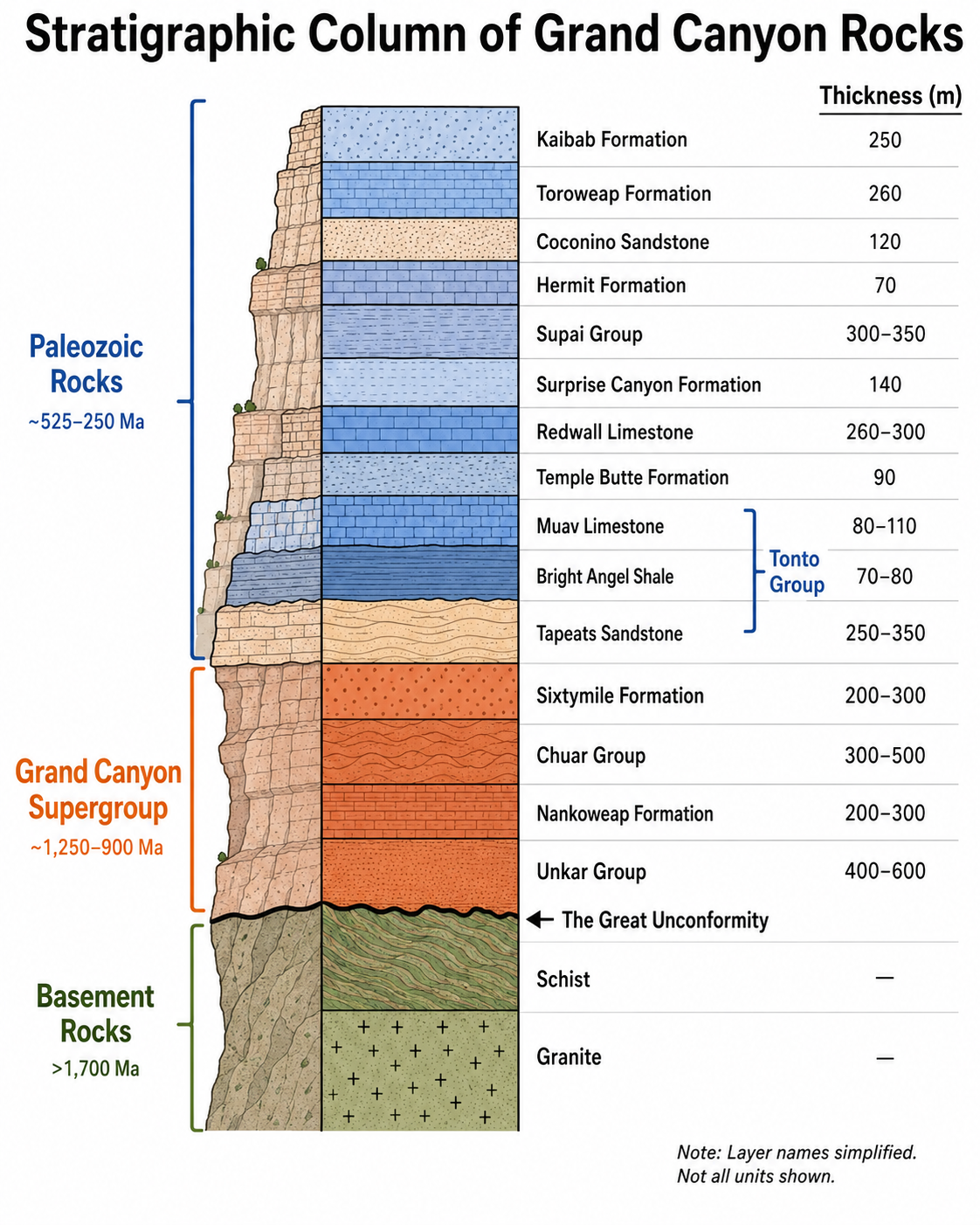
Fig. 4.6 A stratigraphic column turns the complicated canyon wall into a readable vertical sequence. The basic rule is the same as in the photo: younger layers are generally above older layers. The column also makes it easier to compare named rock units, group related layers, and notice major gaps in the record such as the Great Unconformity. Image credit: Course-created diagram, adapted from the U.S. Geological Survey stratigraphic column of Grand Canyon rocks, public-domain source.#

Fig. 4.7 Fossils add another line of evidence because organisms appear, disappear, and change through time. When the same fossil types are found in matching layers in different places, they can help geologists correlate strata and estimate relative ages. In the Grand Canyon, deeper fossil-bearing layers generally record older life, while higher fossil-bearing layers record younger parts of Earth history. Image credit: National Park Service Fossils and Paleontology Program, stratigraphic column by Allen Glazner, fossil photos by NPS contributors, graphic by Allyson Mathis, CC BY-SA 4.0 where indicated by NPS.#
4.2.2. Rocks as historical records#
Solid materials can lock in information in a way that liquids and gases usually cannot. A gas mixes and moves. A liquid flows. A solid can preserve structure, composition, and timing after it cools, crystallizes, or is buried. This is why rocks are so important for reconstructing the past.
There are different kinds of records. Archaeological artifacts tell us where humans have been and what they were doing. The geological record includes rocks and structures that tell us about Earth’s physical history. The fossil record is the part of the geological record that preserves evidence of life. These records overlap, but they are not the same.
Rocks are commonly grouped into three major types. Igneous rocks form when molten rock cools and solidifies. Basalt, granite, and pumice are examples. Metamorphic rocks form when older rocks are changed by heat, pressure, or chemical reactions without fully melting. Marble, gneiss, and slate are examples. Sedimentary rocks form when sediments such as sand, silt, clay, minerals, or remains of living organisms accumulate and are pressed together. Sandstone, shale, and chalk are examples.
These categories are not permanent labels that a rock keeps forever. Rocks can change through the rock cycle. Igneous rock exposed at the surface can be broken down by erosion, transported, and deposited as sediment. Sediment can be buried and compressed into sedimentary rock. Sedimentary or igneous rock can be heated and squeezed into metamorphic rock. If rock melts, it can later cool into new igneous rock. This cycle is part of why Earth’s oldest evidence is difficult to preserve: Earth keeps reworking its own surface.
Rocks are made of minerals, which are naturally occurring crystalline materials with particular chemical compositions and structures. A single rock usually contains a mixture of different mineral crystals in contact with one another. Many common minerals are silicates, built mainly from silicon and oxygen combined with other elements. Quartz and feldspar are familiar examples.
Rock type tells us how a rock formed. Mineral composition tells us what it is made of. Both kinds of information matter. Basalt is a dark, dense igneous rock common on the seafloor and in volcanic regions. It is rich in iron- and magnesium-bearing silicate minerals. Granite is lighter and less dense, rich in quartz and feldspar, and common in continental crust and mountain ranges. The contrast between basalt and granite will matter later when we discuss why seafloor and continental crust behave differently.

Fig. 4.8 The rock cycle shows why Earth’s record is both powerful and incomplete. Rocks preserve information, but they can also be eroded, buried, metamorphosed, melted, and remade, which is why reconstructing early Earth requires combining several kinds of evidence. Image credit: Woudloper via Wikimedia Commons, CC BY-SA 1.0.#

4.2.3. Sedimentary layers and relative time#
Sedimentary rocks are especially useful for reconstructing surface environments. Sediments are often deposited in layers. In an undisturbed sequence, the youngest layers are usually near the top and the oldest layers are near the bottom. This simple ordering allows geologists to determine relative age: which rocks are older and which are younger, even before assigning exact numerical ages.
Sediments form through erosion and transport. Wind, water, and ice break surface material into smaller pieces. Rivers carry material toward lakes, floodplains, deltas, and oceans. Wind can bury sand or dust. Organisms can contribute shells, skeletons, or other hard parts. Over time, buried sediments are compressed and cemented into rock.
The distinct layers in sedimentary rocks are called strata. A single layer is a stratum. Strata often differ in color, texture, grain size, or composition because the environment changed as the sediment was deposited. The Grand Canyon is a familiar example of exposed strata. The canyon itself was carved by the Colorado River over millions of years, but the exposed rocks record much older environments that existed at different times.
Relative dating using strata does not by itself tell us that a rock is, for example, 500 million years old. It tells us that one layer is older or younger than another. This still matters. If the same distinctive layer can be matched in different places, fossils and rocks in those layers can be compared. Relative dating gives the order of events. Radiometric dating can then help assign numerical ages to some of those events.
Checkpoint
How can sedimentary layers show relative age even when no numerical date has been measured?
Geologists analyze rocks in several ways. Mineralogical analysis identifies the minerals present and can reveal the temperature, pressure, or chemical environment in which the rock formed. Chemical analysis measures which elements are present. Isotopic analysis measures ratios of isotopes, which are atoms of the same element with different numbers of neutrons. Some isotope ratios act like natural clocks because radioactive isotopes decay into daughter products at measurable rates.
The Grand Canyon’s layers did not become visible all at once. This video connects the visible canyon to the sequence of deposition, uplift, river downcutting, and erosion that exposed the rock record. The main point is that the canyon itself is geologically young compared with many of the rocks exposed in its walls.
4.2.4. Radiometric dating and half-life#
Radiometric dating is one of the most powerful tools for measuring geological time. The basic idea is that some isotopes are radioactive, meaning their nuclei can spontaneously change into different nuclei. This decay happens at random for any single atom, but in a large sample the average decay rate is stable and measurable.
Carbon provides a familiar example. Carbon-12 and carbon-13 are stable isotopes. Carbon-14 is radioactive and decays into nitrogen-14. Carbon-14 dating is extremely useful for relatively recent organic material because living things exchange carbon with their environment while alive. After death, that exchange stops, and the amount of carbon-14 decreases over time. However, carbon-14 is not useful for dating ancient rocks that are millions or billions of years old. Its half-life is too short for that purpose.
A half-life is the time required for half of a radioactive substance to decay. After one half-life, half of the original parent isotope remains. After two half-lives, one fourth remains. After three, one eighth remains. After many half-lives, so little parent material remains that the clock becomes difficult or impossible to read reliably.
That is why different clocks are used for different timescales. Carbon-14 is useful for young organic materials, with an effective range of roughly tens of thousands of years. To date rocks that are billions of years old, geologists use longer-lived radioactive systems, such as uranium-lead, potassium-argon, or related methods. Uranium-238, uranium-235, and potassium-40 are useful because their half-lives are long enough to preserve measurable parent and daughter isotopes over deep time.
Radiometric dating does not usually date when a rock first appeared on a planet’s surface in every possible sense. It commonly dates the time since a mineral or rock cooled enough to become a closed system. If the rock later melts or is strongly altered, the clock can be reset or disturbed. This is not a flaw in the method. It is part of what the method is telling us: the rock records the last event that locked in the isotopic system being measured.
Scientists check radiometric ages in several ways. They compare numerical ages with the relative order of sedimentary strata. They compare different isotope systems when possible. For young archaeological materials, they compare radiocarbon ages with historical records and tree-ring data. No dating method is magic, but the agreement among independent checks is why radiometric dating is so central to modern geology.
Checkpoint
Why does a short-lived radioactive isotope work well for recent material but fail for billion-year-old rocks?
For astrobiology, radiometric dating matters because habitability is a historical question. We want to know when Earth formed, when oceans appeared, when the surface became stable enough for life, when major impacts occurred, and when evidence of life appears. Without clocks, we would have a pile of clues but no reliable timeline.
The first visual below emphasizes the simple half-life idea; the second shows why radiometric dating becomes powerful when many grains or phases are compared rather than relying on a single isolated measurement.

Fig. 4.9 Radiometric dating begins with the half-life idea: after each half-life, about half of the remaining parent isotope has decayed. This animation is useful because it shows the repeated fractional decrease more clearly than a static table of numbers. Image credit: Carie Frantz via Wikimedia Commons, CC BY-SA 4.0.#


Fig. 4.10 This isochron diagram is more advanced than the calculations used here, but it shows an important scientific point: radiometric dating is not just guessing from one atom. Geologists compare isotope ratios across materials and look for internally consistent patterns that act as natural clocks. Image credit: Woudloper via Wikimedia Commons, CC BY-SA 3.0.#

Interactive Simulation: Radioactive Dating Game
Use this PhET simulation to connect the half-life idea to dating actual materials. Try the carbon-14 and uranium-238 options and notice why a short half-life is useful for recent organic remains but not for rocks that are billions of years old. Interactive credit: PhET Interactive Simulations, University of Colorado Boulder.
4.2.5. Fossils, preservation, and bias#
Fossils are powerful evidence, but the fossil record is incomplete. Most organisms do not become fossils at all. Soft tissues decay. Small organisms are hard to preserve and harder to identify. Rocks that once contained fossils can be eroded, buried too deeply, heated, or destroyed by tectonic recycling.
The easiest fossils to find are often relatively young and come from organisms with hard parts, such as shells, bones, or teeth. That creates a major bias. For most of Earth’s history, life was microscopic. Microbes do not usually leave obvious bones or shells. Their evidence may appear as microscopic structures, chemical signatures, mineral patterns, or layered microbial communities such as stromatolites. These can be difficult to interpret because the key question is often, “Was this made by life, or could geology alone have made something similar?”
This problem is not limited to Earth. If we search Mars, Europa, Enceladus, or ancient rocks from another world, we should not expect evidence of life to be obvious. A possible fossil, chemical pattern, or mineral texture would need to be tested against non-biological explanations. The older and more altered the evidence is, the more careful that comparison becomes.
Checkpoint
Why can a planet or time period be inhabited without preserving obvious fossil evidence?
Fossil formation can happen in several ways. Mineral-rich parts of organisms, such as bones, teeth, and shells, may survive long enough to be buried. Minerals can replace parts of the organism, producing petrified remains. A decaying organism can leave a mold that later fills with minerals. In rare cases, organic matter can be preserved more directly, such as in ice or tree resin. Even coprolites, which are fossilized waste, can preserve information about ancient diets and ecosystems.
The important lesson is not that fossils are useless because they are incomplete. The lesson is that absence of a fossil is not automatically absence of life. A planet or time period may have been inhabited without preserving evidence that survives to the present. This is one of the hardest problems in astrobiology: life may be fragile, local, microscopic, or poorly preserved.

Fig. 4.11 Stromatolites are a useful bridge between biology and geology because microbial communities can build layered structures that may be preserved in rock. They also show why early-life evidence can be hard to interpret: the evidence may be structural, chemical, or microscopic rather than a familiar animal fossil. Image credit: Paul Harrison via Wikimedia Commons, CC BY-SA 3.0.#

4.2.6. Geological time and the age of Earth#
Earth history is organized using the geological time scale. The largest divisions are eons. From oldest to youngest, Earth’s eons are the Hadean, Archean, Proterozoic, and Phanerozoic. Eons are subdivided into eras, periods, epochs, and ages. The Phanerozoic eon, for example, includes the Paleozoic, Mesozoic, and Cenozoic eras.
These divisions are not arbitrary calendar labels. They are based on changes in the rock and fossil records. Boundaries often mark major transitions in Earth’s environment or life. The most important point here is that most of Earth history happened before the familiar animals of the Phanerozoic. Dinosaurs may dominate popular images of ancient life, but they belong to a relatively recent part of the story.
We do not determine Earth’s age by finding a single piece of Earth that formed at the exact beginning and survived untouched. Earth is active. Plate tectonics, erosion, metamorphism, and melting have destroyed or altered many of the oldest rocks. The oldest known rocks are a little over 4 billion years old, but individual mineral grains called zircons are older. Some zircons from Western Australia are about 4.4 billion years old.
Zircons are valuable because they are tough minerals that can survive erosion and recycling. A zircon grain can be older than the sedimentary rock in which it is later found. Uranium-lead dating of zircons provides evidence that parts of Earth’s crust existed very early. Some zircon evidence also suggests that liquid water may have interacted with Earth’s surface by about 4.4 billion years ago, which pushes possible habitability much earlier than the old picture of a long-lasting molten hellscape.
Moon rocks also help constrain Earth’s history. Earth and the Moon formed in the same early Solar System, and the Moon preserves ancient surfaces better than Earth because it lacks plate tectonics, flowing water, and an atmosphere. The oldest Moon rocks are about 4.4 billion years old, giving a minimum age for the Earth-Moon system.
Meteorites provide another constraint. Some meteorites are fragments of asteroids, but primitive meteorites contain some of the earliest solids that condensed in the Solar System. Calcium-aluminum-rich inclusions, often abbreviated CAIs, are especially important because they are among the oldest dated solids. Their ages are about 4.567 billion years, which is commonly used as a reference point for the beginning of Solar System solid formation.
Earth did not form instantly at that moment. It grew by accreting smaller bodies. Current evidence indicates that most of Earth’s mass accumulated within the first few tens of millions of years after the first solids formed, and the Earth-Moon system formed within the first roughly 60 to 100 million years. The exact details remain an active research area, but the broad picture is clear: Earth is about 4.54 billion years old, and the earliest evidence for crust and perhaps water appears surprisingly soon afterward.
The two visuals below combine the large-scale time structure with one concrete reason early Earth evidence is difficult: the oldest directly dated minerals are tiny surviving grains, not complete untouched rocks from Earth’s formation.

Fig. 4.12 A spiral time scale shows that most of Earth history occurred before familiar animals, plants, and humans. The visual also reinforces the chapter’s deep-time theme: habitability and life have to be studied across billions of years, not just recent history. Image credit: Till Lauer via Wikimedia Commons, CC BY-SA 4.0.#

Jack Hills matters because its ancient zircon grains preserve clues from a time when most of Earth’s original crust has been erased or recycled. The key idea is that a tiny mineral can act like a durable time capsule: its isotopes can record when it formed, and its chemistry can hint at whether liquid water may have existed on early Earth.
4.3. The Hadean Earth and the Dawn of Life#
This narration is AI-generated from the course text.
4.3.1. How Earth got an atmosphere and oceans#
The Hadean eon is the earliest chapter of Earth history. The name comes from Hades and suggests hellish conditions. That label is partly understandable. Early Earth formed through impacts. It was extremely hot, at least partly molten, and exposed to frequent collisions with leftover planetesimals. It did not begin as the calm, blue planet we know today.
But the Hadean should not be imagined as one unchanging inferno lasting for hundreds of millions of years. Evidence from ancient zircons suggests that Earth’s surface may have cooled enough for crust and liquid water relatively early. The early planet likely experienced alternating periods of cooling and renewed disruption, especially from impacts.
Earth needed an atmosphere and oceans for life as we know it to get started. Immediately after formation, conditions were not favorable for stable oceans. Earth was too hot for liquid water to remain at the surface. It was also too small and too warm to hold onto large amounts of hydrogen and helium gas from the solar nebula. The young Sun’s solar wind would have helped remove those light gases.
The material that formed Earth was also mostly dry compared with icy bodies beyond the snow line. In the early Solar System, the snow line marked the region far enough from the young Sun for water ice to condense. Earth formed inside that region, where rock and metal were easier to keep solid than ice. That means Earth’s water probably came from a mixture of sources, including water-bearing planetesimals incorporated during accretion and later impacts.
As planetesimals struck the growing Earth, heat melted material and released gases and steam. This process, called outgassing, helped build a secondary atmosphere. Because Earth was massive enough, it could hold onto heavier gases better than it could hold hydrogen and helium. As Earth cooled, water vapor could condense into rain and collect in low regions, forming oceans.
Volcanic outgassing continued after the first atmosphere and oceans formed. Volcanoes released water vapor, carbon dioxide, nitrogen, sulfur compounds, hydrogen sulfide, and other gases. Early Earth’s atmosphere was very different from the modern atmosphere. Today Earth’s atmosphere is mostly nitrogen and oxygen, but oxygen became abundant only after life had already been present for a long time. Early Earth was not simply a version of modern Earth with fewer continents and more volcanoes. It was chemically different.
The two visuals below are complementary. The first gives a broad model-based view of Hadean Earth, while the second isolates the specific process of volcanic outgassing that helped build the early atmosphere and oceans.

Fig. 4.13 This artist impression should be treated as a model-based visualization, not a direct picture of early Earth. It is useful because it combines several Hadean ideas from the text: a hotter young Earth, impacts, volcanism, early atmosphere formation, and a Moon much closer than it is today. Image credit: Tim Bertelink via Wikimedia Commons, CC BY-SA 4.0.#

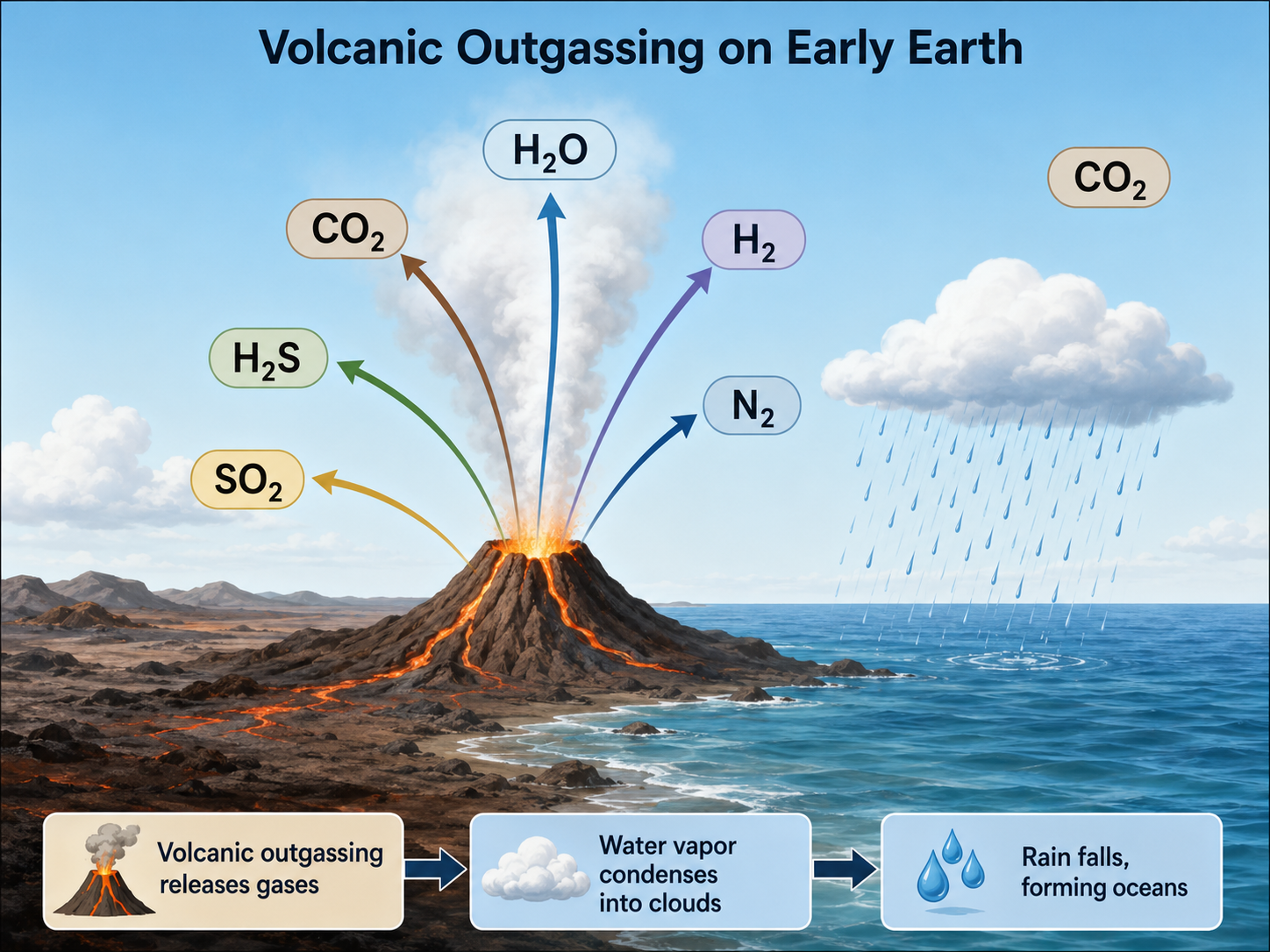
Fig. 4.14 Volcanic outgassing helped build Earth’s secondary atmosphere by releasing gases from the interior, including water vapor, carbon dioxide, nitrogen, hydrogen-bearing gases, and sulfur-bearing gases. As Earth cooled, water vapor could condense as rain and collect into oceans, turning interior chemistry into surface habitability. Image credit: Course-created diagram.#
Together, these visuals show the basic sequence: early Earth had to cool from a hot, impact-shaped planet into a world where outgassed water vapor could condense, collect at the surface, and begin forming oceans.
This matters for the search for life elsewhere because a planet’s first atmosphere may not be the atmosphere we observe later. Atmospheres evolve. They can be outgassed, stripped, chemically altered, buried in rocks, or changed by life. If we eventually study an Earth-sized exoplanet, its present atmosphere would be a snapshot in a long history, not a complete biography.
4.3.2. Could life have existed during the Hadean?#
The possibility of Hadean habitability is one of the most important ideas in this chapter. If Earth had liquid water and a stable crust by about 4.4 billion years ago, then habitable environments may have appeared only about 100 to 200 million years after Earth formed. That does not prove life existed then. It means that the conditions needed for life may have been present earlier than once assumed.
The problem is that early Earth was also being bombarded by leftover planetesimals. Accretion did not stop cleanly once Earth formed. The impact rate declined over time, but large impacts continued. The Moon preserves visible scars from this period in the form of impact craters. Earth must have experienced even more impacts because it is larger and has stronger gravity, but erosion, plate tectonics, and surface recycling erased much of that record.
The two timelines below complement each other. The first is a research-focused figure that compares bombardment and habitability in early Mars and Earth, while the second is a public-facing summary that shows why the older picture of a simple late cataclysm is now viewed more cautiously.

Fig. 4.15 This research timeline is useful because it connects bombardment history directly to possible crustal habitability rather than treating impacts only as destructive events. In particular, it helps us see why the older idea of a single sharp Solar-System-wide Late Heavy Bombardment at about \(3.9\ {\rm Ga}\) is no longer treated as settled. Image credit: Moser et al. (2019), Nature Geoscience, non-free research figure used here for educational commentary.#

Fig. 4.16 This timeline offers a more accessible summary of the same big idea: the older story of a continuously sterilized early Earth is harder to defend than it once seemed. The important point is not that life definitely existed during the Hadean, but that evidence from zircons and ancient possible biosignatures makes early habitability more plausible than many older textbook narratives suggested. Graphic credit: Lucy Reading-Ikkanda/Quanta Magazine, non-free magazine graphic used here for educational commentary.#
Together, these timelines shift the question away from whether early Earth was simply “too violent” for life and toward a more useful question: could habitable environments appear, disappear, and reappear between major impacts?
Checkpoint
How is evidence for early habitability different from evidence that life actually existed?
A key point is that “frequent” impacts in geological language do not mean constant impacts every day across the whole planet. Large impacts could be separated by thousands, hundreds of thousands, or millions of years. They did not strike every environment at once. That means early Earth could have had habitable intervals and local refuges even during a period of elevated bombardment.
The effect of an impact depends strongly on impactor size. A 10 to 20 kilometer object can have global consequences, as seen in the impact associated with the extinction of the non-avian dinosaurs. Larger impacts during the Hadean could have been far more severe, possibly boiling parts of the ocean or sterilizing surface environments. Whether early life could survive such impacts depends on where it lived, how deep it lived, how large the impacts were, and how often they occurred.
This is where the distinction between origin and survival matters. Life might arise during a calm interval but be destroyed by a later giant impact. Or life might survive in protected environments, such as deep ocean settings, subsurface rock, or hydrothermal systems. These possibilities are not the same, and the evidence is hard to preserve. The honest conclusion is cautious: early Earth may have been habitable surprisingly early, but whether life existed and survived during the Hadean remains uncertain.
4.3.3. The Moon as a record of early impacts#
The Moon helps us study Earth’s early impact history because it preserves ancient surfaces. The lunar highlands are bright, heavily cratered regions where craters often overlap. Radiometric dating of lunar samples indicates that many highland rocks are about 4.0 to 4.4 billion years old. These regions record intense early bombardment.
The lunar maria are darker, smoother plains that fill large impact basins. They formed when large impacts fractured the lunar crust and allowed lava to flood low areas. The maria have fewer craters than the highlands, which means their surfaces are younger. Many maria basalts are about 3.0 to 3.9 billion years old. When lava floods a surface and cools, it resets the radiometric clock for that rock, so the age measured is the age of the lava flow, not the age of the basin-forming impact itself.
For many years, textbooks described a Late Heavy Bombardment: a spike in impacts around 3.9 billion years ago, roughly 500 to 600 million years after Solar System formation. That idea is still historically important, and some versions remain discussed, but it should not be presented as settled fact. Lunar samples are difficult to interpret because impact events can mix, melt, and reset rocks. More recent studies have weakened the simple picture of a sudden Solar System-wide cataclysm.
A more cautious framing is better for this course. The early Earth and Moon experienced heavy bombardment that declined over time. There may have been variations in the impact rate, and there are still debates about timing and causes, but the old single-spike Late Heavy Bombardment model should not be treated as confirmed history. This is a useful example of how science works: a model can be helpful, widely discussed, and later revised when better evidence and better dynamical studies become available.
Crater counts are one way scientists estimate the ages of surfaces when rock samples are unavailable. A surface with more craters has generally been exposed longer than a surface with fewer craters, assuming the impact rate is understood. This method is less precise than radiometric dating, but it is valuable for worlds where sample return is difficult or impossible. Orbiter missions are much cheaper than bringing rocks back to Earth, so crater counts often provide the first timeline for planetary surfaces.
Checkpoint
Why does the Moon preserve early impact evidence better than Earth?
For astrobiology, the impact history matters because impacts can both harm and help habitability. Large impacts can devastate environments, vaporize water, and reset surfaces. Smaller impacts can deliver water and organic material, excavate subsurface rock, and create hydrothermal systems that may be temporarily habitable. Impacts are not simply “bad for life” or “good for life.” Their role depends on timing, size, frequency, and context.
The Moon preserves two complementary visual records: a global view that distinguishes highlands from maria and a close view that shows how dense the crater record can be.

Fig. 4.17 The bright highlands and dark maria are not just visual features. They mark different lunar terrains with different ages and histories, which is why the Moon helps reconstruct early Solar System bombardment after Earth’s own early surface record was mostly erased. Image credit: Gregory H. Revera via Wikimedia Commons, CC BY-SA 3.0.#


Fig. 4.18 Crater counting is not just a matter of noticing that a surface looks “beat up.” Scientists count and compare craters across defined regions to estimate relative surface ages: regions with more accumulated craters are generally older, while smoother regions with fewer craters are generally younger or have been resurfaced. This NASA visualization highlights counted lunar craters, making the method much clearer than a single crater image would. Image credit: NASA/Goddard Space Flight Center Scientific Visualization Studio, NASA media.#
This short NASA video adds motion to the lunar bombardment discussion by showing how the Moon’s surface changed over time and why the Moon preserves evidence that Earth has mostly erased.
4.4. Geology and Habitability#
This narration is AI-generated from the course text.
4.4.1. Looking inside Earth#
We cannot simply look inside Earth. The deepest boreholes reach only a tiny fraction of Earth’s radius. The Kola Superdeep Borehole reached a little over 12 kilometers in depth, while Earth’s radius is about 6371 kilometers. Direct drilling barely scratches the surface.
Most of what we know about Earth’s interior comes from seismic waves. These waves travel through Earth after earthquakes or other energetic events. They behave somewhat like sound waves, but their speed and direction change depending on the composition, density, pressure, temperature, and phase of the material they pass through. Some waves travel through solids and liquids differently. By studying when waves arrive at different locations and how they change, geologists infer Earth’s internal structure.
Earth’s interior can be described by composition. The core is the densest region and contains mostly iron and nickel. It includes a liquid outer core and a solid inner core. The mantle surrounds the core and is made mostly of silicate rock. The crust is the low-density outer layer where we live, including basaltic oceanic crust and granitic continental crust.
It is easy to imagine Earth’s interior as mostly molten because lava comes out of volcanoes. That picture is misleading. Most of the mantle is solid rock, but rock can behave slowly and plastically under high temperature and pressure. It can flow over long timescales even while remaining solid. The pitch drop experiment is a useful analogy: a material can look solid over short times but flow over long times if it is viscous enough.
Earth can also be described by mechanical behavior. The lithosphere is the cool, rigid outer shell, including the crust and uppermost mantle. It is broken into plates. Beneath it lies the asthenosphere, a warmer, softer part of the upper mantle that can flow slowly. The plates of the lithosphere move over this softer material.
Mantle motion is driven by heat. Hot material rises, loses heat, and eventually sinks again. This process is convection, similar in basic idea to a pot of boiling water, though mantle convection is much slower and involves solid rock flowing over geological time. Convection helps move heat from Earth’s interior toward the surface.

Fig. 4.19 Earth’s layered interior explains why the surface cannot be understood by surface observations alone. The crust, mantle, liquid outer core, and solid inner core have different compositions and mechanical behavior, and those differences connect to volcanism, plate motion, and magnetic-field generation. Image credit: IsadoraofIbiza via Wikimedia Commons, CC BY-SA 4.0.#

4.4.2. Differentiation and planetary cooling#
Earth’s layered structure formed through differentiation, the process by which materials separate by density. Dense materials such as iron sank toward the center, while less dense silicate material remained above. Differentiation required early Earth to be very hot, probably molten or nearly molten over large regions.
Several heat sources contributed to this early melting. Impacts during accretion converted kinetic energy into heat. As dense material sank inward, gravitational potential energy was converted into thermal energy. Radioactive decay also added heat. Together, these processes allowed Earth to separate into core, mantle, and crust.
Differentiation happened early. Isotopic evidence suggests that Earth’s core formed within the first few tens of millions of years after the first Solar System solids. The giant impact that formed the Moon occurred after substantial differentiation, which is part of why the Moon’s composition provides important clues about Earth’s early interior.
Other rocky worlds also differentiated, but they did not all remain geologically active in the same way. Cooling rate depends strongly on size. Larger worlds retain internal heat longer because heat takes longer to escape from the interior and because their outer layers act like insulation. Smaller worlds such as the Moon and Mercury cooled more quickly and now have little internal geological activity.
Ongoing heat production also matters. Radioactive elements inside Earth continue to produce heat. This does not mean Earth is powered only by radioactivity, but radioactive decay helps keep the interior warm enough for long-term mantle convection. A planet that cools too quickly may lose volcanism, tectonics, and magnetic field generation. That can affect habitability by changing atmosphere, climate, and surface renewal.

Fig. 4.20 Differentiation explains why rocky planets are layered rather than well-mixed. Dense metallic material sinks toward the center while lower-density silicate material remains above, setting up the core-mantle-crust structure that later controls volcanic, tectonic, and magnetic behavior. Image credit: Lucyin via Wikimedia Commons, CC BY-SA 4.0.#

4.4.3. Plate tectonics and Earth’s changing surface#
Earth is unusual among the terrestrial worlds because it has active plate tectonics. The Moon and Mercury have little or no current internal geological activity. Mars had major volcanism in the past, but its interior has cooled enough that surface activity is limited today. Venus is more complicated. Its thick atmosphere hides the surface from ordinary visible-light imaging, but radar maps show volcanic plains and relatively few impact craters. That suggests much of Venus’s surface is geologically young, perhaps less than a billion years old, though Venus does not show Earthlike plate tectonics.
Tectonics refers to deformation of the lithosphere by stretching, compression, or other forces. A plate is a large fractured piece of the lithosphere. In plate tectonics, plates move gradually over, under, and past one another. The motion is slow, typically only a few centimeters per year, but over millions of years that is enough to rearrange oceans and continents.
Plate motion is measured today using precise GPS observations. Over a human lifetime, the motion is subtle. Over 100 million years, a plate moving 2 centimeters per year travels about 2000 kilometers. That is enough to move continents across climate zones, close oceans, build mountains, and split supercontinents apart.
The theory of plate tectonics explains several types of evidence. Continents fit together in puzzle-like ways, most famously South America and Africa. Similar fossils and rock types appear on now-separated continents. Seafloor rocks show symmetrical patterns of magnetic reversals on both sides of mid-ocean ridges. Oceanic crust is young compared with continental crust. Together, these clues show that Earth’s surface is continually being created, moved, and recycled.

Fig. 4.21 A global plate map shows that plate tectonics is not one local phenomenon. Earth’s lithosphere is divided into moving plates, and the boundaries between those plates concentrate earthquakes, volcanism, mountain building, rifting, and subduction. Image credit: Mikenorton via Wikimedia Commons, CC BY-SA 3.0.#

Plate tectonics does not only explain where continents were in the past; it also lets geologists model where continents may move in the future. This video uses the possible formation of a future supercontinent to show the same basic idea used throughout this section: continents are temporary arrangements on a moving lithosphere, not fixed features of Earth’s surface.
4.4.4. From continental drift to seafloor spreading#
Alfred Wegener proposed continental drift in 1912. He argued that continents gradually move across Earth’s surface. His evidence included the fit of continents and the matching of rocks and fossils across ocean basins. Wegener’s idea was bold and partly correct, but it was rejected by many geologists because he lacked a convincing mechanism. He suggested forces such as Earth’s rotation or solar and lunar tides, but those were too weak to push continents through solid rock.
The missing evidence came later from the ocean floor. During World War II, magnetometers were used to search for submarines. Those instruments also mapped magnetic anomalies along the seafloor. Scientists discovered that rocks on the seafloor recorded Earth’s magnetic polarity at the time they cooled. Since Earth’s magnetic field reverses over time, newly formed seafloor preserves a striped pattern of magnetic reversals.
This led to the discovery of seafloor spreading. At mid-ocean ridges, mantle material rises, melts partially, erupts, and cools to form new oceanic crust. As new material is added, older seafloor is pushed outward. On the other side of an ocean basin, seafloor can be recycled into the mantle through subduction at trenches.
This mechanism solved Wegener’s problem. Continents do not plow through solid oceanic rock like ships through water. Instead, continents are embedded in moving plates. Some plates carry continents. Others are mostly oceanic. Plates move because of mantle convection, slab pull, ridge push, and related processes. The full system is complex, but the central idea is that Earth’s outer shell is mobile.
The two visuals below show why plate tectonics became convincing only after several independent lines of evidence came together. The continental evidence suggested that the continents had once been joined, while the seafloor evidence eventually revealed a mechanism that could move them.

Fig. 4.22 This fossil-distribution map is stronger than a simple Pangaea outline because it shows why Wegener argued that the continents had once been connected. The puzzle-like fit of the continents mattered, but the matching fossil ranges across now-separated landmasses made the case harder to dismiss. Image credit: Osvaldocangaspadilla via Wikimedia Commons, derived from USGS material, public domain.#


Fig. 4.23 Magnetic stripes on the seafloor supplied the missing mechanism that Wegener did not have. New oceanic crust forms at mid-ocean ridges, records Earth’s magnetic polarity as it cools, and then moves outward on both sides of the ridge. The resulting symmetry supports seafloor spreading and helped turn continental drift into the broader theory of plate tectonics. Image credit: Chmee2 via Wikimedia Commons, derived from USGS material, public domain.#

4.4.5. Oceanic crust, continental crust, and recycling#
Earth has two main kinds of crust. Oceanic crust is mostly basalt. It is relatively dense, thin, and young, typically only about 5 to 10 kilometers thick and less than about 200 million years old. Continental crust is mostly granitic in broad composition. It is less dense, much thicker, and can be much older.
This difference matters because dense oceanic crust can sink back into the mantle at subduction zones. Continental crust is more buoyant and harder to subduct deeply. As a result, oceanic crust is constantly produced and destroyed, while continental crust can preserve much older rocks.
Subduction is central to Earth’s long-term habitability. When oceanic crust sinks into the mantle, it carries water, minerals, and carbon-bearing rocks downward. Some of that material melts or triggers melting, producing volcanoes above subduction zones. Volcanism then returns gases, including carbon dioxide, to the atmosphere.
Plate boundaries create many familiar geological features. Where plates move apart, rift valleys or mid-ocean ridges can form. Where plates slide past one another, faults form. Where plates collide, mountain ranges can rise, such as the Himalayas. Where oceanic plates subduct, trenches and volcanic arcs can form.
Because plates move, continents change position over time. About 200 million years ago, the continents were joined in the supercontinent Pangaea. Pangaea later broke apart, and the continents drifted toward their present locations. This rearrangement changes ocean circulation, climate, habitats, and the interpretation of fossils. If central Africa was once near the South Pole, then fossils or glacial deposits found there must be interpreted in terms of past geography, not modern geography.
For astrobiology, plate tectonics matters because it is one possible way for a rocky planet to regulate climate over very long timescales. It also continually creates new environments and destroys old ones. This is helpful for habitability but frustrating for preserving ancient evidence. Earth’s activity is part of why it stayed habitable, and part of why its earliest history is so hard to read.

Fig. 4.24 Subduction is the key connection between different crust types and long-term habitability. Dense oceanic lithosphere can sink back into the mantle, carrying water and carbon-bearing material downward, while volcanism can return gases to the atmosphere. Image credit: Domdomegg via Wikimedia Commons, CC BY 4.0.#

4.4.6. Atmospheres do not last automatically#
A planet’s atmosphere is not guaranteed to survive. Gas can escape to space in several ways. Light gas particles high in the atmosphere can be heated enough to reach escape velocity, especially on small planets with weak gravity. This is called thermal escape. Impacts can also heat atmospheric gas suddenly and drive some of it into space.
The solar wind provides another loss mechanism. The Sun constantly emits a stream of charged particles. If those particles interact directly with the upper atmosphere, they can transfer energy to atmospheric atoms and molecules, helping them escape. This process is especially important for worlds without strong global magnetic fields.
Gravity matters. A more massive planet holds atmospheric gas more strongly. Temperature matters too because hotter gas particles move faster. The type of gas matters because light molecules escape more easily than heavy molecules. This is why hydrogen and helium are difficult for small rocky planets to retain over billions of years.
Atmospheric escape helps explain differences among terrestrial planets. Mars is smaller than Earth and lacks a strong global magnetic field today. Its atmosphere is thin, and spacecraft observations show that solar wind interactions continue to remove atmospheric material. Venus also interacts with the solar wind, but it has a very thick atmosphere, so the proportional effect is different. Earth’s atmosphere has survived because Earth is massive enough, cool enough at the upper atmosphere, geologically active, and protected in part by a magnetic field.

Fig. 4.25 Mars is the chapter’s clearest warning that atmospheres do not automatically last. Without a strong global magnetic field today, Mars interacts more directly with the solar wind, and spacecraft observations show atmospheric particles escaping to space. Image credit: NASA Goddard via Wikimedia Commons, NASA media/public domain.#

4.4.7. Earth’s magnetic field#
Magnetic fields are produced by moving electric charge. A planet-scale magnetic field requires a dynamo: motion of electrically conducting fluid inside the planet. For a rocky planet, the basic ingredients are an electrically conducting fluid region, convection in that fluid, and rotation fast enough to organize the motion.
Earth has a liquid outer core made mostly of iron and nickel. That fluid conducts electricity. Heat escaping from the core drives convection. Earth also rotates once per day, which helps organize the moving fluid into a global magnetic field. The result is Earth’s magnetosphere, a magnetic bubble that deflects much of the solar wind.
Other worlds help test this idea. Venus rotates very slowly and does not have a strong Earthlike global magnetic field. Mars likely had a magnetic field early in its history, but its smaller size allowed its core to cool enough that the global dynamo shut down. Mercury is small and rotates slowly, yet it has a weak magnetic field, which makes it an interesting case: its core must still be at least partially molten or otherwise able to sustain a dynamo. Giant planets produce magnetic fields differently, using electrically conducting layers such as metallic hydrogen.
Earth’s magnetic field does not block every particle. Some charged particles still enter near the poles, where they collide with gases in the upper atmosphere and produce auroras. This is why auroras are beautiful evidence of both protection and leakage. The magnetosphere shapes how the solar wind interacts with Earth; it does not isolate Earth completely from space.
Checkpoint
How can a magnetic field help protect an atmosphere without completely isolating a planet from the solar wind?
For habitability, the magnetic field is part of a larger atmospheric story. A magnetic field is not the only factor that determines whether a planet keeps an atmosphere. Gravity, atmospheric composition, volcanic replenishment, stellar activity, and distance from the star all matter. But Earth’s magnetic field is one reason its atmosphere has been more protected from direct solar wind stripping than Mars’s atmosphere.

Fig. 4.26 This schematic shows why the magnetosphere is better imagined as a solar-wind-shaped bubble than as a simple bar magnet surrounding Earth. The solar wind compresses the Sun-facing side and stretches the night side into a tail, shaping how charged particles interact with the atmosphere. Image credit: NASA-derived schematic by Aaron Kaase via Wikimedia Commons, public domain.#

4.5. Climate Regulation and Change#
This narration is AI-generated from the course text.
4.5.1. The greenhouse effect as a requirement for habitability#
Earth’s climate has changed many times. Volcanism, plate tectonics, changes in atmospheric composition, impacts, life, ocean circulation, and long-term variations in Earth’s orbit and spin all affect climate. Even so, Earth has avoided becoming permanently frozen or permanently overheated for most of its history. That long-term stability is one of the most important features of Earth’s habitability.
Without an atmosphere, Earth would be much colder. Sunlight would still reach the surface, but heat would escape more easily back to space. Earth’s average surface temperature would be below the freezing point of water. The fact that Earth has liquid oceans tells us the atmosphere is not a minor detail. It is central to habitability.
The greenhouse effect is the trapping of heat by certain gases in the atmosphere. Visible light from the Sun passes through the atmosphere relatively easily and warms the surface. The warmed surface emits infrared radiation upward. Greenhouse gases absorb some of that infrared radiation, transfer energy to surrounding air, and re-emit radiation in different directions. The result is a warmer surface than Earth would have without those gases.
Greenhouse gases include water vapor, carbon dioxide, methane, and nitrous oxide. Carbon dioxide is not the strongest greenhouse gas molecule-by-molecule, but it is important because it can remain in the atmosphere long enough to influence climate and because geology can regulate it over long timescales. Water vapor is also extremely important, but its atmospheric abundance responds strongly to temperature.
The greenhouse effect is not automatically bad. Without it, Earth would be too cold for the surface oceans that life depends on. The problem is not the existence of a greenhouse effect. The problem is whether the greenhouse effect is too weak, moderate, or too strong. Venus is an example of a world where greenhouse warming is extreme. Mars is an example of a world where the present greenhouse effect is too weak to maintain warm, wet surface conditions globally.
The static figure gives the energy-flow picture; the animation reinforces the same idea dynamically.
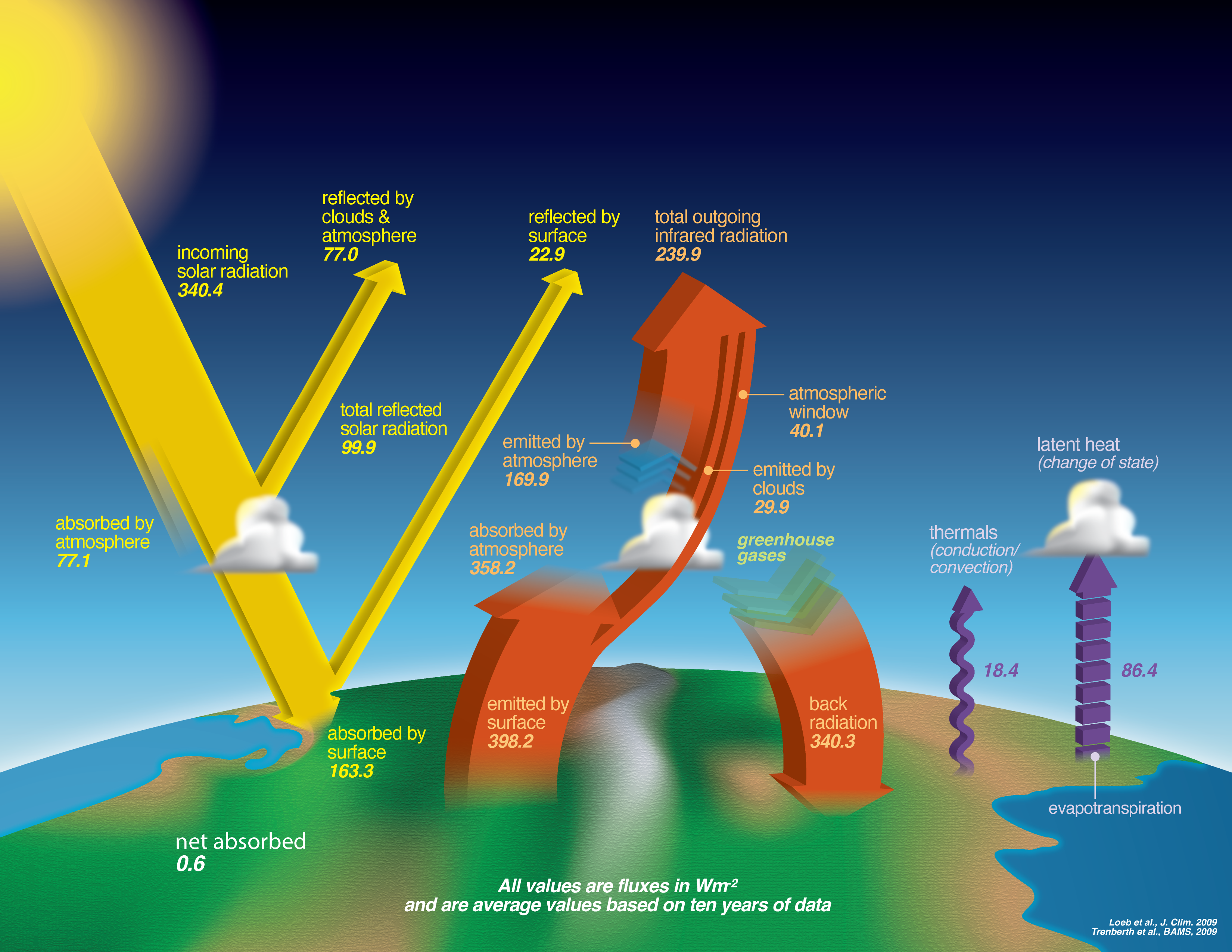
Fig. 4.27 The greenhouse effect is easiest to understand as an energy-flow problem. Sunlight enters mostly as shortwave radiation, some sunlight is reflected, and the rest is absorbed by the atmosphere and surface. The warmed surface emits infrared radiation, and greenhouse gases absorb and re-emit part of that energy, including back toward the surface. This diagram is more detailed than the simplified greenhouse-effect visual, so focus first on the large yellow incoming/reflected arrows and the large red infrared arrows. Image credit: NASA/My NASA Data, NASA media.#

Fig. 4.28 The animation separates incoming sunlight from outgoing infrared radiation and shows why a moderate greenhouse effect is necessary for Earth’s surface liquid water. Image credit: NASA-JPL/Caltech, NASA media.#
Interactive Simulation: Greenhouse Effect
Use this PhET simulation to explore why greenhouse gases matter for surface temperature. The useful comparison is between incoming sunlight and outgoing infrared radiation: visible light reaches the surface more easily, while greenhouse gases absorb and re-emit some of the infrared radiation trying to leave Earth. Interactive credit: PhET Interactive Simulations, University of Colorado Boulder.
4.5.2. The carbon dioxide cycle#
Earth’s long-term climate is regulated in part by the carbon dioxide cycle. This cycle moves carbon among the atmosphere, oceans, rocks, and mantle. It is not fast on human timescales, but over hundreds of thousands to millions of years it can help stabilize climate.
Carbon dioxide is removed from the atmosphere through weathering and carbonate formation. Carbon dioxide dissolves in rainwater, making it weakly acidic. That rainwater reacts with rocks on land, breaking down minerals and carrying dissolved material into rivers and oceans. In the oceans, dissolved carbon combines with calcium and other ions to form carbonate minerals, which can become carbonate rocks such as limestone.
Carbon dioxide is returned to the atmosphere through volcanism. Plate tectonics carries carbonate rocks and carbon-bearing material into subduction zones. As material is buried, heated, and chemically transformed, some carbon is released through volcanic outgassing. In this way, plate tectonics helps close the long-term carbon cycle.
Venus provides an important comparison. Venus has a thick carbon dioxide atmosphere and lacks abundant carbonate rocks at the surface. If carbon remains in the atmosphere rather than being locked into rocks, greenhouse warming can become much stronger. Venus is not simply Earth placed closer to the Sun; it is a planet whose atmosphere, surface, water history, and geology evolved differently.
The carbon dioxide cycle is a feedback system. A feedback occurs when a change in one part of a system affects the processes that either amplify or counteract the original change. A positive feedback amplifies change. A negative feedback counteracts change.
On long timescales, the carbon dioxide cycle can act as a negative feedback. If Earth warms, evaporation and rainfall tend to increase. More rainfall can increase weathering, which removes more carbon dioxide from the atmosphere. Lower carbon dioxide weakens greenhouse warming and tends to cool the planet. If Earth cools, evaporation and rainfall decrease. Weathering slows, while volcanoes continue to add carbon dioxide. Carbon dioxide can build up, strengthening greenhouse warming and pushing temperatures upward.
Checkpoint
How can the carbon dioxide cycle act like a slow planetary thermostat?
This feedback is not perfect. It is slow, and it depends on continents, weathering, oceans, volcanism, and plate tectonics. But it helps explain why Earth has remained broadly habitable despite major changes in solar brightness and atmospheric composition over billions of years.
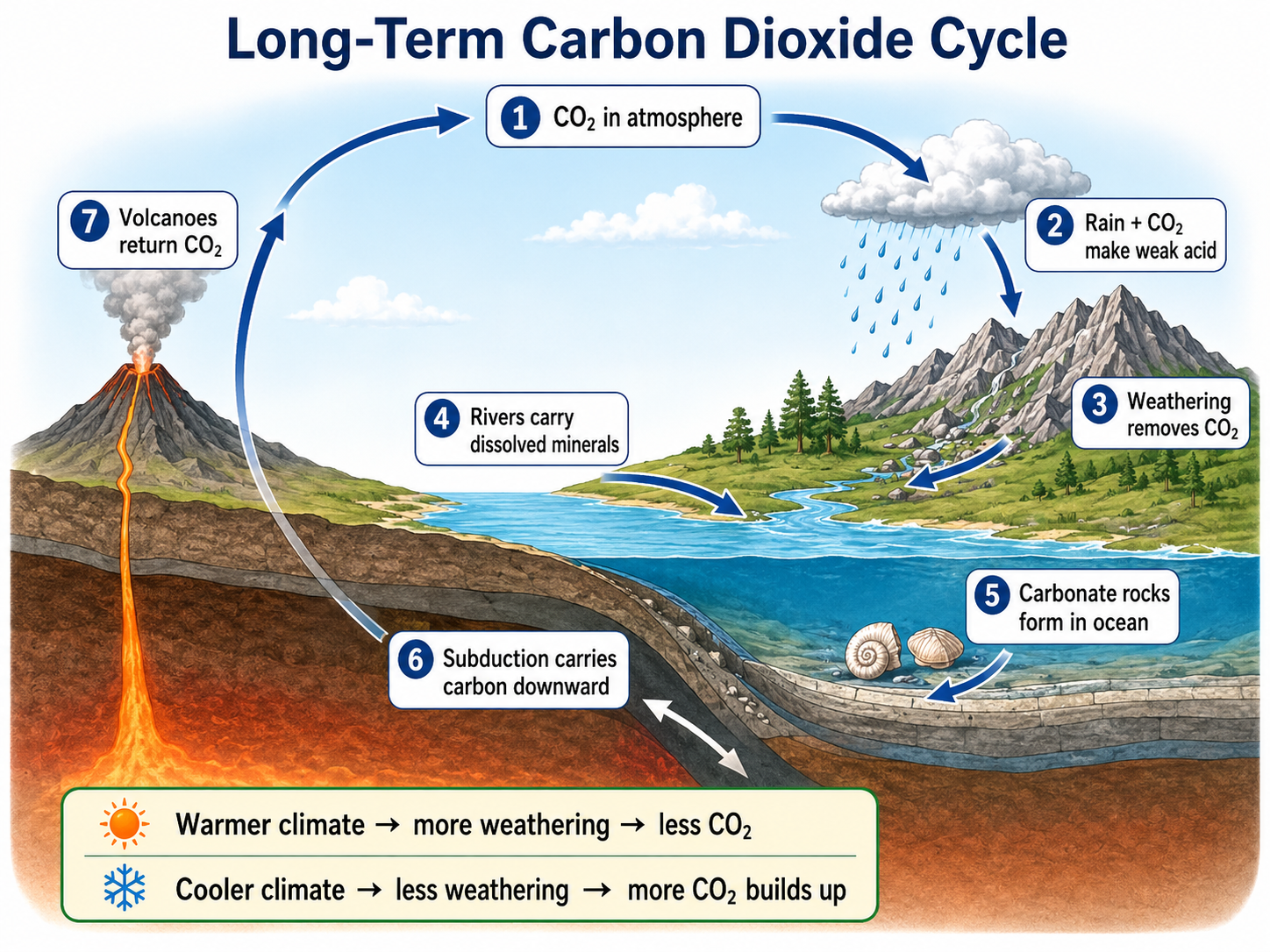
Fig. 4.29 This simplified carbon dioxide cycle shows the long-term climate feedback at the center of this section. Rainwater removes carbon dioxide from the atmosphere by weathering rocks, rivers carry the dissolved material to the ocean, carbonate rocks store carbon on the seafloor, plate tectonics carries some of that carbon downward, and volcanoes can return carbon dioxide to the atmosphere. The important habitability idea is the feedback: warmer climates can increase weathering and remove more carbon dioxide, while cooler climates slow weathering and allow volcanic carbon dioxide to build back up. Image credit: Course-created diagram.#
4.5.3. Ice ages, Milankovitch cycles, and Snowball Earth#
Earth’s climate still changes even with long-term carbon regulation. Ice ages are periods when large portions of Earth’s surface are covered by ice. The most recent ice age ended about 12,000 years ago, when global climate warmed and ice sheets retreated. Ice ages are common in recent geological history, with warmer interglacial periods between colder glacial intervals.
One reason ice ages occur is that Earth’s orbit and spin change slowly over time. Earth’s axial tilt is about \(23.5^\circ\), but it varies over a cycle of about 41,000 years. Earth’s axis also wobbles through precession over about 26,000 years. Earth’s orbital eccentricity, which measures how stretched its orbit is, varies over longer cycles, including one near 100,000 years and another near 400,000 years.
These variations are called Milankovitch cycles. They do not usually change the total sunlight Earth receives by enormous amounts, but they change where and when sunlight is distributed across the planet. That matters for whether winter snow melts during summer or survives and accumulates into ice sheets. When ice expands, it reflects more sunlight, which can cool the planet further. This is an ice-albedo feedback.
Checkpoint
Why can Milankovitch cycles help pace ice ages without being the only cause of climate change?
At several times in Earth history, evidence suggests that ice may have reached very low latitudes, possibly even producing episodes sometimes called Snowball Earth. The evidence includes glacial deposits in places that were near the equator at the time. A fully frozen Earth would be a severe challenge for surface life, but the carbon dioxide cycle offers a possible recovery mechanism. If weathering slows dramatically under ice while volcanoes continue releasing carbon dioxide, greenhouse warming can eventually become strong enough to melt the ice.
This shows both the strength and imperfection of Earth’s climate regulation. Earth’s systems can recover from extreme states, but not instantly and not gently. Habitability is not a guarantee of comfort. It means conditions remain within ranges where life can persist somewhere, even if many environments become hostile.
The orbital visual shows the pacing mechanism, while the climate visual shows why feedbacks can amplify modest orbital forcing into large climate shifts.

Fig. 4.30 Milankovitch cycles change where and when sunlight reaches Earth. Eccentricity, axial tilt, and precession do not create ice ages by themselves; they alter the seasonal and regional distribution of sunlight, which can then be amplified by climate feedbacks such as snow and ice reflecting more sunlight. Image credit: Pablo Carlos Budassi via Wikimedia Commons, CC BY-SA 4.0.#


Fig. 4.31 This combined GIF places the three Milankovitch motions side by side: axial precession changes the direction of Earth’s spin axis, eccentricity changes the shape of Earth’s orbit, and obliquity changes the amount of axial tilt. These motions affect climate by changing where and when sunlight reaches Earth, especially when their effects are amplified by snow, ice, and other climate feedbacks. Original animations credit: NASA/JPL-Caltech, NASA media; combined GIF hosted by Medill Reports Chicago.#

Fig. 4.32 Snowball Earth episodes show that habitability does not mean steady, comfortable surface conditions. Life could persist in refuges while much of the surface became hostile, and recovery would depend on slow geological feedbacks such as volcanic carbon dioxide buildup. Image credit: Oleg Kuznetsov via Wikimedia Commons, CC BY-SA 4.0.#

4.5.4. Long-term habitability as a linked system#
Earth’s long-term habitability depends on linked processes, not one isolated feature. Volcanic outgassing helped produce the atmosphere. Water vapor condensed to form oceans. Earth’s gravity helped retain heavier gases. The magnetic field helped reduce atmospheric loss from the solar wind. The greenhouse effect kept the planet warm enough for surface liquid water. Plate tectonics and the carbon dioxide cycle helped regulate greenhouse warming over long timescales.
None of these processes is perfect. Earth has experienced ice ages, Snowball Earth episodes, mass extinctions, impacts, major volcanic events, and atmospheric transformations caused by life itself. Yet the planet has remained habitable for billions of years. That is the central fact that astrobiology tries to understand and compare.
This comparison is not simply about finding “another Earth.” A world might be habitable in a different way. Mars may have had habitable environments in the past. Europa and Enceladus may have subsurface oceans beneath ice. Exoplanets may have atmospheres and climates unlike anything in our Solar System. But Earth teaches us what kinds of evidence matter: atmosphere, water, energy, chemistry, geological cycling, and preservation of history.
Earth also teaches humility. The same geological activity that helped sustain habitability has erased much of the earliest record. If we struggle to reconstruct the origin and early survival of life on our own planet, we should expect the search for life elsewhere to be difficult. Evidence may be indirect, incomplete, or ambiguous. A scientifically responsible search must distinguish possible habitability from actual evidence of life.

Fig. 4.33 Earth’s habitability is a linked system, not a checklist of isolated traits. This diagram is useful at the end of the climate section because it connects atmosphere, oceans, land, biology, and transport processes, reinforcing why long-term habitability depends on feedbacks among several parts of the planet. Image credit: NASA Earth Observatory-derived diagram via Wikimedia Commons, public domain.#

4.6. Formation of the Moon#
This narration is AI-generated from the course text.
4.6.1. The problem of the Moon’s origin#
The Moon is not just a bright object in the night sky. It is part of Earth’s history. Understanding the Moon’s origin helps us understand early Earth, giant impacts, planetary formation, and the evidence preserved outside Earth’s active surface environment.
Before the Apollo missions, scientists considered several models for the Moon’s formation. One idea was co-formation: Earth and the Moon formed together from the same region of the solar nebula. Another idea was capture: the Moon formed elsewhere and was later captured by Earth’s gravity. A third idea was fission: a fast-spinning early Earth threw off material that became the Moon.
Each model had problems. Co-formation struggles to explain why the Moon has a much smaller iron core than Earth. Capture requires a very specific and unlikely set of conditions, because an object passing Earth would normally either miss, collide, or be scattered rather than settle into a stable orbit. Fission requires an early Earth spinning so fast that it could shed material, but the details do not work well physically.
The Apollo missions changed the debate by bringing back lunar rocks. Those samples gave scientists ground truth: direct material from the Moon that could be analyzed chemically and isotopically. Moon rocks showed that the Moon is depleted in volatile elements, meaning easily vaporized substances are less abundant. The Moon’s lower average density indicates it has proportionally less iron than Earth. At the same time, lunar rocks appeared chemically similar in important ways to Earth’s mantle.
This combination of evidence did not fit the older models well. It suggested that the Moon formed from material related to Earth’s outer layers, heated strongly enough to lose volatiles, and assembled after a major energetic event.
The giant impact model treats the Moon as evidence to be explained, not just as the aftermath of a dramatic collision. A successful model has to reproduce several observed features of the Earth-Moon system, including the Moon’s low iron content, its chemical similarity to Earth’s mantle, and its orbit. This segment shows why scientists test different versions of the Theia impact rather than assuming that any large collision would automatically make our Moon.
4.6.2. The giant impact model#
The leading explanation is the giant impact model. In this model, a Mars-sized impactor collided with the proto-Earth within roughly the first 60 to 100 million years after the first Solar System solids formed. The impact ejected hot material into orbit around Earth. Some of that material later accreted to form the Moon.
This model explains several key observations. The Moon’s smaller iron core makes sense if much of the Moon formed from mantle-like material rather than from Earth’s metallic core. The chemical similarity between Moon rocks and Earth’s mantle also fits. The depletion of volatile elements fits a hot, energetic formation process.
At first, the giant impact model can sound like a just-so story: an invented event that conveniently explains the Moon. But in science, a model is not judged only by whether it tells a plausible story. It must be compared with evidence and with alternative models. The giant impact model invokes a natural cause, explains several observations at once, and makes testable predictions about lunar composition, angular momentum, and the aftermath of a large collision.
Checkpoint
Why can the giant impact model count as science even though no one observed the Moon forming?
The model has also changed over time. Modern simulations explore different impact angles, speeds, impactor compositions, and post-impact mixing. The details are still studied actively. That is normal. A scientific model can be broadly successful while still being revised in its details.
The Moon’s formation also connects back to habitability. A giant impact would have strongly affected early Earth’s surface, atmosphere, rotation, and thermal state. The Moon later influenced Earth’s tides and helps stabilize Earth’s axial tilt compared with what it might have been otherwise. The Moon is therefore not a side topic. It is part of the story of how Earth became the planet we are trying to understand.
The first visual is a clean model sequence, while the second connects the model to modern simulation work.

Fig. 4.34 This simple sequence shows the core idea of the giant impact model: a large impact ejects material into orbit, that material forms a disk, and the disk later accretes into the Moon. It is a model-based visualization, not a direct observation of the past. Image credit: Citronade via Wikimedia Commons, CC BY-SA 4.0.#


Fig. 4.35 Modern simulations test variations on the giant impact model by changing impact angle, speed, composition, and post-impact mixing. This visual should be read as a simulation-informed illustration of a possible process, not a photograph of what definitely happened. Image credit: NASA Science, Moon Formation, NASA media.#
This NASA video connects the basic giant-impact story to modern simulations, showing that the model is still being tested and refined rather than treated as a frozen historical fact.
4.6.3. What the Moon teaches about scientific evidence#
The Moon’s origin is a useful example of how planetary science works. Scientists cannot rerun the early Solar System. They cannot watch the Moon form. Instead, they compare models against surviving evidence: lunar rocks, Earth rocks, isotope ratios, orbital properties, computer simulations, and the physics of collisions.
This is the same kind of reasoning used throughout astrobiology. We often study events we cannot repeat directly: planet formation, atmospheric escape, the origin of life, early bombardment, and climate evolution. That does not make the science weak. It means the evidence must be handled carefully, and models must remain open to revision.
The giant impact model also reinforces a broader lesson from Chapter 2. A scientific explanation should rely on natural causes, explain observations as simply as possible, and make predictions that can be tested. The giant impact model survives not because it is dramatic, but because it explains evidence better than the earlier alternatives.

Fig. 4.36 Lunar rocks matter because they let scientists compare Moon-origin models against real material evidence. Chemical composition, isotopic similarity to Earth’s mantle, volatile depletion, and radiometric ages all help decide which formation models remain plausible. Image credit: NASA via Wikimedia Commons, NASA media/public domain.#

4.7. Before moving on#
Check your understanding
Before continuing, make sure you can answer these questions in your own words:
Why is geology essential for understanding Earth’s habitability rather than merely describing Earth’s rocks?
How do rocks, fossils, isotope ratios, and craters preserve different kinds of evidence about the past?
Why does early habitability not automatically prove that life existed during the Hadean?
How do volcanism, plate tectonics, the magnetic field, and the greenhouse effect work together in Earth’s long-term habitability?
Why is the giant impact model for the Moon a scientific model rather than just a convenient story?
These questions are not a summary of the chapter. They are a check on whether the main ideas are connected in your mind.